 Bellingham Exterior
 Roofing Built for Sudden Valley's Microclimate
Sudden Valley sits in a pocket of Whatcom County that behaves a little differently than roofs closer to downtown Bellingham. Mature tree canopy, proximity to Lake Whatcom, and lots that stay shaded for much of the day create a damp, slow-drying environment that asphalt shingles have to withstand year-round. Add in the driving rain that blows through the broader Whatcom County region off the water, and you get a combination of moisture, shade, and organic debris that ages a roof faster than a similar home out in open sun would age.
None of that means asphalt shingles are the wrong choice for Sudden Valley — they're still one of the most practical, cost-effective roofing systems available, and the majority of homes in this neighborhood are shingled for good reason. It means the installation details matter more here than they do in drier, more exposed parts of the county. A roof that's cut corners on ventilation, underlayment, or flashing will show it in Sudden Valley years before it would somewhere else.
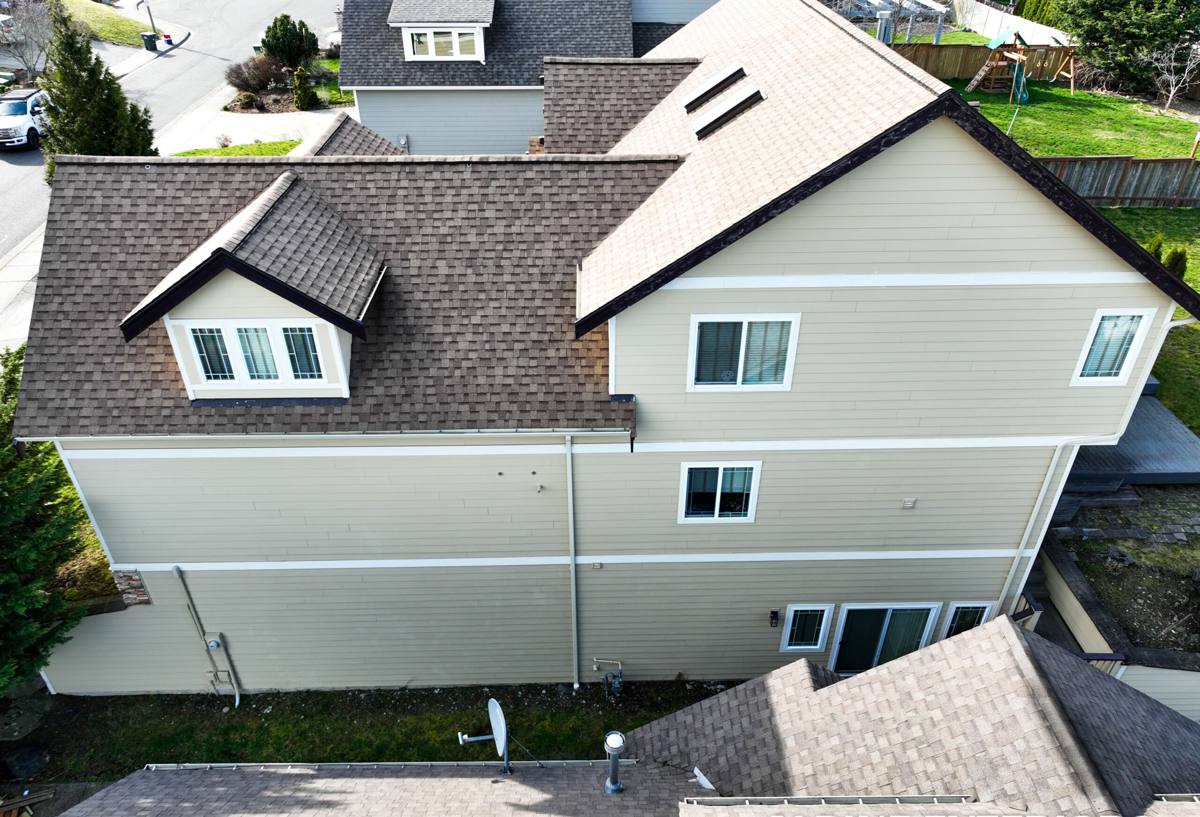
What Driving Rain and Moss Do to an Asphalt Shingle Roof Over Time
Moss and Algae in the Shade
Tree cover keeps a roof from drying out fully between rain events. Moss spores land on shaded, north-facing slopes and low-slope sections, take root in the granule surface, and start lifting shingle edges as they grow. Once moss gets a foothold, it holds moisture against the shingle mat itself, which shortens the shingle's usable life and can eventually work water back under the tab. Black algae streaking is a related but separate issue — it's cosmetic rather than structural, but homeowners understandably don't want it on a roof they just paid for.
Wind-Driven Rain and Flashing
Rain that comes in at an angle finds every weak point in a roof system — step flashing at wall intersections, valley metal, pipe boots, and the transitions around dormers and chimneys. On a sun-baked roof, minor gaps might stay dry most of the year. On a roof that's shaded and damp as often as many Sudden Valley homes are, those same gaps get tested constantly, and small flashing mistakes turn into leaks faster.
Choosing the Right Asphalt Shingle for a Shaded, Wet Lot
Not every asphalt shingle is built the same way, and the difference matters more on a shaded lot. We generally steer Sudden Valley homeowners toward algae-resistant, laminated (architectural) shingles rather than basic three-tab products, for the reasons below.
| Shingle Type | Typical Lifespan | Moss/Algae Resistance | Best Fit |
|---|---|---|---|
| 3-Tab (standard) | 15-20 years | Low unless treated | Budget projects, full-sun lots |
| Architectural / Laminated | 25-30 years | Moderate to good with algae-resistant granules | Most Sudden Valley homes, shaded lots |
| Premium/Designer Laminated | 30+ years | Good, often with extended algae warranty | Steep-slope, high-visibility, or heavy-shade roofs |
Algae-resistant shingles use copper- or zinc-infused granules that slow algae growth on the shingle surface. They don't eliminate moss risk entirely — moss is a different organism that responds more to shade and debris buildup than to those granules — but they meaningfully cut down on the black streaking that shaded roofs are prone to, and they hold up better over a long moss season.
Color and Heat Considerations
Darker shingle colors show streaking and moss contrast more visibly than lighter, variegated colors. On a heavily shaded Sudden Valley lot, a mid-tone or variegated color often hides the early stages of algae and debris buildup better than a solid dark charcoal or black, which can help a roof look presentable longer between cleanings.
What a Correct Asphalt Shingle Roof Installation Actually Involves
A shingle roof is only as good as what's underneath it. On a home in a wet, shaded setting like Sudden Valley, the underlayment and flashing details do more of the real work than the shingles themselves.
- Tear-off and deck inspection: old roofing removed down to the deck, with any soft or water-damaged sheathing replaced before anything new goes down.
- Ice-and-water shield at vulnerable areas: self-adhering membrane at valleys, eaves, and roof-to-wall transitions where wind-driven rain is most likely to find a way in.
- Synthetic underlayment across the field: a water-resistive barrier under the shingles that also protects the deck during the install itself, which matters when work happens in typical Bellingham weather.
- New flashing, not reused flashing: step flashing, valley metal, and pipe boots replaced rather than caulked over old metal.
- Proper nailing pattern: shingles fastened per manufacturer specification (nail count and placement), not just enough to hold them down — this affects both wind rating and warranty validity.
- Ridge and intake ventilation tied together: so the attic can actually exchange air rather than trap moisture.
Ventilation and Moisture: The Part Homeowners Don't See
Attic ventilation gets overlooked because it's invisible from the ground, but it directly affects how long a shingle roof lasts in a damp, shaded setting. An attic that can't vent properly traps warm, moist air against the underside of the roof deck. In winter, that trapped moisture condenses; over a long moss season, it also keeps the deck and the bottom side of the shingles from ever fully drying out, which accelerates the same moss and algae growth we're already fighting on the outside of the roof.
A balanced system needs both intake (typically at the eaves or soffits) and exhaust (typically at the ridge), sized to work together. We check this on every Sudden Valley project, because it's common to find a home with ridge vents installed but little or no functioning intake — which looks like ventilation on the outside but doesn't actually move air.
Our Process, Start to Finish
We keep the process straightforward because a roof project is disruptive enough without added confusion.
- On-site inspection: we get on the roof (not just a look from the driveway) to check deck condition, existing ventilation, flashing points, and moss/algae extent.
- Written estimate: a clear scope covering tear-off, deck repair allowance, underlayment, flashing, shingle selection, and ventilation work — no vague line items.
- Material selection: we walk through shingle tiers and colors suited to a shaded, wet lot, with honest trade-offs on cost versus longevity.
- Scheduling around weather: tear-off is timed to dry stretches where possible, and the deck is never left exposed longer than necessary.
- Installation: tear-off, deck repair as needed, underlayment and flashing, shingle installation, ventilation work.
- Cleanup and magnetic sweep: job site and yard cleared of debris and stray fasteners.
- Final walkthrough: we go over the finished roof and ventilation with the homeowner before calling the job done.
Maintenance: What Sudden Valley Homeowners Should Do Between Roofs
A well-installed shingle roof still benefits from basic upkeep in a shaded, moss-prone setting. This is especially true here, where debris from overhanging trees builds up faster than on more open lots.
- Clear leaves, needles, and moss buildup from valleys and roof-to-wall areas at least once a year, more often on heavily shaded slopes.
- Keep gutters and downspouts clear so water isn't backing up under the eave edge.
- Address moss early with an appropriate treatment rather than letting it establish and lift shingle tabs.
- Trim back overhanging branches where practical to reduce shade, debris, and physical abrasion on the roof surface.
- Have the roof looked at after any major windstorm, since a lifted or cracked shingle is far cheaper to fix before the next rain than after a leak develops.
Repair or Replace? How to Tell
Not every problem roof needs full replacement, but on an aging shingle roof in a wet, shaded setting, isolated repairs can be a short-term fix if the underlying shingles are near the end of their service life.
| Factor | Favors Repair | Favors Replacement |
|---|---|---|
| Age of roof | Under 15 years | Approaching or past expected lifespan |
| Extent of damage | Isolated area (one slope, one flashing point) | Widespread moss, curling, or granule loss |
| Deck condition | Solid, no soft spots | Signs of rot or repeated leak staining in attic |
| Ventilation | Adequate and balanced | Missing or mismatched intake/exhaust |
When we inspect a Sudden Valley roof, we'll tell you honestly which category it falls into. If a targeted repair will genuinely buy you several more good years, that's what we'll recommend — replacement isn't the answer to every roof problem.
Why Local Experience in Sudden Valley Matters
Sudden Valley is a distinct community within greater Bellingham — many homes sit on private, tree-lined roads within a homeowners' association, and lots vary widely in slope, tree cover, and sun exposure. A crew that already works in this neighborhood knows to plan for tighter access on some streets, to account for heavier shade and debris on lake-facing or tree-lined lots, and to build in the ventilation and moisture details that this specific setting demands. That local familiarity also means fewer surprises on estimate day and a realistic sense of what a roof in this part of Whatcom County actually needs to hold up over the long moss season, not just what a generic roofing spec sheet says.
If you're weighing a repair, a full replacement, or just want an honest read on how much life is left in your current roof, we're glad to come out, get on the roof, and give you a clear, no-pressure estimate using the form below.