 Bellingham Exterior
 Birch Bay's Exterior Challenge Is Different From Inland Bellingham
Birch Bay sits right on the water in Whatcom County, and that changes what a home's exterior has to deal with year after year. A house a few miles inland in Bellingham gets plenty of rain, but a house in Birch Bay gets rain pushed sideways by wind coming straight off Georgia Strait, plus a steady dose of salt air that inland homes simply don't see. Add in the shade and dampness that a lot of Birch Bay lots have from surrounding evergreens, and you've got a climate that's genuinely harder on siding, roofing, windows, and decks than most of the county.
We work on homes throughout Whatcom County, but Birch Bay gets its own approach. The materials and details that hold up fine in a sheltered neighborhood aren't always the right call a few blocks from the beach. This page covers what we see on Birch Bay homes, how we handle each part of the exterior, and why the products we choose to install — and the ones we don't — matter more here than almost anywhere else we work.
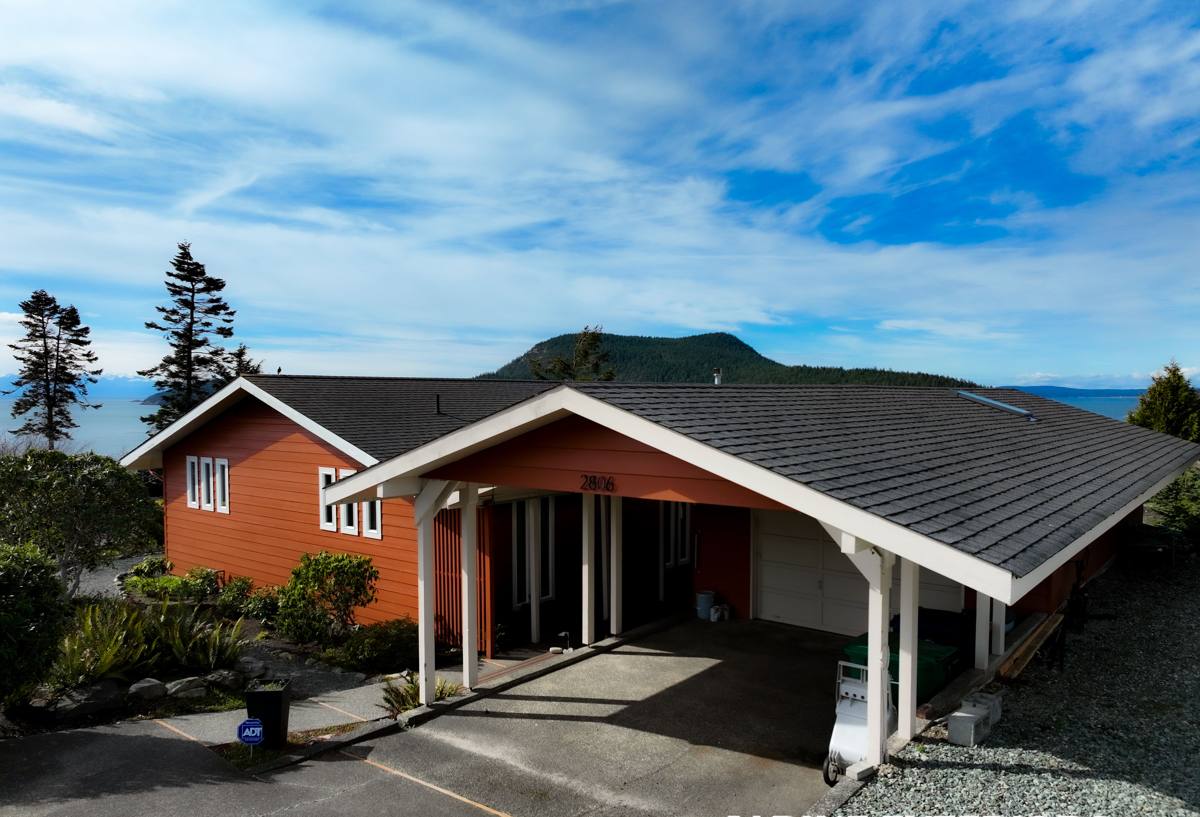
Salt Air, Driving Rain, and Moss: What It Does to a House
Salt Air
Airborne salt doesn't just affect boats and docks. It settles on siding, trim, fasteners, and roofing metal, and it accelerates corrosion on anything that isn't rated for a marine-adjacent environment. Cheap fasteners rust and streak. Untreated metal flashing pits and fails early. Paint and coatings break down faster under salt exposure than they do a few miles inland, which means a home's exterior finish has to work harder just to look the same after a decade.
Wind-Driven, Sideways Rain
Birch Bay's exposure to wind off the water means rain doesn't just fall — it drives horizontally into wall assemblies, window seams, and roof edges. That kind of wind-driven rain finds every gap in flashing, every weak caulk joint, and every seam in siding that wasn't installed to spec. A house built for a calm, sheltered lot inland can develop moisture problems in Birch Bay that would never show up somewhere less exposed.
The Long Moss Season
Between the marine moisture and the tree cover on many Birch Bay properties, moss and algae growth start earlier in the fall and hang on longer into spring than they do elsewhere in the county. Moss holds moisture against roofing and siding surfaces, and over years that constant dampness is what actually causes damage — not the moss itself, but what it traps against the material underneath it.
Siding: Why We Only Install James Hardie in a Climate Like This
We made a decision a while back to install only James Hardie fiber cement siding, and nowhere does that decision matter more than in a place like Birch Bay. We don't install vinyl, LP SmartSide, primed spruce, cedar, or other fiber cement brands, and we're upfront about why.
Wood and Wood-Composite Siding in a Salt-Air, High-Moisture Environment
Cedar and primed wood siding can look great when they're new, but they're organic materials, and organic materials are exactly what moss, algae, and rot need to take hold. In a location with a long moss season and steady coastal moisture, wood siding demands more frequent recoating, caulking, and moisture monitoring than most homeowners want to keep up with. LP SmartSide, an engineered wood product, has improved a lot over the years, but it still relies on its factory coating and careful edge-sealing to keep moisture out of the wood strand core — a coastal environment with wind-driven rain is a tougher test of that seal than most inland settings.
Vinyl Siding Near the Water
Vinyl is affordable and low-maintenance in a lot of ways, but it isn't dimensionally stable — it expands, contracts, and can warp with temperature swings, and salt air deposits can dull and chalk the surface faster than in a drier, cleaner-air environment. Vinyl also relies on overlapping panels rather than a sealed, monolithic-feeling wall system, and in wind-driven rain conditions, that lap-and-gap design gives water more opportunities to work behind the panel.
Why James Hardie Fits Birch Bay
James Hardie fiber cement is non-combustible, dimensionally stable, and engineered specifically for tough climate zones — the HZ5 product line used in the Pacific Northwest is formulated for cold, wet, high-moisture conditions. The factory-applied ColorPlus finish is baked on and warrantied against fading, cracking, and peeling, which matters in an environment where salt air and UV exposure both take a toll on paint. It doesn't feed moss and algae the way wood does, and it holds up to direct wind-driven rain far better than lapped vinyl. It's also backed by a strong, transferable manufacturer warranty — meaningful for anyone buying or selling a home near the water, where exterior condition gets scrutinized in inspections.
None of this means other products are junk — they have real uses and real fans. It means that for the specific conditions Birch Bay throws at a house, we think Hardie is the material that holds up with the least maintenance and the fewest surprises, and we'd rather install one product well than several products with compromises we'd have to explain later.
Roofing: Built to Shed Salt, Wind, and Moss
A Birch Bay roof needs good ventilation, corrosion-resistant flashing and fasteners, and a moss-resistant surface strategy — not just shingles nailed down and left alone. We pay close attention to valley flashing, roof-to-wall transitions, and ridge ventilation, since those are the spots where wind-driven rain and trapped moisture cause the most damage over time. Where moss pressure is high, we talk through zinc or copper strip options and realistic cleaning intervals rather than promising a maintenance-free roof, because in this climate, that promise isn't honest.
Windows: Sealing Out Sideways Rain
Window failures near the water are almost always about the installation, not the window itself. Flashing that isn't properly layered, sealant that's applied instead of integrated into the water management system, or a rough opening that wasn't prepped correctly — any of these can let wind-driven rain in around a perfectly good window. We install with flashing sequencing that assumes water will hit the window sideways, because in Birch Bay, it will. We also talk with homeowners about glass packages suited to a marine climate, since condensation and heat loss show up differently on an exposed, wind-loaded wall than on a sheltered one.
Decks: Standing Up to Marine Exposure
Decks in Birch Bay take a combination of UV, salt air, and near-constant dampness that ages fasteners, framing connectors, and decking surfaces faster than an inland deck. We use fasteners and structural hardware rated for corrosion resistance, pay attention to ledger flashing and drainage so water doesn't sit against the house, and talk through decking material trade-offs — composite versus wood — with the salt-air factor specifically in mind, since some coatings and composite formulations handle coastal exposure better than others.
Cost Factors for Birch Bay Exterior Projects
Every home and lot is different, and we won't quote a number without seeing the property, but these are the factors that most often move a Birch Bay project's scope and cost compared to a similar job inland:
| Factor | Why It Matters in Birch Bay |
|---|---|
| Wind and salt exposure of the specific lot | Waterfront and bluff-facing homes need more corrosion-resistant hardware and tighter water management than sheltered lots |
| Existing moisture damage | Long-term moss and moisture exposure can mean hidden sheathing or framing repair once old siding or roofing comes off |
| Tree cover and shade | Heavier moss pressure may call for added ventilation details or moss-resistant roofing strategy |
| Access and site conditions | Some Birch Bay properties have tighter access or slope that affects staging and labor time |
| Scope of siding removal | Full tear-off to sheathing versus overlay changes both cost and the ability to address moisture issues underneath |
Why a Local Crew Matters Here
A crew that mostly works drier, more sheltered jobs elsewhere in the region can miss the details that matter in Birch Bay — the flashing sequence that handles sideways rain, the fastener spec that won't rust out in five years, the roof ventilation that keeps moss pressure manageable. We work throughout Whatcom County, and the coastal conditions in Birch Bay specifically inform how we detail flashing, choose hardware, and sequence installation on every job out there. That's not a marketing line — it's the difference between an exterior that looks right for two years and one that actually performs for twenty.
What Birch Bay Homeowners Can Do Between Projects
- Rinse salt film off siding and windows periodically, especially on wind-exposed elevations
- Keep gutters and downspouts clear, since clogged gutters push water into wall and roof edges during wind-driven storms
- Watch for moss buildup on roofing and address it before it spreads and holds moisture against the surface
- Check caulking around windows and trim annually — coastal UV and salt exposure break down sealants faster than inland conditions
- Trim back tree cover where practical to reduce shade, debris, and moss pressure on roofing and siding
- Have a professional look at flashing and fastener condition every few years, since corrosion issues are easier to catch early than after they've caused water intrusion
Get a Free, No-Pressure Estimate
If you own a home in Birch Bay and you're dealing with siding, roofing, window, or deck issues — or you just want an honest read on how your exterior is holding up against the salt air and wind — we're glad to come take a look. There's no pressure and no obligation, just a straightforward assessment from a crew that knows what this specific stretch of coastline does to a house. Use the form below to request your free estimate.