 Bellingham Exterior
 Siding Repair Built for Birch Bay's Waterfront Conditions
Birch Bay sits right on the water, and that changes what "siding repair" actually means out here compared to a job five miles inland. Homes along the bay take a steady diet of salt-laden air, wind-driven rain coming off the water, and long stretches of gray, damp weather that keep moisture sitting against exterior walls longer than it does in drier parts of Whatcom County. We're a Bellingham-based crew that works this stretch of coastline regularly, and we've learned that a siding repair here needs to solve the actual problem — not just patch the visible damage and hope the underlying cause doesn't come back in a year.
This page is specifically about repairing existing siding on Birch Bay homes — not a full re-side. If your siding is generally sound but has isolated damage, soft spots, failing caulk lines, or moss and mildew staining that keeps returning, this is the service you need. We'll also tell you honestly when a "repair" isn't the right call anymore.
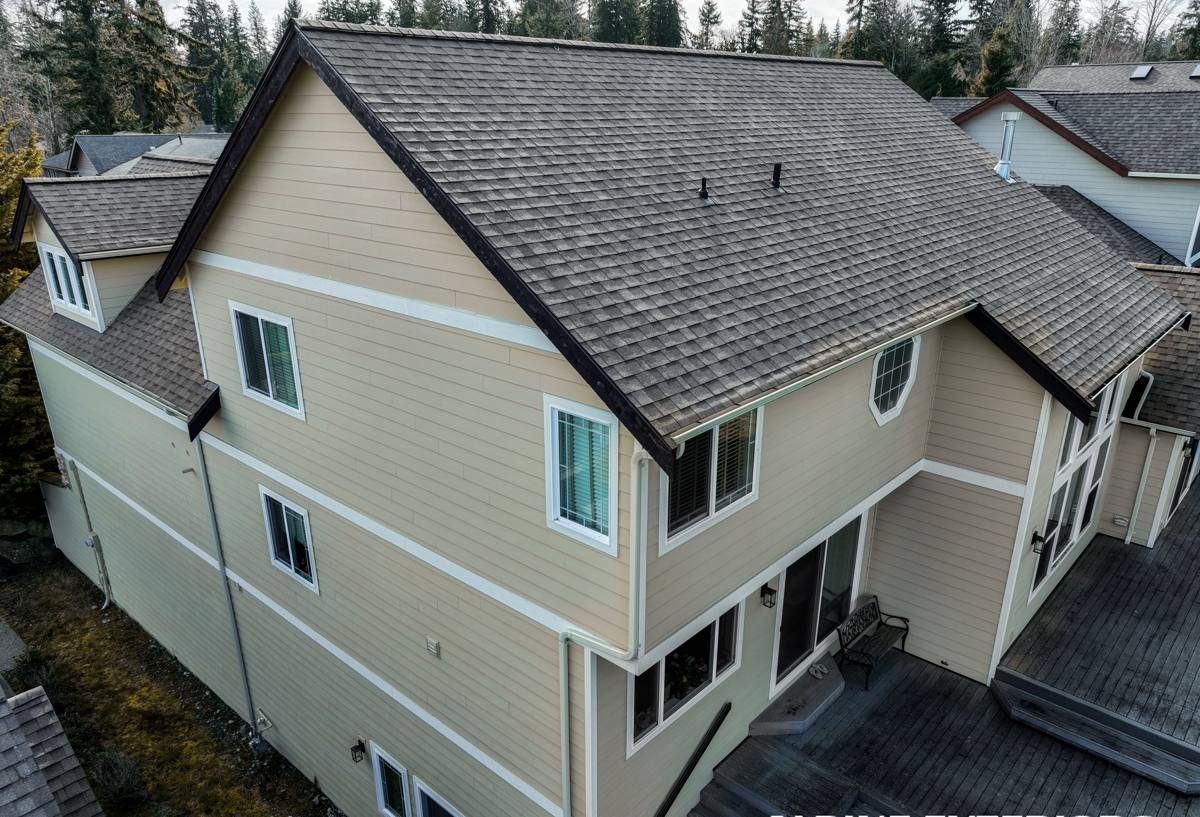
Why Birch Bay Siding Fails Differently
Most siding damage we see in Birch Bay traces back to one of three things: salt air accelerating corrosion on fasteners and trim, wind-driven rain forcing water sideways into seams and laps that were only ever designed for water running downward, and moss holding moisture against the wall for weeks at a time during the wet season. Any one of these will shorten the life of a siding system. Together, they compound.
Salt Air and Metal Fasteners
Homes closer to the water see faster corrosion on nails, trim flashing, and any exposed metal components. Once fasteners start to rust and lose their grip, siding panels loosen, gaps open up, and water gets behind the cladding — which is when small problems turn into rot.
Wind-Driven Rain
Storms coming off the bay don't just fall straight down — they push rain sideways into every lap joint, corner, and penetration point (hose bibs, light fixtures, vents). Siding that was installed with tight but not properly flashed laps, or caulk used in place of real flashing, is the first to show water intrusion here.
Extended Moss Season
Whatcom County's wet season runs long, and shaded, north-facing walls near the water can stay damp for months at a stretch. Moss and algae don't just look bad — they hold moisture directly against the siding surface, which is exactly the condition that causes paint failure, substrate softening, and eventually rot underneath.
What a Correct Siding Repair Actually Involves
A repair that just replaces a cracked or stained board without addressing why it failed is a repair you'll be paying for again. Here's what we check on every Birch Bay siding repair call, regardless of how small the visible damage looks:
- What's the moisture source — direct rain exposure, a failed flashing detail, an irrigation sprinkler hitting the wall, or trapped condensation?
- Is the damage isolated to the siding, or has it reached the water-resistive barrier (house wrap) or sheathing underneath?
- Are the fasteners in the surrounding area still sound, or is corrosion spreading beyond the damaged section?
- Is the existing product a fiber cement board that can be matched and patched cleanly, or a different material (vinyl, LP SmartSide, cedar) where a true match isn't realistic?
- Are trim, corner boards, and butt joints in the repair zone properly caulked and flashed, or were they relying on caulk alone to keep water out?
Skipping that diagnostic step is how homeowners end up with a new-looking patch over wet, still-rotting sheathing. We open up enough of the wall to actually see what's going on before we quote a fix.
Our Repair Process
1. On-Site Assessment
We walk the exterior with you, probe any soft or discolored areas, and check the usual failure points first: bottom courses near grade, window and door trim, corners, and any wall that faces the prevailing weather off the bay.
2. Diagnosis Before Demo
Before we cut anything open, we identify the likely moisture path. If we suspect it's gone past the siding into the sheathing, we'll say so upfront rather than surprise you mid-job.
3. Removal and Inspection
We remove only the affected siding and enough surrounding material to confirm the extent of damage. If we find rot in the sheathing or framing, that gets addressed as part of the job — patching over compromised structure isn't a repair, it's a delay.
4. Correct Reassembly
New material goes back with proper lap sequencing, corrosion-resistant fasteners, and correct flashing at any penetration or trim joint — not caulk as a substitute for flashing. This is the step that determines whether the repair lasts five years or fifteen.
5. Finish Match
Where we're working with James Hardie ColorPlus siding, we match against the existing factory finish as closely as the product line allows. Exact matches get harder on older installations as finishes weather over time — we'll be upfront if a perfect blend isn't achievable and what your options are (patch-and-accept-slight-variation vs. repainting the affected elevation).
Repair vs. Replace: An Honest Comparison
Not every damaged wall needs a full re-side, but not every problem should be patched either. Here's how we think through it:
| Situation | Repair Usually Makes Sense | Replacement Usually Makes Sense |
|---|---|---|
| Extent of damage | Isolated to one or two wall sections | Recurring damage across multiple elevations |
| Underlying structure | Sheathing and framing are sound | Rot has spread into sheathing/framing broadly |
| Siding material | James Hardie fiber cement, matchable | Older or discontinued product, no reasonable match |
| Age of siding | Mid-life, otherwise performing well | Near or past expected service life |
| Root cause | A specific, fixable detail (one bad flashing, one leak point) | Systemic issue (original installation lacked proper water management) |
We'll tell you plainly which category your home falls into. A repair we don't believe will hold isn't a repair we want to sell you — it just means you're back to square one, with less budget for the fix that actually works.
Why We Repair With James Hardie — and Not With Whatever's Already on Your Wall
We install and repair with James Hardie fiber cement siding exclusively. We don't install vinyl, LP SmartSide, Cemplank, Allura, primed spruce, or cedar, and if your Birch Bay home currently has one of those products, we'll say so honestly rather than pretend it's not relevant to a repair conversation.
If your existing siding is Hardie, a repair is usually straightforward: we can source matching board profiles and factory ColorPlus finishes, and fiber cement handles wind-driven rain and salt air far better over the long run than wood-based or vinyl alternatives — it doesn't absorb moisture the way wood products can, and it won't warp or become brittle from UV and temperature swings the way vinyl can near the water.
If your existing siding is a different product, we'll still repair it honestly where that's the right call for your budget and situation — but we won't pretend it performs the same as fiber cement in this climate, and if you're facing a bigger failure that's really pointing toward replacement, we'll walk you through why Hardie is what we'd put on the wall instead: it's non-combustible, engineered for moisture-heavy Pacific Northwest climates (Hardie's HZ10 product line is specifically formulated for regions like ours), and backed by a strong transferable warranty when installed to manufacturer spec.
Signs Your Birch Bay Home Needs a Siding Repair Now
- Soft or spongy spots when you press on the siding, especially near the bottom courses or under windows
- Persistent moss or algae growth that returns within weeks of cleaning
- Visible gaps opening at lap joints or corner boards
- Rust streaking from fasteners or trim
- Paint or finish peeling in a localized area rather than uniformly across the wall
- A musty smell or visible staining on interior walls that back up to an exterior wall
- Caulk that's cracked, shrunk, or pulled away from joints and trim
Any one of these on its own might be minor. Two or more together, especially on a wall facing the water, usually means water has already found its way past the surface.
Seasonal Timing for Repairs
Whatcom County's wet season makes certain repairs harder to do right — you can't properly flash and seal a wall in the middle of a driving rainstorm, and damaged sheathing needs to dry out before new siding goes back on. We prioritize:
- Drier stretches (typically late spring through early fall) for repairs involving sheathing replacement or larger sections of wall
- Any season for smaller isolated repairs where we can protect the work area and complete it in a single visit
- Pre-winter inspections in early fall, so failing caulk, loose trim, or early moss growth gets addressed before the heaviest rain and wind off the bay arrives
If you're not sure which category your situation falls into, that's exactly what the assessment is for — we'd rather look at it and tell you it can wait than have you sit on a real problem through another wet season.
Why a Local Crew Matters for This Job
Siding repair is one of those jobs where local experience genuinely changes the outcome. A crew that works Birch Bay and the surrounding Bellingham area regularly already knows which walls take the worst of the wind-driven rain, how fast moss comes back on shaded, water-facing elevations, and where salt air tends to chew through fasteners first. That's not something you can fully learn from a manufacturer's installation manual — it comes from repeatedly seeing how this specific coastline treats a house.
It also matters for accountability. We're not driving in from out of the area for a one-time job — we're a Bellingham-based company that expects to be reachable if a repair needs a follow-up look. That's worth factoring in when you're comparing quotes, especially for a coastal property where getting the water management details right the first time saves you from repeating the job.
Get an Honest Look at Your Siding
If you're dealing with damaged, stained, or failing siding on a Birch Bay home, we'll come take a real look — not a five-minute glance from the driveway — and give you a straight answer on whether it's a repair, and what that repair actually needs to include to hold up against this coastline's weather. Request a free, no-pressure estimate using the form below.