 Bellingham Exterior
 Homeowners ask us this a lot, usually after getting a quote from another contractor who bid three different siding products at three different prices: why does Bellingham Exterior Co only install James Hardie? It's a fair question, and it deserves a real answer rather than a marketing line. The short version is that after years of tearing old siding off Whatcom County homes and seeing exactly what our climate does to different materials over time, we stopped offering products we didn't want to stand behind. This page explains the reasoning in detail.
What Bellingham's Climate Actually Does to Siding
Bellingham sits close enough to the water that salt-laden air is a constant, low-grade factor on every exterior surface, not just on waterfront homes. Add to that the region's long stretch of driving rain from fall through spring, and a moss season that can run half the year on shaded, north-facing walls, and you have a climate that is genuinely harder on siding than most of the country realizes. This isn't a place where you can install a bargain product and expect it to look and perform the same in year twelve as it did in year one.
Salt air accelerates corrosion of fasteners and trim metal. Driving rain finds every gap in flashing and every seam in a poorly lapped board. Moss and algae thrive in the damp, shaded conditions common under mature Whatcom County tree cover, and they don't just look bad — sustained moisture retention against a wall assembly is what eventually causes rot, whether the siding itself is affected or not. Any siding decision here has to be evaluated against those three pressures specifically, not against generic national averages.
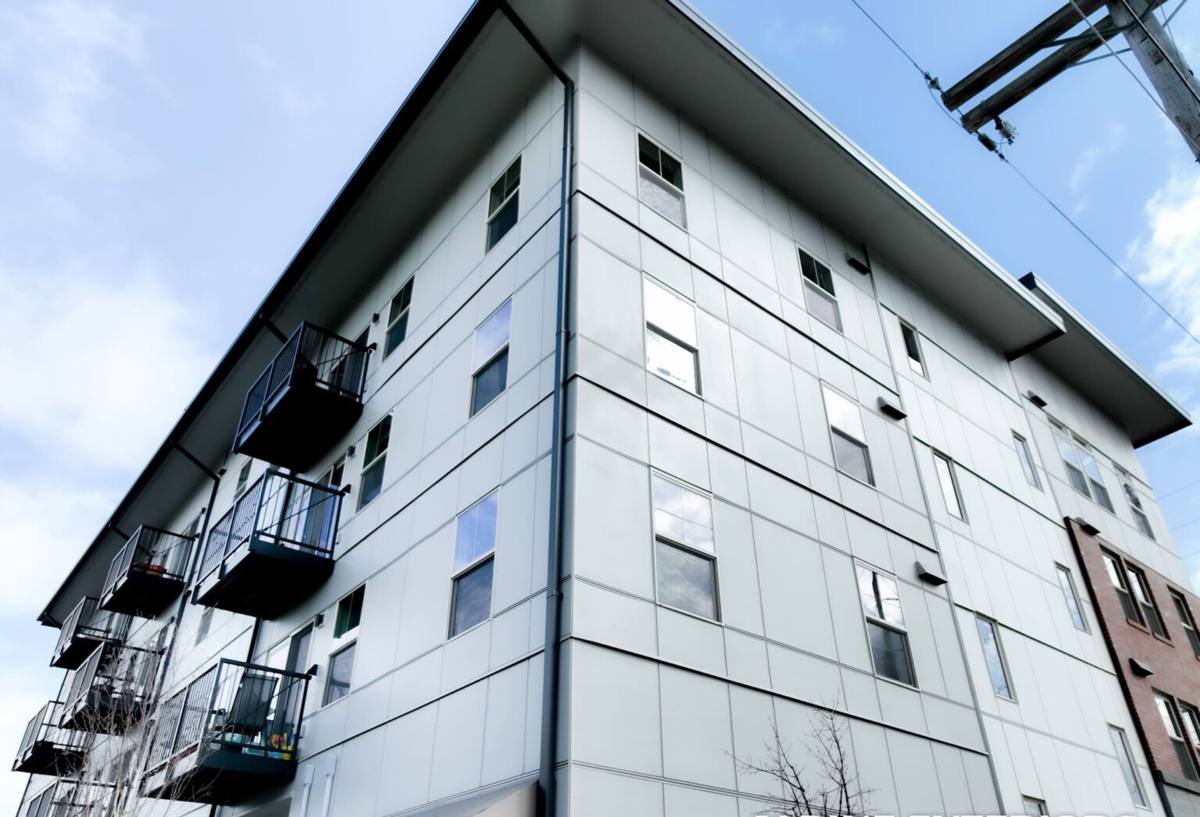
Why We Don't Offer Vinyl, LP SmartSide, Cedar, or Primed Spruce
We're not going to tell you these products are junk — that's not honest, and it's not our place. Vinyl is inexpensive and low-maintenance in mild, dry climates. LP SmartSide is an engineered wood product that has genuinely improved over the years. Cedar has real aesthetic appeal and a long history in the Pacific Northwest. Primed spruce is cheap and easy to source. Each of these has a legitimate use case somewhere.
Our issue is narrower and more specific: in a marine climate with sustained moisture exposure, each of these products asks the homeowner to accept a trade-off we're no longer willing to install and warranty.
- Vinyl expands and contracts significantly with temperature swings, which over time opens gaps at seams and trim — exactly where wind-driven rain wants to get in. It also can't be painted to refresh a faded color; you replace it.
- LP SmartSide is a wood-strand product with an engineered resin coating. It performs well when installation details (caulking, flashing, ground clearance) are followed exactly, but any wood-based substrate is less forgiving of installation shortcuts in a climate this wet, and any breach of the coating exposes wood fiber to moisture.
- Cedar requires ongoing maintenance — refinishing, re-staining, and vigilant moss removal — to hold up in our rain and shade conditions. Skip a maintenance cycle or two and the cost of catching back up is steep.
- Primed spruce is dimensional lumber with a factory primer, not a true engineered siding product. It has the least moisture resistance of the group and the shortest realistic service life here.
We stopped installing all four not because they're bad products in the abstract, but because we were the ones getting called back in year six or eight to explain moss staining, seam gaps, or soft spots that a different material handles better in this specific climate. Standardizing on one product means every crew, every detail, and every warranty conversation is consistent.
What James Hardie Is, Specifically
James Hardie siding is fiber cement: a mix of cellulose fiber, sand, and Portland cement, cured and formed into planks, panels, and shingles. It's non-combustible, dimensionally stable across temperature swings, and doesn't support rot the way wood-based products can. It was engineered from the start to handle exactly the kind of moisture cycling that Pacific Northwest homes deal with.
HardiePlank Lap Siding
The most common product on Whatcom County homes — horizontal lap boards in a range of textures (smooth, cedarmill, beaded) that replicate traditional wood lap siding without the wood.
HardieShingle and HardiePanel
HardieShingle gives the look of cedar shingle siding, often used as an accent on gables or dormers. HardiePanel is a vertical panel product used for board-and-batten styling, common on more modern or farmhouse-style Bellingham homes.
HardieTrim
Fiber cement trim boards for corners, fascia, and window/door surrounds, so the entire building envelope — not just the field siding — is made from the same moisture-resistant material.
ColorPlus Technology: Why the Finish Matters as Much as the Board
A siding board is only as good as its finish, and this is where a lot of the maintenance-burden difference actually comes from. James Hardie's ColorPlus finish is baked on in multiple coats at the factory under controlled conditions, not brushed or sprayed on-site after installation. That matters in a place like Bellingham for a few concrete reasons:
- A factory finish resists fading and chalking from UV exposure far longer than field-applied paint.
- It's more resistant to moss and algae staining because the cured finish doesn't provide the same porous surface for organic growth to grip.
- Touch-up and color-match products are formulated specifically for the ColorPlus line, so repairs blend in rather than becoming a visible patch.
- It carries its own dedicated finish warranty, separate from the product warranty on the board itself.
Homeowners who skip ColorPlus and buy primed Hardie boards to paint on-site are taking on a maintenance schedule closer to what a wood product requires — which defeats a good part of the reason to choose fiber cement in the first place.
Engineered for Climate: The HZ5 Product Line
James Hardie makes region-specific formulations under what it calls its HZ (HardieZone) system. HZ5 is the version engineered for climates with more freeze-thaw cycling and moisture exposure — which fits Whatcom County better than the standard HZ10 formulation used in milder, drier parts of the country. We install HZ5 product on every job here, not because it's required by code, but because it's built for the specific moisture and temperature conditions this region actually sees.
How the Materials Compare in a Marine Climate
| Factor | James Hardie Fiber Cement | Vinyl | LP SmartSide | Cedar |
|---|---|---|---|---|
| Moisture/rot resistance | Not wood-based; won't rot | Rot-proof itself, but seams can trap moisture behind it | Good if coating stays intact; wood fiber core | Requires maintenance to resist moisture |
| Salt air / corrosion behavior | Stable; fasteners are the main concern | Stable but can become brittle with UV/salt exposure over decades | Coating can degrade faster near salt air | No inherent resistance |
| Moss/algae resistance | Strong, especially with ColorPlus finish | Moderate; grime and algae show on textured surfaces | Moderate | Low without frequent cleaning/treatment |
| Fire resistance | Non-combustible | Combustible, can melt/warp near heat | Combustible | Combustible |
| Typical maintenance | Occasional wash, minimal repainting | Occasional wash only | Regular caulk/paint inspection | Re-stain/seal every few years |
| Realistic service life here | 30+ years installed to spec | 20-30 years, seams degrade first | 20-25 years with maintained coating | 15-25 years with consistent upkeep |
Warranty: What Actually Transfers
James Hardie backs its ColorPlus products with a non-prorated limited warranty that covers both the fiber cement substrate and the factory finish, and it's transferable to a subsequent homeowner if the house sells within the warranty period — a real factor if you're thinking about resale value down the road. Warranty terms vary by product line and are worth reading in full before any job starts; we walk every customer through the actual document rather than a summary, because the fine print (installation requirements, what voids coverage) is where warranties actually matter.
What Correct Hardie Installation Requires
A lot of the siding failures we get called to look at — on any brand — trace back to installation shortcuts, not the material itself. Fiber cement is unforgiving of certain mistakes because it's a rigid board, not a flexible one. Correct installation includes:
- Proper ground clearance (typically a minimum 6 inches from grade, more near hardscape or irrigation)
- Correct fastener type, spacing, and penetration depth per Hardie's installation manual
- Weather-resistant barrier and flashing detail behind every seam, window, and penetration
- Proper lap and butt-joint gaps, caulked and sealed per spec rather than tight-butted
- Factory-cut or properly scored field cuts to avoid chipping and exposed raw edges
- Correct nailing pattern to avoid over-driving fasteners, which can crack the board or create water entry points
These details are why product choice and installer choice aren't separable questions. A great product installed wrong will fail in this climate faster than people expect, and a warranty claim often depends on documented, spec-correct installation.
What This Means for Your Budget
Fiber cement generally costs more upfront than vinyl and is comparable to or somewhat more than engineered wood siding, depending on the specific product line, trim package, and finish. We won't quote a number here because every home's square footage, trim complexity, tear-off scope, and access all move the price. What we can say honestly: the upfront cost difference narrows considerably when you account for the repainting, sealant maintenance, and earlier replacement cycles that lower-cost products in this climate tend to require.
If you're weighing a siding replacement and want a straight answer about what's actually going on with your walls — not just a product pitch — we're happy to take a look. Estimates are free, there's no pressure, and we'll tell you honestly what we'd do if it were our own house.