 Bellingham Exterior
 An Honest Look at a Popular Product
Homeowners in Bellingham and across Whatcom County ask us about LP SmartSide often, usually because a neighbor has it, a builder recommended it, or it came up during a bid comparison. It's a fair question, and it deserves a straight answer rather than a sales pitch. We don't install LP SmartSide on the homes we work on. That's not because it's a scam or a bad product in every application — it's an engineered wood siding with real strengths. It's because, after years of evaluating siding systems for this specific climate, we decided the trade-offs don't line up with what we're willing to put our name behind here on the coast.
This page explains what LP SmartSide actually is, what it does well, where it runs into trouble in a marine climate like ours, and why we standardized on James Hardie fiber cement instead.
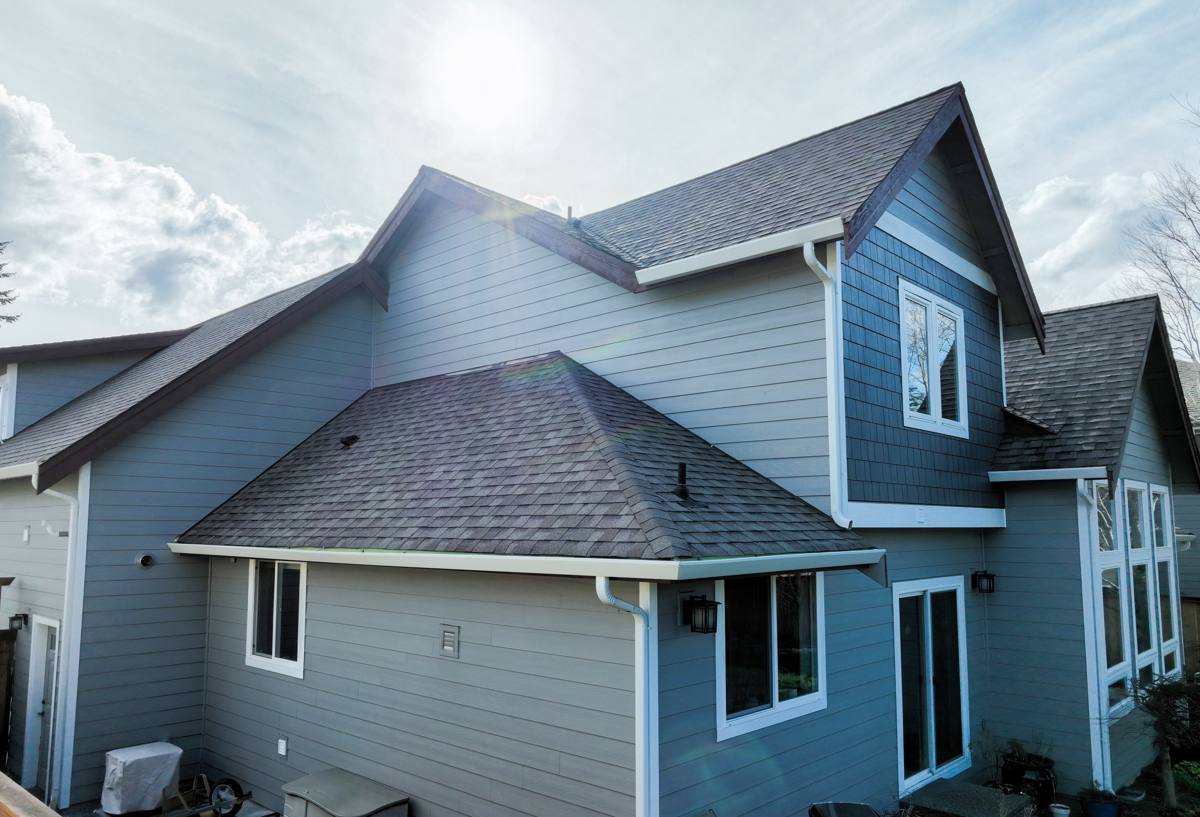
What LP SmartSide Actually Is
LP SmartSide is an engineered wood siding product. Instead of solid lumber or plywood, it's made from wood strands bonded with resin under heat and pressure, then treated with a zinc-borate process (LP calls it SmartGuard) intended to resist fungal decay and termites. The panels or lap boards are factory-primed, and in some product lines, factory-finished with a color coat.
What It Gets Right
- Lighter and easier to handle on-site than fiber cement, which can speed up install labor
- Good impact resistance for its weight — it holds up well to accidental bumps and hail
- Wide range of textures, including convincing wood-grain profiles, at a lower material cost than cedar
- A real factory warranty backed by a large, established manufacturer
- Accepts fasteners and field cuts more easily than some rigid materials
None of that is marketing spin — it's a legitimate product used successfully across the country, including in wetter regions. The issue for us isn't whether it can perform. It's whether it performs reliably, for decades, on a house that sits under Pacific Northwest rain and marine air with only annual maintenance in between.
The Core Trade-Off: A Wood-Based Substrate
Underneath the treatment and the primer, LP SmartSide is still a wood-strand product. Wood-based substrates are dimensionally reactive to moisture — they expand, contract, and, if water gets past the surface and stays there, they can swell or soften over time. The zinc-borate treatment helps resist rot and insects, but it doesn't change the basic physics of a wood product sitting wet.
That distinction matters more in Whatcom County than it does in a lot of the country. Bellingham sees a long wet season, driving rain off the Strait and Bellingham Bay, and enough shade and humidity on north- and west-facing walls to keep moss establishing itself on siding, trim, and roofs for months at a time. Add the salt air common along the water and low-lying neighborhoods, and you have a climate that tests every seam, cut edge, and caulk joint on a house far harder than a drier inland market would.
Where Moisture Gets In
Engineered wood siding is factory-treated on the face and edges of the board as manufactured, but every field cut made on-site — around windows, corners, penetrations, trim — exposes raw, untreated substrate unless it's primed and sealed correctly, every time, by every crew member, on every cut. Manufacturers are explicit about this in their installation manuals precisely because it's the most common point of failure. Miss one cut, one nail-head sealant dab, one caulk joint that later cracks in the sun and rain cycle, and that's an entry point for water into a wood-based panel.
Installation Sensitivity We're Not Willing to Gamble On
Every siding product has an installation spec. The difference with engineered wood siding is how unforgiving the spec is, and how invisible a mistake stays until years later. Clearance from grade, clearance from roof lines and decks, fastener placement, caulk selection, and paint maintenance schedules are all called out specifically in the manufacturer's requirements — and all of them affect warranty coverage.
We install a lot of siding in conditions that don't always cooperate: tight schedules between rain windows, older homes with uneven substrates, additions where flashing details are already compromised. On a product where a single missed sealant bead can become a multi-year moisture problem hidden behind the paint, that installation sensitivity is a real liability — for the homeowner and for us as the contractor standing behind the work.
Combustibility: A Difference Worth Knowing
This one gets less attention than moisture, but it's a straightforward material fact: LP SmartSide is a wood-based product and is combustible. James Hardie fiber cement is approximately 90% sand, cement, and cellulose fiber, and it is non-combustible. For homeowners in wooded parts of Whatcom County, or anyone thinking about wildfire exposure, insurance considerations, or simply wanting the most fire-resistant exterior available, that's a meaningful and factual distinction between the two material categories — not a knock on LP's engineering, just a difference in what the material is.
Maintenance Reality Over the Life of the Siding
Engineered wood siding is not a "install and forget" product. To hold its warranty and its performance, it needs:
- Repainting on a regular cycle (typically every 5–8 years, sooner in harsh exposure)
- Ongoing inspection and re-caulking of joints, corners, and penetrations
- Prompt attention to any moss, algae, or standing moisture near grade or under decks
- Careful monitoring for edge swelling, which is often the first visible sign of a moisture problem
That's a real, recurring commitment — one a lot of homeowners take on willingly, and one that's entirely reasonable in a drier climate. In Bellingham's rain and moss season, that maintenance window gets tighter and less forgiving, and the cost of skipping a cycle is higher.
How It Stacks Up Against James Hardie
| Factor | LP SmartSide | James Hardie Fiber Cement |
|---|---|---|
| Core material | Engineered wood strand (resin-bonded, zinc-borate treated) | Fiber cement (sand, cement, cellulose fiber) |
| Combustibility | Combustible | Non-combustible |
| Moisture behavior | Can swell or degrade if water penetrates unsealed cuts/joints | Dimensionally stable; not a wood-based swelling risk |
| Factory finish | Primed, or factory topcoat on some lines | ColorPlus baked-on factory finish on most lines |
| Repaint cycle | Roughly every 5–8 years | 15+ years typical with ColorPlus finish |
| Installation tolerance | Sensitive — field cuts and seams must be sealed correctly every time | Sensitive but less moisture-consequential if a seam is imperfect |
| Warranty structure | Manufacturer warranty, maintenance-dependent | Long-term transferable warranty, less maintenance-dependent |
Why We Standardized on James Hardie Instead
We made a decision, as a company, to install only James Hardie fiber cement siding. Not because every alternative is unusable everywhere, but because Hardie's material properties line up directly with what Whatcom County's climate demands: a non-combustible substrate that isn't dimensionally reactive to moisture the way wood-based products are, a factory-baked ColorPlus finish that stretches the repaint cycle well beyond what primed wood products need, and climate-engineered HZ product lines built specifically for wet, marine-influenced regions like ours. When it's installed to spec — proper clearances, correct fasteners, flashing done right — it holds up against driving rain, salt air, and season after season of moss and shade with a maintenance burden that's a fraction of what wood-based siding requires.
Standardizing on one product also means our crews install it constantly. There's no guessing on details, no mixed familiarity across different siding systems — every house gets the same disciplined, repeatable installation, which is where most long-term siding failures actually originate, regardless of brand.
What This Means for Your Project
If you already have LP SmartSide on your home and it's performing well, that's genuinely good news — well-installed engineered wood siding with a diligent maintenance history can last a long time, and we're not here to tell you to tear off something that's working. If you're planning new siding, a remodel, or a full re-side and want it done once and done right for this climate, we think fiber cement is the stronger long-term investment, and it's the only product we put our name behind.
Questions Worth Asking Any Siding Contractor
- What siding products do you install, and why did you choose them?
- What does the manufacturer's warranty actually require of me to stay valid?
- How is this product rated for combustibility?
- What's the realistic maintenance schedule — repainting, caulking, inspection — over 15 years?
- How does this product perform specifically in a wet, marine climate like Bellingham's?
If you'd like an honest opinion on your specific house — not a generic pitch — we're happy to walk the property, look at your current siding condition, and talk through what fits your budget and your home. Reach out for a free, no-pressure estimate and we'll give you a straight answer, the same way we have here.