 Bellingham Exterior
 Why Birch Bay Is a Different Job Than Siding a House Downtown
Birch Bay sits right on the water, and that changes what siding has to survive. A home a few miles inland in Bellingham deals with plenty of rain, but a home in Birch Bay deals with rain riding in sideways on wind off the Strait, salt-laden air that settles on every exterior surface, and a moss and algae season that runs longer than almost anywhere else in Whatcom County. None of that is exotic — it's just constant. Siding here doesn't fail because of one big storm. It fails slowly, from years of moisture finding the same weak seams, fasteners, and caulk joints over and over.
That's the lens we use on every Birch Bay estimate. We're not asking "will this siding look good on day one," we're asking "what does this material and this installation do after fifteen winters of onshore wind and wet moss shade." That question is why we standardized on James Hardie fiber cement and stopped installing vinyl, LP SmartSide, primed spruce, and cedar altogether. We'll get into the reasoning below, but the short version is: waterfront exposure punishes shortcuts, and Hardie gives us the most margin for error over the life of the siding.
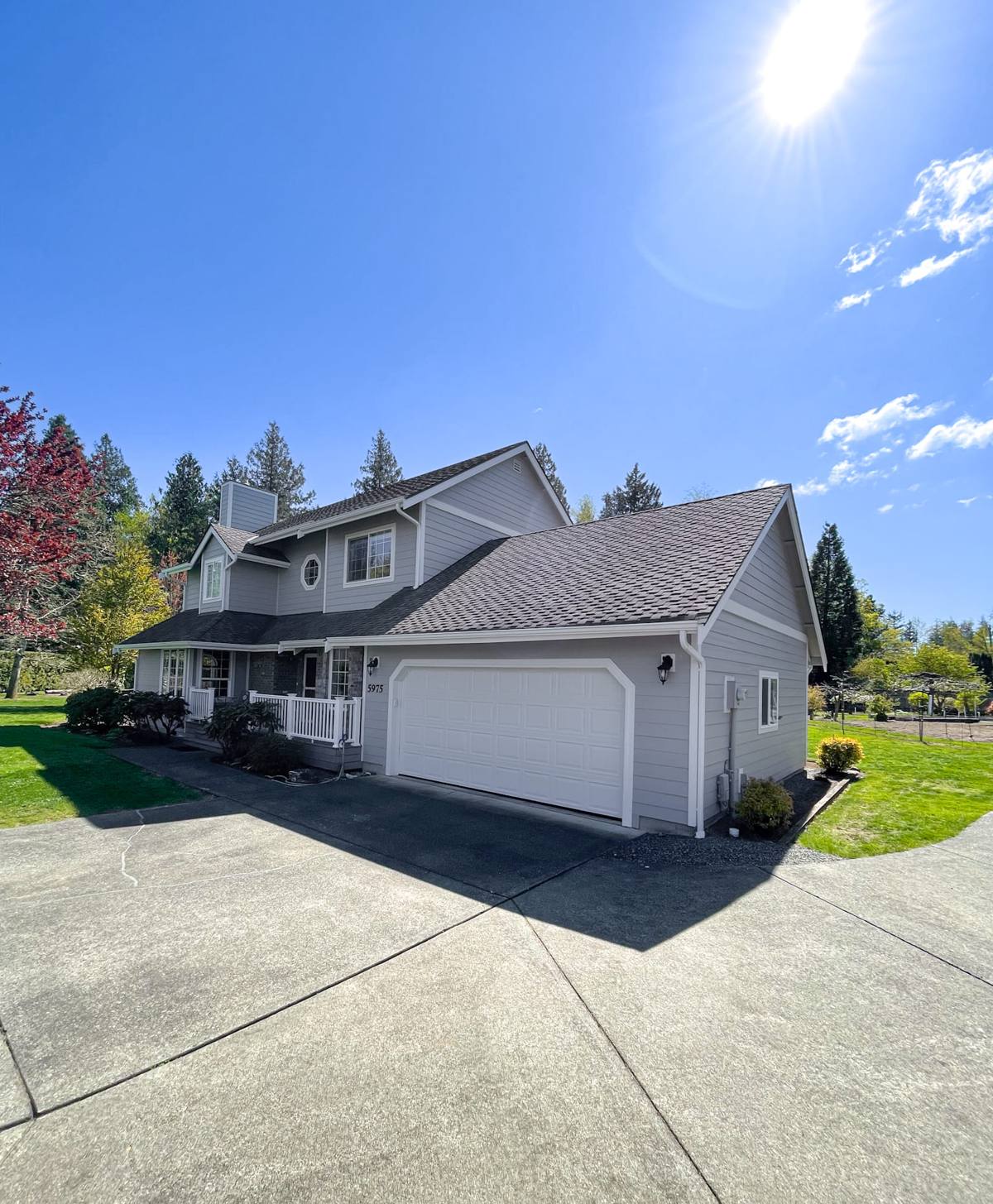
What Birch Bay's Climate Actually Does to Siding
Salt Air
Airborne salt doesn't just sit on the surface — it works into fastener heads, caulk joints, and any exposed raw edge of a building material. On metals it accelerates corrosion. On wood-based products it accelerates moisture uptake at the exact spots where the material is already most vulnerable: cut ends, nail holes, and butt joints.
Wind-Driven Rain
Rain that comes in mostly straight down is a manageable design problem — laps and overlaps shed it. Rain that comes in at an angle, pushed by wind off open water, gets forced upward and sideways into seams that were never meant to see that kind of pressure. This is why flashing detail and caulking discipline matter more on a Birch Bay job than on a sheltered inland lot.
Extended Moss and Algae Season
Shaded, damp, north-facing walls near mature trees or close to the water stay wet longer between dry spells. That extended dampness is exactly what moss and algae need to establish. Once organic growth takes hold on a siding surface, it holds even more moisture against that surface, which speeds up whatever deterioration process is already underway underneath.
Where James Hardie Fits That Reality
James Hardie fiber cement is engineered from cement, sand, and cellulose fibers — there's no wood fiber susceptible to rot, no vinyl susceptible to warping in temperature swings, and no combustible substrate. For a waterfront property, the practical benefits are:
- It doesn't absorb and swell with moisture the way wood-based siding does, so repeated wetting from wind-driven rain doesn't compound into structural softening over time.
- ColorPlus factory-applied finish is baked on under controlled conditions, which holds up better against salt air and UV than field-applied paint, and it doesn't require repainting on the same schedule wood siding does.
- It's non-combustible, which matters in Whatcom County's increasingly active wildfire-adjacent seasons even for coastal properties that aren't in a traditional fire zone.
- James Hardie engineers products by climate zone — homes in our region use HardieZone 5 (HZ5) products, engineered for areas that see a mix of moisture exposure and freeze-thaw cycling, rather than a one-size-fits-all formulation.
None of that makes Hardie maintenance-free. It still needs to be installed correctly, caulked correctly, and painted (on cut edges) correctly. But it gives a Birch Bay home a siding material that isn't fighting its own core materials against the climate from day one.
Why We Don't Install Vinyl, LP SmartSide, or Cedar Here
Each of those products has legitimate uses somewhere. On a waterfront lot in Birch Bay, here's the honest trade-off we weigh for each:
| Material | Coastal/Moisture Performance | Maintenance Burden | Our Take for Birch Bay |
|---|---|---|---|
| Vinyl siding | Doesn't rot, but panels can warp or buckle with temperature swings and wind-driven rain can push moisture behind panels at seams | Low, but limited repair options once faded or damaged | Weak point is what's happening behind it, not the panel itself |
| LP SmartSide (engineered wood) | Treated to resist moisture, but it's still a wood-strand product — any breach at a cut edge or fastener gives water a path in | Moderate; edge sealing and caulk maintenance is critical | Too much margin depends on perfect field sealing in a wet, salty environment |
| Cedar / primed spruce | Natural wood; attractive but absorbs moisture readily, especially in shaded, damp wall sections | High; regular refinishing and vigilant moss/algae management required | Extended moss season here shortens its practical service life |
| James Hardie fiber cement | Cement-based, doesn't swell or rot; factory finish resists salt and UV | Low; periodic cleaning and caulk inspection | Best fit for sustained wind, rain, and salt exposure |
This isn't a claim that vinyl, engineered wood, or cedar are bad products — plenty of them perform fine in sheltered, inland settings. It's a statement about where we've decided our labor and our name are best spent, and on a Birch Bay lot specifically, we think Hardie gives homeowners the best odds over a 20-30 year horizon.
What a Correct Installation Involves
Most siding problems we get called to look at in coastal neighborhoods aren't material failures — they're installation shortcuts that only show up years later, once wind-driven rain finds them. A correct James Hardie install for a Birch Bay home includes:
Water-Resistive Barrier and Flashing First
Before a single piece of siding goes up, the wall needs a continuous, properly lapped weather-resistive barrier and correctly integrated flashing at every window, door, and penetration. On a wind-exposed lot, flashing details around openings are the single biggest predictor of whether a wall stays dry.
Proper Clearances and Gaps
James Hardie specifies minimum clearances from grade, roof lines, decks, and other siding terminations, plus expansion gaps at butt joints and trim. Skipping these is one of the most common shortcuts we see — and it's invisible until moisture starts working into the gap that should have been there.
Fastening to Spec
Corrosion-resistant fasteners, driven at the correct spacing and depth (not overdriven, not underdriven), matter even more in salt air than inland. Overdriven nails crack the board's fastening zone; underdriven nails leave panels loose enough to work and eventually let water track behind them.
Caulking Discipline
Every joint, seam, and trim intersection needs the right sealant, applied correctly — not as an afterthought to hide a gap, but as a designed part of the water management system. This is where wind-driven rain gets stopped or gets in.
Field-Cut Edge Sealing
Every cut edge of a Hardie board needs to be primed and painted before or immediately after installation. An unsealed cut edge is the one place raw fiber cement is exposed to moisture, and in a salt-air environment that detail can't be skipped.
Our Process on a Birch Bay Job
- Site walk and moisture check. We look at wall orientation, tree shade, drainage, and any existing moss or staining patterns before quoting anything — those tell us where the wall has been struggling.
- Tear-off and sheathing inspection. Old siding comes off and we check the sheathing underneath for soft spots or prior water damage before anything new goes up. This step catches problems a quote from a photo never would.
- Weather barrier and flashing installation. Continuous barrier, correctly lapped, with flashing integrated at every opening and penetration.
- Hardie installation to spec. Correct clearances, correct fastening, correct expansion gaps — no shortcuts because a wall is hard to reach or the weather's turning.
- Caulking and edge sealing. Every seam and every cut edge, done as part of the install, not rushed at the end of the day.
- Final walkthrough. We go over the finished job with the homeowner and point out anything they should keep an eye on going forward.
What Drives the Cost of a Birch Bay Siding Job
| Factor | Why It Matters |
|---|---|
| Home size and number of stories | More wall area and higher scaffolding/lift needs directly affect labor |
| Condition under the old siding | Sheathing repair or additional water barrier work adds time once we're inside the wall |
| Trim and architectural detail | Corner boards, window trim, and dormers all add cutting and caulking time |
| ColorPlus line selected | Product lines and color options vary in material cost |
| Site access and wind exposure | Waterfront lots can require extra staging, weather timing, and protection during install |
We don't quote a flat per-square-foot number over the phone for exactly this reason — a Birch Bay lot with mature tree shade and tricky access is a different job than an open, easy-access lot even if the square footage is identical.
Keeping It Looking Right After Installation
A correct James Hardie install is low-maintenance, not no-maintenance. In a salt-air, moss-prone environment like Birch Bay, a little seasonal attention goes a long way:
- Rinse siding periodically with a garden hose to clear salt residue and organic buildup, especially on shaded or north-facing walls.
- Inspect caulk joints once a year, particularly around windows and trim, and have any cracked or separated sealant redone before winter storms.
- Keep vegetation trimmed back from walls so air can circulate and walls can dry between rain events.
- Watch gutters and downspouts — overflow running down a wall face is one of the fastest ways to create a permanently damp strip of siding.
- Address any moss or algae growth early with a gentle wash rather than letting it establish and hold moisture against the surface.
Why a Crew That Already Works Birch Bay Matters
Siding installation isn't just following a manufacturer's manual — it's applying that manual to the specific conditions of the wall in front of you. A crew that's already done work along the Birch Bay waterfront knows which wall orientations tend to hold moss, how far wind-driven rain typically pushes up under eaves in an onshore blow, and what clearance and flashing details matter most on lots with heavy tree cover or direct water exposure. That's knowledge you only build by doing the work here repeatedly, not by reading a spec sheet.
It also matters for scheduling and sequencing. Coastal jobs are more weather-sensitive during the open-wall phase between tear-off and dried-in siding — a crew that knows the local weather patterns plans around that instead of getting caught mid-project by a system rolling in off the water.
Get a Free, No-Pressure Estimate
If your Birch Bay home's siding is showing moss staining, soft spots, failing caulk, or you're just planning ahead for a wet Pacific Northwest winter, we're happy to walk the property with you and give you an honest read on what's going on and what James Hardie siding would involve for your home. Use the form below to request a free estimate — no pressure, no obligation.