 Bellingham Exterior
 Composite Decking in Silver Beach: What It Actually Needs to Handle
Silver Beach sits along Lake Whatcom on Bellingham's east side, and it's a different kind of lot than a lot of the properties we work on elsewhere in Whatcom County. Homes here are often tucked into wooded, sloped ground with heavy tree canopy overhead, close to water, and shaded for a good part of the day. That combination — shade, standing moisture, and limited direct sun to dry things out — is exactly the environment that wears out a deck fastest. Add in the driving rain that comes through the wider Bellingham area off Bellingham Bay through fall and winter, and you've got a climate that's hard on any outdoor structure, composite or wood.
Composite decking was built for conditions like this. It doesn't absorb water the way wood does, it won't rot, and it resists the kind of surface staining that shaded, damp lots produce. But composite isn't maintenance-free, and it isn't foolproof — how it's installed matters just as much as what it's made of. A composite deck put down without attention to drainage, airflow, and fastening will still grow moss, still trap moisture underneath, and still fail early. This page is about doing that job correctly for a Silver Beach property specifically.
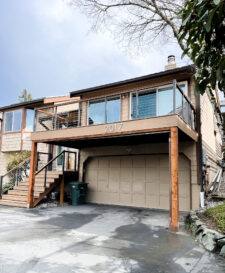
What Bellingham's Climate Does to a Deck Over Time
Whatcom County's marine climate means long stretches of damp weather rather than short, hard storms. That's actually harder on decking than an occasional downpour — it means wood and debris on a deck surface rarely get a full chance to dry out between rain events, especially from late fall through early spring. On a shaded, tree-covered lot like most of Silver Beach, that drying window shrinks even further.
Moss and Algae Growth
Moss doesn't need much to get started — shade, moisture, and a rough or porous surface for spores to grab onto. Silver Beach's tree cover and proximity to the lake give moss almost ideal conditions for a long season, often stretching well beyond what homes on more open, sun-exposed lots deal with. Once moss establishes on a deck surface or in board grooves, it holds moisture against the material and creates a slip hazard, particularly on stairs and landings.
Trapped Moisture and Substructure Rot
The composite boards themselves resist rot, but the framing underneath — joists, beams, ledger boards — is typically still wood, and it's the substructure that fails first on a poorly built deck. Lake-side, shaded lots with limited airflow underneath a deck are a common spot for us to find soft, decayed framing on decks that otherwise look fine from the top.
Debris Buildup from Tree Canopy
Needles, leaves, and organic debris from surrounding trees collect in board gaps and along the edges of a deck faster here than on open lots. Left alone, that debris holds moisture against the boards and feeds moss and mildew growth, even on composite material that doesn't itself absorb water.
Composite vs. Wood for a Silver Beach Deck
We install both wood and composite decking, and for most Silver Beach properties composite is the better long-term fit given the shade and moisture profile of the neighborhood. Here's the honest comparison:
| Factor | Composite Decking | Wood Decking |
|---|---|---|
| Moisture absorption | Very low — resists swelling and cupping | Absorbs moisture readily, prone to cupping and warping in shade |
| Moss and algae resistance | Better on the surface, but grooved/textured boards can still hold spores | Porous surface stains and grows moss faster in shaded, damp spots |
| Maintenance | Periodic cleaning, no sealing or staining required | Annual or biennial cleaning, sanding, sealing/staining |
| Upfront cost | Higher material cost | Lower material cost |
| Longevity in shaded, damp conditions | Long service life if substructure is built correctly | Shorter service life without diligent, ongoing maintenance |
| Appearance over time | Consistent color, some fading possible depending on product | Requires refinishing to maintain appearance |
Composite isn't automatically the right call for every homeowner or every budget, and we'll tell you honestly if wood makes more sense for your situation. But for a shaded, lake-adjacent lot where a deck will spend a lot of the year damp, composite's resistance to moisture absorption is a real, practical advantage — not just a sales pitch.
What a Correct Composite Deck Installation Involves
Substructure and Moisture Management First
The framing is where most deck failures start, and it's the part homeowners can't see once the job is done — which is exactly why it has to be right the first time. On Silver Beach lots we pay particular attention to ledger board flashing where the deck attaches to the house, since that connection point is a common source of hidden water intrusion. Joists get proper flashing tape to keep water out of end grain and fastener penetrations, and we build in the clearance needed for air to actually move underneath the deck rather than sit stagnant against damp ground or a hillside.
Board Selection and Fastening
Composite boards vary in how they handle grooved hidden-fastener systems versus solid boards with face screws, and in how their surface texture sheds debris and resists moss compared to smooth-capped alternatives. We'll walk through the options that make sense for a shaded lot — generally favoring boards with a cap or shell layer that resists moisture penetration and doesn't rely on surface sealing to perform. Fasteners matter too: proper hidden-fastener clips or coated, corrosion-resistant screws sized correctly for the board profile prevent the board movement and squeaking that comes from undersized or mismatched hardware.
Drainage, Airflow, and Moss Prevention Built In
Where a deck sits low to the ground or over a walk-out area, we look at how water actually drains off and away from the structure rather than pooling underneath. Proper board spacing, correct slope away from the house, and unobstructed venting at the skirting all reduce the standing moisture that feeds moss and mildew. On heavily shaded lots we'll also talk through realistic expectations — no installation eliminates moss risk entirely when a deck sits under full tree canopy, but correct drainage and airflow cut down how fast and how badly it takes hold.
Our Process, Start to Finish
- On-site assessment — we look at your existing deck or build site, sun/shade exposure, drainage patterns, and how close you are to the lake or tree line.
- Honest product discussion — we go over composite board options and trade-offs for your specific lot, not a generic pitch.
- Written estimate — clear scope, material selection, and cost breakdown before any work starts.
- Demo and substructure inspection — if replacing an existing deck, we check the framing underneath before deciding what can be reused.
- Framing and moisture management — ledger flashing, joist tape, and proper spacing/venting done before a single composite board goes down.
- Board installation — correct fastening system for the product, attention to expansion gaps and drainage slope.
- Final walkthrough — we go over care and cleaning specific to your deck's exposure, not a generic handout.
Maintenance Checklist for a Silver Beach Composite Deck
Composite cuts down maintenance significantly compared to wood, but "low-maintenance" isn't "no-maintenance," especially on a shaded lot near the water. A simple seasonal routine keeps moss from getting a foothold and keeps the substructure dry:
- Sweep leaves, needles, and organic debris out of board gaps regularly during fall and through the wet season
- Rinse the deck surface periodically to prevent pollen, algae film, and organic buildup from setting in
- Check and clear gaps at the skirting or lattice to keep airflow moving underneath the deck
- Inspect for early moss growth in shaded corners and stair treads and address it before it spreads
- Confirm gutters and downspouts above the deck are directing water away, not onto the deck surface
- Look underneath annually for signs of moisture at the ledger board or joist connections
- Avoid pressure-washing at close range or high pressure, which can damage the cap layer on some composite boards
Cost Factors for Silver Beach Composite Decks
Composite decking costs more upfront than wood, and pricing varies with board selection, deck size, substructure condition, and site access. Rather than quoting a number that won't hold up across different properties, here's what actually moves the price:
| Factor | Why It Matters Here |
|---|---|
| Existing substructure condition | Lake-side, shaded lots more often need joist or ledger repair before new decking goes down |
| Site access and slope | Sloped, wooded Silver Beach lots can require more setup and material handling than a flat, open lot |
| Board and fastener system chosen | Hidden-fastener grooved boards typically cost more installed than face-screwed solid boards |
| Railing and stair requirements | Multi-level lake-side decks with stairs add material and labor beyond a simple single-level deck |
| Drainage and venting work needed | Low-clearance or ground-level sections may need extra grading or venting work to perform long-term |
We'll always give you a written, itemized estimate before work starts so you know exactly what you're paying for and why — not a vague ballpark that changes once the crew shows up.
Why Hiring a Crew That Already Works Silver Beach Matters
A lot of deck problems we get called out to fix started with a crew that did solid, competent work — just not work suited to this specific kind of lot. Framing details that are fine on a flat, sunny property in another part of Whatcom County can fall short on a shaded, sloped, lake-adjacent lot where moisture sits longer and moss pressure is higher. Knowing to add extra ventilation under a low-clearance section, to flash a ledger board more carefully because of the humidity, or to steer a homeowner toward a board profile that resists moss better in deep shade — that comes from having done this specific work on this specific kind of property before, not from a general decking résumé.
We work throughout Bellingham and Whatcom County, and Silver Beach's combination of tree cover, lake proximity, and driving winter rain is a profile we've built for repeatedly. That means fewer surprises during the estimate, a substructure built for the actual conditions your deck will sit in, and a finished deck that's set up to handle a long Bellingham moss season rather than fight it.
If you're thinking about a new composite deck or replacing an aging one in Silver Beach, we're happy to come take a look and give you a straightforward, no-pressure estimate — just fill out the form below.