 Bellingham Exterior
 Blaine's Coastal Climate and What It Does to a Roof
Blaine sits right on the water, at the northern edge of Whatcom County, and that location shapes what a roof has to deal with. Salt-laden air off Semiahmoo Bay and Drayton Harbor drifts inland with the prevailing wind, settling on shingles, flashing, fasteners, and gutters. Add in driving rain that comes sideways during winter storms, near-constant marine humidity, and a moss season that runs long even by Pacific Northwest standards, and you've got a roof environment that's tougher than what a roof twenty miles inland has to handle.
Salt air accelerates corrosion on any exposed metal — fasteners, flashing, vent stacks, even the granule-coated surface of an aging asphalt shingle. Driving rain finds every gap in flashing or underlayment that a calmer climate would never expose. And moss doesn't just sit on a roof looking bad; it holds moisture against the surface, works into laps and seams, and lifts shingles enough to let water underneath. None of this is unique to Blaine, but the combination — salt, wind, rain, and moss, all at once, most of the year — is more concentrated here than in drier or more sheltered parts of Bellingham and Whatcom County.
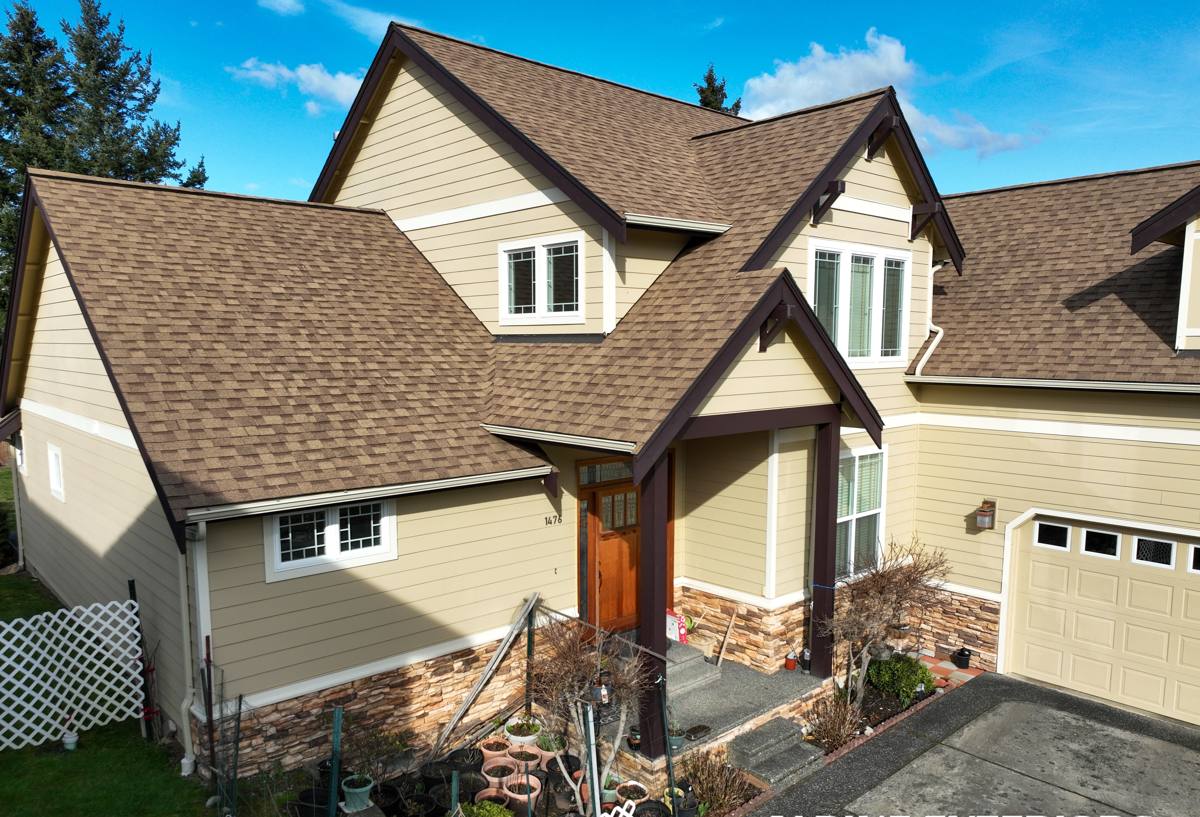
Why Metal Roofing Holds Up Well in This Environment
Metal roofing isn't a magic fix, but it addresses several of Blaine's specific problems directly. It's an inorganic material, so it doesn't give moss or algae the organic surface they feed on the way asphalt granules can. A properly installed metal roof sheds wind-driven rain efficiently because of its long panel runs and minimal horizontal seams compared to a shingle roof's thousands of overlapping edges. And it holds up to wind uplift better than most other roofing materials when it's fastened correctly.
That said, metal roofing is not automatically salt-air-proof. The performance depends heavily on the coating system, the fastener material, and how the details are handled at penetrations, valleys, and edges. A metal roof installed with the wrong fasteners or a low-grade paint finish can corrode faster near the water than a well-maintained asphalt roof would. This is exactly where a lot of the value of hiring the right crew shows up — not in the panel itself, but in the choices made around it.
Choosing the Right System for a Blaine Home
Panel Profiles
There are a few common metal roofing approaches, and they're not interchangeable in a coastal setting.
| System | Fastener Exposure | Typical Longevity | Best Fit |
|---|---|---|---|
| Standing seam | Concealed clips, no exposed fasteners on the field | Longest of the common options | Full coastal exposure, low-maintenance goals |
| Exposed-fastener panels | Screws through the panel face | Shorter, driven by fastener/washer life | Outbuildings, budget-conscious projects |
| Stone-coated steel | Concealed, shingle-style profile | Long, comparable to standing seam | Homeowners wanting a shingle or shake look with metal durability |
Concealed-fastener systems like standing seam generally perform best in a salt-air environment because there are far fewer penetration points where water and corrosion can start. Exposed-fastener panels can still be a reasonable choice for a shop, garage, or budget-driven project, but the neoprene washers under each screw head are a wear item, and in a coastal climate they don't last as long as they would inland.
Coatings and Corrosion Resistance
The paint or coating system on a metal panel matters as much as the metal underneath. Higher-grade PVDF (often marketed under names like Kynar 500) coatings resist chalking, fading, and coastal corrosion significantly better than lower-grade polyester finishes. We steer homeowners toward proven, well-coated panel systems for exactly this reason — it's not about brand loyalty, it's about what actually survives salt exposure over decades rather than years.
What a Correct Installation Actually Involves
The panel itself is only part of the job. Most metal roof failures we get called to inspect trace back to detailing, not the metal.
Underlayment and Moisture Barrier
Self-adhering ice-and-water membrane belongs at eaves, valleys, and around every penetration — these are the spots where wind-driven rain is most likely to get pushed backward under a panel edge. A quality synthetic underlayment across the rest of the deck adds a second line of defense and gives the roof a dry surface to work on if weather moves in partway through the job.
Fastening and Flashing
Fasteners need to match the panel metal to avoid galvanic corrosion — mixing incompatible metals (say, the wrong fastener alloy against steel, or uncoated steel touching aluminum) sets up a corrosion reaction that can eat through a connection years before the panel itself would fail. Flashing at valleys, sidewalls, chimneys, and vent penetrations has to be formed and lapped correctly, not just caulked and hoped for. In a wind-exposed, salt-air location like Blaine, we treat these details as the part of the job that actually determines how long the roof lasts.
Ventilation
Balanced intake and exhaust ventilation keeps moisture from building up in the attic space, which matters in a climate this humid. Poor ventilation under a metal roof can lead to condensation on the underside of the panels, which defeats a lot of the moisture-resistance benefit the metal was supposed to provide in the first place.
Our Process, From Inspection to Cleanup
- Inspection. We look at the existing roof, decking condition, ventilation, and how the home is exposed to wind and salt air based on its position and surroundings.
- Deck and structure check. Coastal moisture can hide rot under an old roof surface — we check the deck before assuming it's ready for new material.
- System selection. We walk through panel profile, coating, and color options based on your home, budget, and how much maintenance you want to deal with long-term.
- Tear-off or overlay decision. We'll tell you honestly whether your existing roof can be built over or needs to come off — this affects both cost and long-term performance.
- Installation. Panels, underlayment, and flashing go in with attention to the coastal details above — fastener compatibility, sealed penetrations, and properly lapped flashing.
- Final walk-through and cleanup. We inspect the finished roof with you, sweep the property for stray fasteners and debris, and answer any questions before we consider the job done.
Metal Roofing vs. Composition Shingle in Blaine's Climate
| Factor | Metal Roofing | Composition Shingle |
|---|---|---|
| Moss resistance | Naturally resistant to growth on the panel surface | Granules give moss and algae something to hold onto |
| Wind-driven rain | Fewer seams, sheds water efficiently when detailed correctly | Many overlapping edges create more entry points |
| Salt air / corrosion | Depends on coating and fastener quality — good systems hold up well | Granule loss and fastener corrosion accelerate near the water |
| Upfront cost | Higher material and install cost | Lower upfront cost |
| Long-term maintenance | Lower once installed correctly | More frequent moss treatment, granule loss, and patching over time |
Neither material is "wrong" for Blaine. Composition shingle can still perform reasonably well with regular maintenance and moss treatment. Metal roofing shifts more of the cost to the upfront installation and less to ongoing upkeep — which fits some homeowners' priorities better than others.
Maintenance That Actually Matters Near the Water
A metal roof cuts down on maintenance, but it isn't maintenance-free, especially this close to the water.
- Keep gutters and valleys clear of needles, leaves, and debris — trapped organic material holds moisture against the panel even on metal.
- Do a visual check after major windstorms for lifted flashing, loose fasteners, or debris impact.
- Rinse off heavy salt spray buildup periodically if your home faces the water directly.
- Touch up any scratches or chips in the coating promptly — a bare spot in a coastal environment is where corrosion starts.
- Trim back overhanging branches to reduce debris load and keep the roof drying out properly between rain events.
- Have a professional look at penetration seals (vent stacks, chimney flashing) every few years, since sealants age faster in constant sun and salt exposure.
Cost Factors to Know Before You Commit
Metal roofing costs more upfront than composition shingle, both in material and labor. Within metal roofing itself, cost is driven by panel profile (standing seam runs higher than exposed-fastener), roof complexity (valleys, dormers, and penetrations all add labor), whether a tear-off is needed versus roofing over existing material, and any deck repair uncovered once the old roofing comes off. We'll walk you through where your specific roof lands on these factors during the estimate — we don't believe in surprising a homeowner partway through a job.
Why a Crew That Already Works in Blaine Matters
Roofing detail work that's correct for a sheltered inland roof isn't always enough for a home exposed to open water and prevailing coastal wind. A crew that regularly works in Blaine and along the Whatcom County coastline already knows which fastener and coating combinations hold up here, how to detail flashing for wind-driven rain rather than just vertical rain, and what Whatcom County's permitting and inspection process expects for a reroof. That local, repeated experience shows up in fewer callbacks and a roof that's actually built for the conditions it has to survive, not just a generic install done to a national spec sheet.
If you're weighing metal roofing for a home in Blaine, we're happy to take a look and give you a straightforward assessment — no pressure, no hard sell. Fill out the form below to schedule a free estimate.