 Bellingham Exterior
 Composite Decking for York Homes
York sits close enough to the water and the tree cover that its decks take a beating most inland neighborhoods never see. Salt-laden air off the bay works into fasteners and hardware, driving rain gets pushed sideways under railings and against ledger boards, and the shade from mature trees keeps boards damp long after a storm has passed. Composite decking was built to handle exactly that kind of punishment, but only when it's detailed correctly for this climate. A composite deck installed the same way you'd build one in a dry inland town will still grow moss, still trap water where it shouldn't, and still loosen at the fasteners within a few seasons.
We build and replace composite decks for homeowners around York and the rest of Bellingham, and the difference between a deck that lasts twenty-plus years and one that needs re-work in five almost always comes down to what's underneath the boards, not the boards themselves.
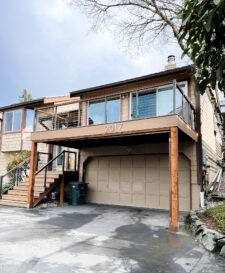
What Whatcom County Weather Does to a Deck
Salt Air and Metal Fatigue
Homes with any exposure toward the water deal with a slow, steady corrosion problem. Standard deck screws, joist hangers, and post bases that aren't rated for coastal exposure will start showing rust streaks and pitting well before the decking itself shows wear. Once fasteners corrode, they lose holding strength — that's a structural issue, not a cosmetic one.
Driving Rain and Wind-Driven Moisture
Bellingham's rain rarely falls straight down. Wind off the water pushes it sideways, which means it gets up under rail caps, behind fascia boards, and into any gap where flashing was skipped. Composite boards themselves don't absorb water the way wood does, but the framing underneath — and any wood trim used for skirting or fascia — absolutely can.
Moss, Algae, and Extended Shade
York's tree cover and the region's long wet season give moss and algae months at a time to establish themselves on any deck surface that doesn't drain and dry quickly. Moss holds moisture against the board surface, and on composite decking that means the board's cap layer is doing constant work to shed water it was never fully dry to begin with.
What a Correctly Built Composite Deck Includes
- Stainless steel or coated coastal-rated fasteners and hardware — not standard galvanized, which corrodes faster under salt exposure
- Joist tape or a moisture barrier over every framing member so screw penetrations don't become water entry points
- Hidden fastener clip systems set with the manufacturer's specified gap for drainage and thermal movement
- Proper board spacing and end-gapping so water sheets off instead of pooling at butt joints
- Ledger board flashing that actually directs water away from the house rim joist, not just a bead of caulk
- Post bases set above grade with a drainage gap, not buried in soil or mulch where they stay wet
- Airflow underneath the deck — skirting with vents, not a sealed box that traps humidity against the joists
None of this is exotic. It's standard good practice that gets skipped when a crew is moving fast or isn't used to building this close to the water. Every one of those details is also invisible once the deck is finished, which is exactly why it matters who builds it.
Choosing a Composite Board for This Climate
Not all composite decking handles moss and moisture the same way. The big factor is the cap layer — the outer shell that resists staining, fading, and moisture absorption. A fully capped board (protected on all four sides) holds up better in a shaded, wet environment than a board that's only capped on the top and edges, because the cut ends and bottom face are where moisture gets in first.
| Factor | What to look for in York's climate |
|---|---|
| Cap coverage | Fully capped (top, bottom, sides) resists moisture wicking at cut ends and fastener holes |
| Surface texture | A texture with some grain or grip sheds standing water better than a dead-flat finish, and resists slickness when damp |
| Color | Darker colors show less moss and algae staining early, but run hotter in direct sun — a tradeoff worth discussing for your yard's exposure |
| Warranty structure | Check whether the warranty covers moisture damage and staining, or only structural failure — the fine print varies a lot between lines |
| Board profile | Grooved-edge boards for hidden fasteners need consistent gapping; solid-edge boards are more forgiving but show fastener heads |
We'll walk you through the specific product lines that make sense for your budget and your yard's sun/shade exposure during the estimate — there isn't one universal right answer, but there are boards that are clearly better suited to a shaded, damp lot than others.
Our Process for a York Composite Deck
1. On-Site Assessment
We look at drainage around the existing footprint, sun and shade exposure, proximity to the water or prevailing wind direction, and the condition of any existing structure if this is a replacement. This is also where we check whether the existing footings and framing can be reused or need to come out.
2. Framing and Structure
If we're building new or replacing an old deck, framing goes in with coastal-rated hardware and proper flashing at the house connection. This is the part of the job that determines how the deck ages — it's also the part that's completely hidden once boards go down, which is why we don't cut corners here even though no one will ever see it.
3. Decking Installation
Boards go down with manufacturer-specified spacing, hidden fastener systems where the product calls for them, and attention to how water will actually move across the surface once it's finished — not just how it looks the day we leave.
4. Railings, Stairs, and Finish Details
Railing posts, stair stringers, and any fascia trim get the same fastener and flashing standards as the deck itself. A deck with a bulletproof frame and a poorly flashed rail post is still going to leak and stain at that one weak point.
5. Walkthrough
We go over maintenance expectations before we leave — what composite decking still needs (periodic washing, keeping debris out of gaps) and what it doesn't (no staining or sealing).
Composite vs. Wood for This Neighborhood
We install wood decking too, and it's a legitimate choice for some homeowners. But in a spot like York, with extended shade and salt-influenced air, wood decking asks for a maintenance schedule — regular cleaning, re-staining or sealing every couple of years — that a lot of homeowners underestimate when they choose it. Composite shifts that maintenance burden almost entirely onto periodic washing instead of refinishing. The tradeoff is upfront cost: composite typically costs more per square foot installed than pressure-treated wood, though usually less than premium hardwood decking, and that gap is generally recovered over time in avoided refinishing labor and materials.
What This Costs
Composite decking projects vary widely based on square footage, framing condition, railing style, and board selection. As a broad range, homeowners in the Bellingham area typically see composite deck installation land somewhere in the moderate-to-upper range compared to basic wood decking, with the final number driven more by structural work (new footings, ledger repair, stairs) than by the decking material itself. We give firm numbers only after seeing the site, since a deck that needs new footings costs meaningfully more than one where we're building on a sound existing frame.
Before You Hire, Check For This
- Ask specifically what fastener and hardware grade they use — "standard" hardware is a red flag this close to the water
- Ask how they flash the ledger board connection to the house, not just how they attach the decking
- Ask whether they've worked in York or similar shaded, water-adjacent parts of Bellingham before
- Get the manufacturer warranty terms in writing, not just a verbal summary
- Confirm whether skirting (if you want it) will include ventilation, or if it will seal the underside of the deck
- Ask what a walkthrough and cleaning schedule looks like once the deck is done
Why a Local Crew Matters Here
York isn't a huge area, but its position relative to the water and its tree cover make it different from a deck build ten minutes inland. A crew that already knows which corners of Bellingham need coastal-rated hardware, which lots hold moisture longest into summer, and how moss behaves on a shaded composite deck through a Whatcom County winter isn't guessing at any of this — they've already seen how the last several decks they built in this exact kind of setting have held up. That experience shows up in details you'll never inspect yourself: what's under the ledger flashing, what grade of screw is holding your rail posts, whether the skirting can breathe.
If you're thinking about a new composite deck or replacing an aging one in York, we're happy to come take a look and give you a straight, no-pressure estimate — just fill out the form below and we'll get in touch.