 Bellingham Exterior
 Building Decks That Hold Up in Puget's Marine Climate
A deck in the Puget neighborhood of Bellingham lives a different life than a deck built in a dry inland climate. It sits under a marine layer that carries salt off the water, takes on months of steady rain, and spends a good part of the year shaded and damp enough for moss to gain a foothold on any surface that doesn't shed water well. None of that is a reason to avoid building a deck here — it's just the set of conditions the deck has to be designed around from the first footing to the last board.
We build decks for homes throughout Bellingham and Whatcom County, and the Puget area gets the same attention to moisture management and material selection as anywhere else we work. A deck that's framed, fastened, and finished for a drier climate will show problems here years before it should — soft spots, streaking, loose railings, moss creeping across the boards by the second or third fall. A deck built for this specific environment won't.
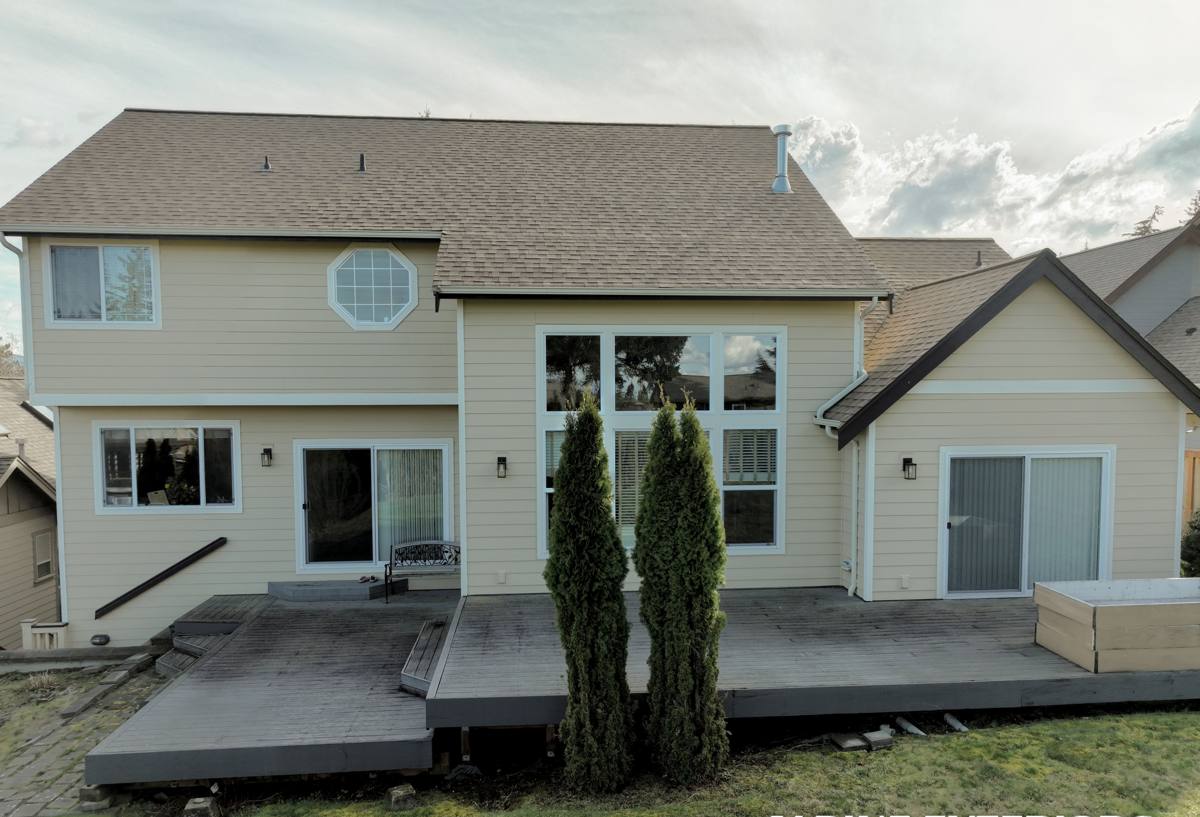
What This Climate Actually Does to a Deck
Salt Air and Metal
Homes close enough to the water pick up airborne salt that accelerates corrosion on anything metal — fasteners, joist hangers, railing brackets, hinges. Standard galvanized hardware can start showing rust streaks and pitting well before a homeowner expects hardware problems, especially on the windward side of a structure. The fix isn't complicated, but it has to be decided at the framing stage, not discovered later.
Driving Rain and Standing Water
Rain here doesn't just fall — wind-driven rain gets pushed sideways into ledger connections, under railing posts, and into any gap that wasn't sealed with that in mind. Combined with our long wet season, any spot on a deck where water can collect and sit — a low corner, a poorly sloped board, a clogged gap between boards — stays wet far longer than it would in a drier climate, which is exactly the condition rot and mold need.
Moss and Shade
Moss needs moisture, shade, and a surface to grip, and a lot of Puget-area lots have mature trees or north-facing exposures that supply all three for much of the year. Once moss establishes on a deck surface it holds even more moisture against the wood and turns boards slippery, which is a real safety issue on stairs and ramps, not just a cosmetic one.
Choosing Decking Material for This Site
There's no single "correct" material for every Puget property — it depends on budget, how much upkeep the homeowner wants to do, and how shaded or exposed the site is. Here's how the common options actually perform in this climate, laid out honestly.
| Material | Moisture & Moss Behavior | Maintenance | Typical Lifespan Here |
|---|---|---|---|
| Pressure-treated pine | Resists rot with proper sealing; can still grow moss in shaded spots if not cleaned | Annual cleaning and re-sealing recommended | 15-20 years with upkeep |
| Western red cedar | Naturally rot- and insect-resistant; still needs sealing to fight moss and graying | Periodic cleaning, stain/seal every few years | 20-25+ years with upkeep |
| Composite decking | Won't rot, but moss and algae can still grow on the surface film in shaded, damp spots | Occasional washing; no staining or sealing | 25-30 years, manufacturer-dependent |
Composite gets asked about a lot because it doesn't rot, and that's a fair reason to like it. Our honest caveat: composite still needs to be washed periodically in a shaded, mossy yard, and it doesn't forgive a poorly built substructure — trapped moisture underneath a composite deck causes problems just like it does under wood, it's just hidden longer because the surface still looks fine. We won't oversell composite as maintenance-free here, because in a Puget yard with real shade, it isn't quite.
Framing and Structure Decisions That Matter Here
Ledger Flashing
Where the deck attaches to the house, proper flashing is what keeps driven rain from working its way behind the ledger board and into the house framing. This is one of the most common failure points on older decks in wet climates, and it's cheap to do right at build time and expensive to fix after the fact.
Joist Protection
Sealing the tops and cut ends of joists before decking goes down keeps water from soaking into exposed end grain — the fastest way for a joist to start rotting from the inside, out of sight under the boards.
Footings and Post Bases
Ground contact with wood posts is a rot risk anywhere, but persistent regional dampness makes it worse. We keep post bases elevated off the concrete on proper standoff hardware so wood never sits in standing water at the base.
Our Deck Building Process
- Site assessment — we look at sun/shade exposure, drainage slope, wind exposure, and how close the site is to salt-air conditions before recommending materials.
- Design and material selection — decking, fasteners, and hardware are chosen together, not separately, so nothing on the deck becomes the weak link.
- Permitting — we handle the permit process for the scope of work involved so the deck is built to code and documented correctly.
- Framing — footings, posts, ledger flashing, and joist protection go in first, since this structural work is what determines how long the deck actually lasts.
- Decking and railing installation — boards and railing are installed with proper gapping for drainage and airflow underneath.
- Final walkthrough — we go over care and maintenance specific to the material chosen so the homeowner knows what upkeep to expect.
Fasteners and Hardware for Salt-Air Conditions
Hardware choice matters more here than it does in a lot of the country, and it's an area where cutting corners doesn't show up until years later. For Puget-area builds we favor stainless steel or high-grade coated fasteners and connectors over standard galvanized hardware, particularly for any project closer to the water or in an exposed, wind-driven location. It costs a bit more up front. It's a lot cheaper than replacing rusted-out joist hangers or railing brackets on a deck that's otherwise sound.
Hardware Comparison
| Hardware Type | Salt-Air Performance | Best Use |
|---|---|---|
| Standard galvanized | Adequate inland, prone to rust streaking near salt air | Sites well inland, less exposed to marine air |
| Hot-dip galvanized | Better corrosion resistance than standard | Moderate exposure sites |
| Stainless steel | Best resistance to salt-air corrosion | Recommended for exposed or near-water sites |
Designing Against Moss Before It Starts
Moss control on a deck is mostly a design problem, not a cleaning problem. Boards installed with correct spacing let water drain through instead of pooling on the surface. A deck framed with a slight slope away from the house keeps water moving instead of sitting. Keeping decking clear of overhanging vegetation where reasonably possible cuts down on shade and debris buildup, both of which feed moss growth. None of this eliminates the need for occasional cleaning in a climate like ours, but it means the deck isn't fighting against its own construction to stay dry.
What Maintenance Actually Looks Like Here
Every deck needs some upkeep, and in this climate the schedule is a little tighter than it would be somewhere drier. This isn't a reason to skip a deck — it's just useful to know going in.
- Sweep or blow off leaves and debris regularly, especially in fall, so they don't trap moisture against the boards
- Wash the surface at least once or twice a year to remove early moss and algae growth before it takes hold
- Check railing hardware and fasteners periodically for rust or looseness, especially after the wet season
- Reseal or re-stain wood decking on the schedule appropriate to the product — don't wait until it's visibly gray and dry
- Keep gutters and downspouts near the deck clear so runoff isn't draining directly onto or under the structure
- Watch shaded corners and stair treads closely — they're the first places moss and slick spots tend to show up
Why Hire a Crew That Already Works Puget
A deck builder who mostly works inland or in a milder climate can still build something that looks right on installation day. The difference shows up two or three winters later, when the decisions that don't get noticed at first — flashing details, hardware grade, drainage slope, board spacing — start to matter. Working regularly in Bellingham and the surrounding Whatcom County area means we're building to the conditions this specific site deals with every year, not adapting a generic approach after the fact.
We'd rather walk a homeowner through the honest tradeoffs between a cedar deck and a composite deck, or explain why we're recommending stainless fasteners on an exposed site, than sell whatever's easiest to install. A deck is a long-term structure attached to your home — it's worth getting the framing and material decisions right the first time.
If you're planning a new deck or replacing an aging one in the Puget area, we're happy to take a look at the site and talk through what makes sense for your home's exposure, budget, and how much upkeep you want to take on. Reach out for a free, no-pressure estimate using the form below.