 Bellingham Exterior
 Roofing in Ferndale Means Building for the Marine Climate
Ferndale sits close enough to Bellingham Bay and the Salish Sea that homes here take on a different kind of weather load than roofs even twenty miles inland. The air carries salt and moisture almost year-round, rain arrives sideways more often than straight down, and shaded rooflines stay damp long after a storm has passed. None of that is dramatic on its own, but stacked together over years, it's exactly the combination that shortens the life of a roof that wasn't installed with this climate in mind.
A new roof installation in Ferndale isn't just about swapping old shingles for new ones. It's about choosing materials and installation details that account for salt exposure, near-constant humidity, and a moss season that can run most of the year in shaded, north-facing sections. Get those details right and a roof will comfortably outlast its rated lifespan. Get them wrong and you'll be dealing with soft decking, curling shingles, or moss undermining the surface well before the material itself was expected to fail.
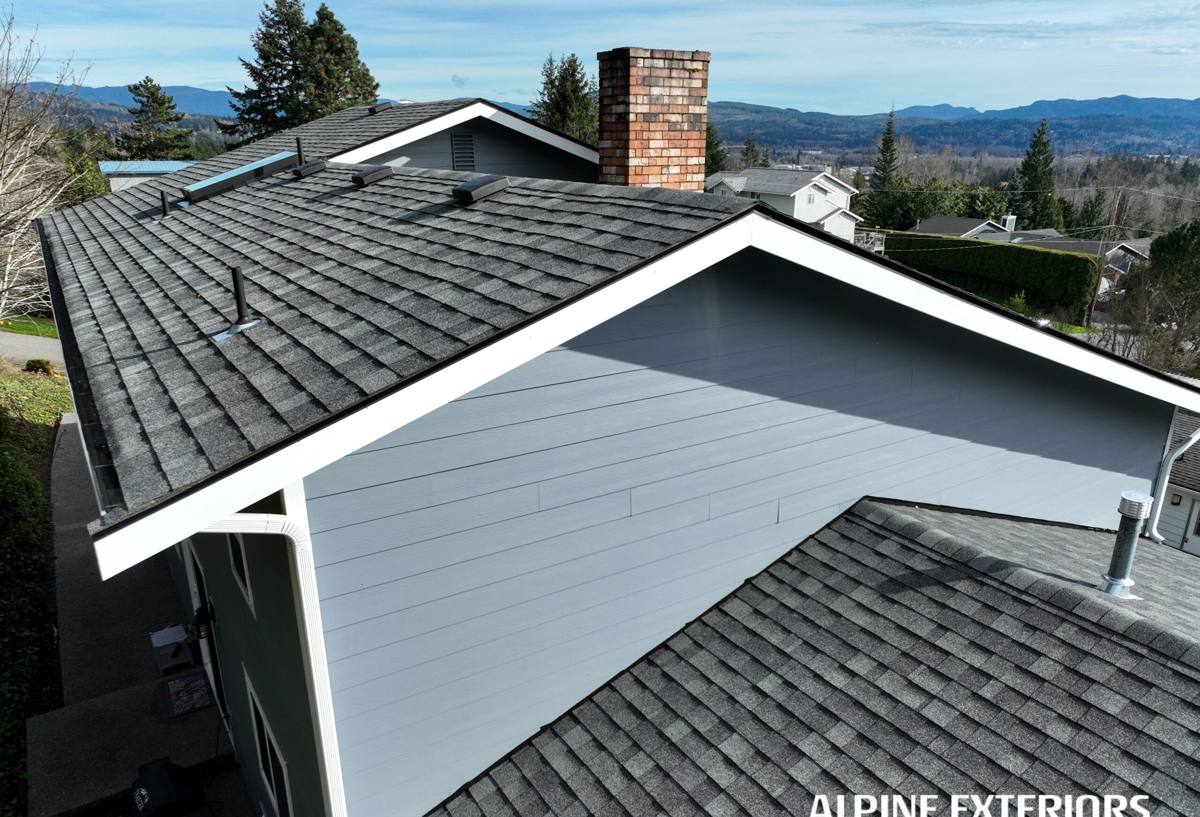
Signs a Ferndale Home Needs Replacement, Not Another Repair
Whatcom County's wet, mild climate hides roof problems well. Moss and algae can mask granule loss, and a roof can look intact from the ground while the underlayment underneath has already given up. A few signs it's time to talk replacement instead of another patch:
- Granules collecting in gutters and downspouts, or shingles that look bald in patches
- Daylight visible through the attic roof deck, or damp insulation after a wind-driven rain
- Soft or spongy spots when walking the roof, especially near valleys and chimneys
- Persistent moss growth that keeps returning within a season or two of cleaning
- Multiple past repairs in different areas rather than one isolated issue
- Shingles curling, cupping, or cracking, particularly on south- and west-facing slopes
One or two of these can often be repaired. Several at once, or a roof already past 18-20 years old in this climate, usually means the smarter money is a full new install rather than continuing to chase leaks.
What a Correct New Roof Installation Actually Involves
Tear-Off and Deck Inspection
Every proper installation starts with a full tear-off down to the decking, not a layover on top of existing shingles. That's the only way to actually see what's underneath. In this climate, we routinely find soft or delaminated plywood around valleys, chimneys, and eaves where moisture has been working its way in slowly. Any damaged decking gets replaced before anything new goes down — covering rot with new shingles just hides the problem for another owner to find later.
Underlayment and Water Barrier Details
Given how often Ferndale sees driving, wind-pushed rain rather than straight-down rain, underlayment choice and installation detail matter more here than in drier parts of the state. Self-adhering ice-and-water membrane belongs at eaves, valleys, and around every roof penetration — chimneys, vents, skylights — as a second line of defense where wind-driven water is most likely to force its way under the shingle line. Synthetic underlayment across the rest of the field holds up better than old-style felt when it gets wet during the install itself, which in this climate is a real possibility on any given work day.
Ventilation
A roof that can't breathe traps moisture in the attic, and trapped moisture is what accelerates deck rot and interior mold in a marine climate. Balanced intake at the eaves and exhaust at the ridge keeps air moving so humidity doesn't sit against the underside of the deck. This is one of the most commonly skipped steps on quick, budget re-roofs, and it's one of the most consequential to skip here.
Material Selection
Not every roofing product performs the same near the coast. Salt-laden air is harder on some metals and fasteners than others, and constant shade plus moisture is what feeds moss. We select materials and hardware rated for coastal/marine exposure rather than defaulting to whatever is cheapest to install, and we'll walk through the honest trade-offs of each option for your specific roof.
Comparing Roofing Materials for Ferndale's Coastal Conditions
| Material | Moisture & Moss Resistance | Salt Air Durability | Typical Lifespan | Maintenance Needs |
|---|---|---|---|---|
| Architectural asphalt shingle | Good with algae-resistant granules | Good with corrosion-resistant fasteners | 25-30 years | Periodic moss removal on shaded slopes |
| Standing seam metal | Excellent — sheds moisture fast, little surface for moss to grip | Very good with proper coastal-rated finish and fasteners | 40-50+ years | Low; occasional fastener and seam check |
| Synthetic/composite shingle | Good to very good depending on product | Good | 30-50 years | Low to moderate |
| Cedar shake | Fair — natural material, needs more upkeep in constant moisture | Fair; requires diligent maintenance near salt air | 20-30 years with upkeep | High; regular treatment and moss control |
We don't push one material as the "only" answer — the right choice depends on your home's style, budget, roof pitch, and how much shade the roof sits under. What we won't do is install a product in a location where we know it will struggle against local conditions without being upfront about the maintenance commitment that comes with it.
Our Installation Process, Start to Finish
- On-site assessment — we inspect the existing roof, attic ventilation, and decking condition, and talk through material options for your home and budget.
- Written estimate — a clear scope of work and price, no vague allowances buried in fine print.
- Scheduling around weather — in Whatcom County, timing a tear-off to avoid multi-day rain systems is part of doing the job right, not an afterthought.
- Tear-off and deck repair — full removal, deck inspection, and replacement of any compromised sheathing.
- Underlayment and flashing — ice-and-water membrane at vulnerable points, new flashing at chimneys, valleys, and penetrations rather than reusing old flashing.
- Ventilation check — intake and exhaust balanced for the attic's actual size and layout.
- Installation — materials installed to manufacturer specification, which is also what keeps the material warranty valid.
- Cleanup and walkthrough — magnetic nail sweep, debris haul-away, and a final walk of the roof and gutters with you before we call it done.
Living With Moss, Algae, and a Long Wet Season
Even a well-installed roof in this region will face moss pressure, especially on north-facing slopes shaded by trees. A new install can reduce how much of a problem this becomes: proper attic ventilation keeps the roof deck temperature more consistent, algae-resistant shingle products slow biological growth, and in some cases zinc or copper strips near the ridge help limit regrowth over time as rainwater carries trace metal down the slope. None of this eliminates moss entirely — nothing does in a climate this wet — but it buys years between cleanings and reduces the risk of moss holding moisture against the shingle surface long-term.
We're also honest that gentle, regular maintenance (soft washing, not pressure washing, and keeping gutters clear so water actually drains) does more for a roof's lifespan here than almost anywhere drier in the state. A new roof is the foundation; a little seasonal upkeep is what lets it hit its full rated life.
Why Hiring a Crew That Already Works in Ferndale Matters
A roofing crew that works Whatcom County regularly already knows which details can't be skipped here — where wind-driven rain tends to find weak points, which shaded rooflines need extra ventilation attention, and which fastener and flashing specs actually hold up against salt air instead of just meeting a generic building code minimum. That local pattern recognition is hard to replicate for a crew that mostly works drier, inland climates and treats every roof the same way.
It also matters for permitting and inspection — knowing what the local building department expects to see, and building to that standard the first time instead of getting flagged and delayed. And it matters for accountability: a company that's planning to keep working in this community has every reason to install a roof it will still stand behind in year five, ten, or twenty, not just at the final walkthrough.
What to Expect During Your Project
- A written scope of work and price before any tear-off begins
- Scheduling that accounts for realistic Whatcom County weather windows
- Protection for landscaping and siding during tear-off and material delivery
- Daily site cleanup, not just cleanup at the very end
- A magnetic sweep for stray nails and staples before we leave the property
- A final walkthrough where we show you the completed work, not just hand over an invoice
- Manufacturer warranty paperwork registered correctly in your name
If you're weighing a repair against a full replacement, or just want an honest read on how much life is left in your current roof, we're happy to take a look. Fill out the form below for a free, no-pressure estimate on your Ferndale roof.