 Bellingham Exterior
 Happy Valley's Siding Has a Harder Job Than Most People Realize
Happy Valley sits close enough to Bellingham Bay and the surrounding tree cover that its homes deal with a combination most siding was never designed for: salt-laden air moving in off the water, long stretches of driving rain through fall and winter, and shaded, moisture-holding conditions that keep moss and algae active for most of the year. Add in Whatcom County's mild but persistently damp climate, and you have an environment that slowly finds every weak point in a siding system — not through one dramatic failure, but through years of small ones nobody notices until paint is peeling, boards are soft, or moss has worked its way into seams.
This is a page about one thing done right: fiber cement siding installed on Happy Valley homes, by a crew that installs nothing but James Hardie products and understands exactly what this neighborhood's climate does to a wall system over time.
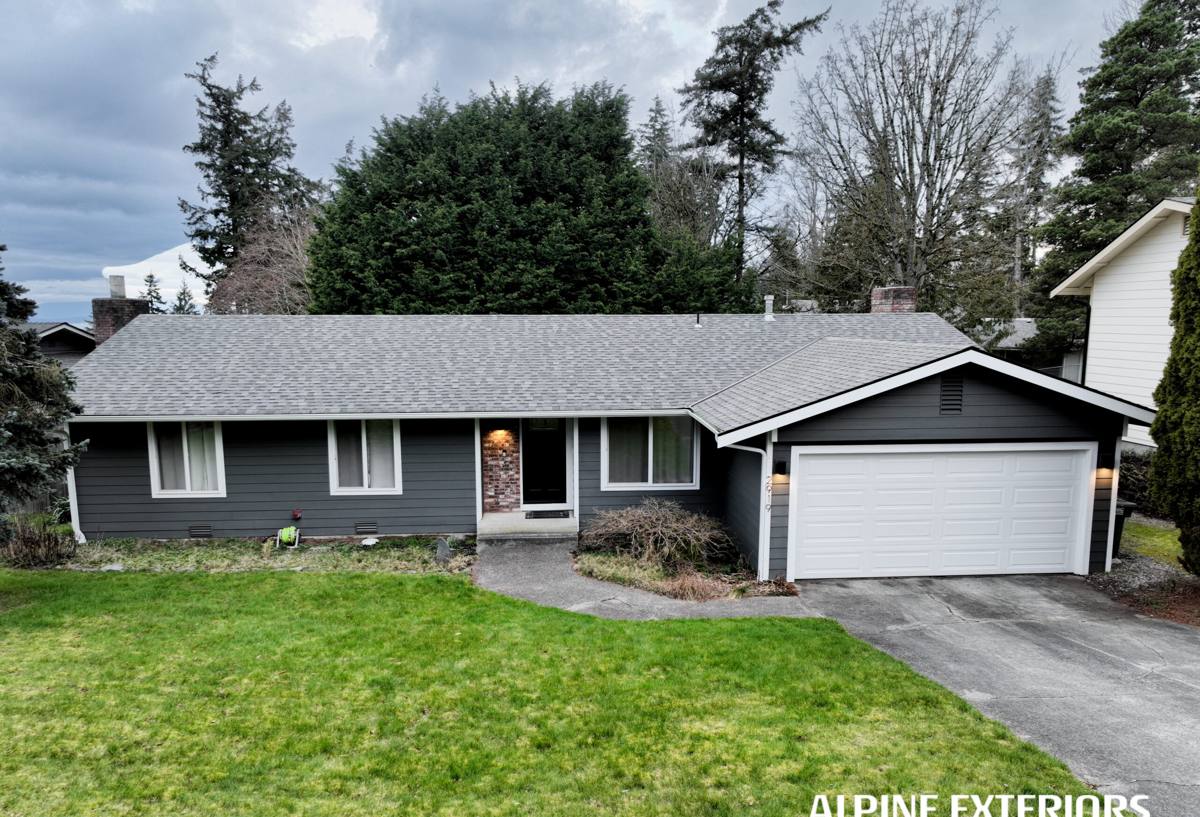
What Happy Valley's Climate Actually Does to Siding
It helps to be specific about the mechanisms, because "wet climate" undersells what's happening on a wall over 15 or 20 years.
Salt Air
Proximity to Bellingham Bay means airborne salt is a real factor here, even a mile or two inland. Salt accelerates corrosion on fasteners, trim flashing, and any exposed metal, and it degrades cheaper paint films faster than inland exposure would. Siding and fasteners rated for coastal or near-coastal use hold up; siding and hardware that weren't tend to show it first at the fasteners and edges.
Driving Rain
Bellingham doesn't get the heaviest rainfall totals in Washington, but wind-driven rain off the water pushes moisture sideways into laps, seams, and butt joints — the places where a siding installation either sheds water or lets it in. Products and installation details that work fine in a dry, still climate can underperform here specifically because of wind-driven exposure.
Moss and Algae Season
Between shade, humidity, and mild temperatures, Happy Valley's moss season runs long — often most of the year on north-facing walls and anywhere tree cover blocks sun and airflow. Moss and algae hold moisture against the siding surface, and on materials that absorb water or have a finish that can't stand up to repeated wet-dry cycling, that constant dampness accelerates rot, swelling, and finish failure.
None of this means Happy Valley is an unusually hostile place to own a home. It means the siding and installation details matter more here than they would somewhere drier, and cutting corners shows up faster.
Why We Install Only James Hardie Fiber Cement
We don't install vinyl, LP SmartSide, primed spruce, cedar, or other fiber cement brands. That's a deliberate standard, not a sales preference, and it's worth explaining plainly rather than just asserting.
Fiber cement as a category resists the specific failure modes this climate causes: it doesn't rot the way wood-based products can when moisture gets past the surface, it doesn't warp or buckle the way vinyl can with temperature swings and long-term UV exposure, and it holds a factory-applied finish far longer than field-applied paint on wood. Within fiber cement, James Hardie's HZ5 product line is engineered specifically for the kind of wet, freeze-thaw-adjacent Pacific Northwest climate Whatcom County sits in, and its ColorPlus finish is a baked-on, factory-controlled coating that resists the fade and chalking that field-painted siding shows after a few damp winters.
We also standardized on one manufacturer because installation quality and product quality only add up to a good result together. Mixing suppliers, using off-brand trim, or substituting fasteners to save money undermines the whole system — and on a home exposed to salt air and driving rain, that system either works as designed or it doesn't.
What a Correct Fiber Cement Installation Actually Involves
Fiber cement siding is only as good as the water management behind it. This is where most siding problems — on any brand, in any neighborhood — actually originate.
The Water-Resistive Barrier Comes First
Before a single board goes up, the wall needs a continuous, correctly lapped water-resistive barrier (housewrap or an equivalent), with seams taped and penetrations flashed. On a home taking wind-driven rain, this layer is the actual line of defense — the siding sheds most of the water, but the barrier behind it handles what gets through.
Flashing at Every Transition
Windows, doors, deck ledgers, roof-to-wall intersections, and any place where two materials meet need proper flashing, installed in the correct shingle-lap order so water is always directed outward and down. This is the single most common place we find shortcuts on older installs, and it's usually the point of origin when a homeowner finds soft sheathing behind otherwise fine-looking siding.
Fastening, Gaps, and Clearances
James Hardie specifies fastener type, spacing, and placement for a reason — under-driven or over-driven nails, wrong fastener material, or missing the stud can all create points where water gets behind the board. Boards also need the correct gap at butt joints and a minimum clearance from grade, decks, and roof lines so splash-back and standing water don't sit against the material.
Caulking and Paint Details
ColorPlus-finished Hardie board is designed to be touched up with a color-matched, factory-approved caulk and touch-up system at joints and fastener heads — not general-purpose caulk that yellows or fails under UV and moisture. Getting this detail right is part of why the finish holds up as long as it does.
Every one of these steps matters more in Happy Valley than in a dry climate, because the margin for error against wind-driven rain and prolonged dampness is smaller.
Signs Your Siding May Already Be Compromised
Because siding failure is usually gradual, it helps to know what to actually look for before it becomes a bigger repair:
- Soft or spongy spots when you press on the siding, especially near the bottom courses or under windows
- Paint that's peeling, bubbling, or chalking heavily rather than just fading evenly
- Persistent moss or algae growth that returns quickly after cleaning, particularly on shaded or north-facing walls
- Visible gaps, warping, or boards that have pulled away from the wall at seams or corners
- Staining or streaking below window sills, deck ledgers, or roof-to-wall intersections — a common sign of flashing failure
- A musty smell or visible mold on interior walls that back up to exterior siding
Any one of these on its own might be minor. Several together, or anything near a flashing point, is worth a professional look before it spreads to the sheathing underneath.
Our Process, Start to Finish
The estimate starts with an actual walk-around of the home, not a drive-by quote — we look at existing siding condition, flashing points, moisture indicators, and anything specific to the lot (shade cover, slope, drainage) that affects how the job should be detailed. From there:
- We assess and document existing conditions, including any areas of concern behind the current siding
- We remove old siding and inspect and repair sheathing as needed before anything new goes up
- We install or verify the water-resistive barrier and flash every window, door, and transition correctly
- We install James Hardie fiber cement per manufacturer specification — correct fasteners, gaps, and clearances
- We finish joints and fastener heads with the appropriate ColorPlus-compatible product
- We walk the finished job with the homeowner before calling it complete
Cost Factors for Happy Valley Siding Projects
Every home is different, but the variables that actually move the price are consistent. This isn't a quote — it's what to expect a real estimate to weigh:
| Factor | Why It Matters |
|---|---|
| Existing sheathing condition | Rot or moisture damage found during removal adds repair scope before new siding can go on |
| Home size and wall complexity | More corners, dormers, and trim detail mean more labor and material per square foot |
| Siding profile and Hardie product line | Lap width, texture, and HZ5 vs. standard specification affect material cost |
| Access and site conditions | Tree cover, tight lot lines, and grade changes common in Happy Valley can affect staging and labor time |
| Trim, flashing, and detail work | Windows, roof lines, and transitions require more time per linear foot than flat wall runs |
Why a Crew That Already Works Happy Valley Matters
Siding installation isn't just following a manual — it's applying that manual correctly to the specific conditions of the lot in front of you. A crew that regularly works this part of Bellingham already knows which walls take the worst wind-driven rain, where moss builds up fastest, and how shade patterns from mature trees affect drying time after a storm. That local pattern recognition shows up in small decisions — extra attention to a north wall's flashing, or clearance choices around a shaded foundation — that a crew working the area for the first time is more likely to miss.
It also means accountability doesn't end when the crew leaves. A local installer is the one you call if a question comes up two years later, and that's a different relationship than a company that installed your siding once and moved on to the next county.
Living With Fiber Cement Siding After Installation
James Hardie siding is low-maintenance, not no-maintenance — especially in a climate that grows moss on nearly everything given the chance. A periodic soft wash (not high-pressure blasting, which can damage the finish and drive water behind the boards) keeps moss and algae from taking hold, and an annual walk-around to check caulking at joints and fastener heads catches small issues before they become water intrusion. Beyond that, ColorPlus finish is designed to go a long time without repainting, which matters on a home where repainting means dealing with wet weather windows for the work itself.
If you're dealing with aging or failing siding in Happy Valley, or planning ahead for a home that's due, we're happy to take a look and walk you through what your home specifically needs. The estimate is free, there's no pressure, and you'll get a straight answer about condition and options — just fill out the form below to get started.