 Bellingham Exterior
 Building Decks for the Puget Area's Realities
A deck in the Puget area doesn't fail the way decks fail in drier parts of the country. It doesn't usually crack apart from sun exposure or dry out and split. Around Bellingham, decks fail quietly — a fastener corrodes below a railing post, moisture wicks into end grain that was never sealed, or a shaded north-facing section stays damp long enough for rot to take hold before anyone notices a problem. Salt-laden air off the Sound, long stretches of driving rain, and a moss season that can run most of the year all work against a deck that wasn't built with this specific climate in mind.
We build and repair custom decks for homeowners throughout the Puget area and greater Bellingham, and the approach we use here is different from what you'd spec for a deck in a dry inland climate. This page covers what that difference actually looks like — the materials, the details, and the process — so you know what to ask for and why it matters.
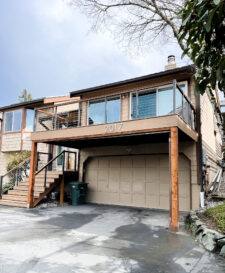
What Coastal Whatcom County Weather Does to a Deck
Salt Air and Corrosion
Proximity to Puget Sound means airborne salt is a constant, low-level factor even on properties that aren't waterfront. Salt accelerates corrosion in fasteners, brackets, and any exposed metal hardware. A deck built with the wrong grade of screw or a bargain joist hanger can start showing rust bleed and weakened connections years before the decking itself shows any wear. This is one of the most common issues we find on older decks in this area — the boards look fine, but the hardware holding it together is failing underneath.
Driving Rain and Water Intrusion
Rain here doesn't just fall straight down — wind-driven rain gets pushed sideways into ledger boards, under railing caps, and into any gap that wasn't properly flashed or sealed. Water that gets behind a ledger board where the deck attaches to the house is one of the most serious and least visible problems a deck can develop, because it can rot both the deck framing and the house's wall framing at the same time.
Moss, Algae, and a Long Damp Season
Bellingham's moss season stretches long, and shaded or low-airflow areas of a deck — under stairs, along the north side of a house, near fences or dense landscaping — can stay damp for weeks. Moss and algae hold moisture against the decking surface, and on wood decking that moisture leads to soft, slippery boards and eventually rot. On any decking material, a moss-covered surface is also a slip hazard, which matters on stairs and landings especially.
Choosing the Right Decking Material for a Puget Property
There's no single "best" decking material — the right choice depends on how much maintenance you want to take on, your budget, and how much shade and moisture exposure your specific site gets. Here's how the common options compare for this climate specifically:
| Material | Moisture & Moss Behavior | Maintenance | Typical Lifespan Here |
|---|---|---|---|
| Pressure-treated wood | Absorbs water at cut ends and fastener holes; needs sealing to resist moss staining | Annual cleaning and re-sealing recommended | 10–15 years with upkeep |
| Cedar | Naturally moisture- and rot-resistant, but softer surface holds moss if not cleaned | Periodic cleaning, occasional oil or sealant | 15–20 years with upkeep |
| Capped composite | Doesn't absorb moisture into the board; moss sits on the surface and rinses off easily | Occasional rinsing, no sealing or staining | 25+ years, manufacturer-warrantied |
| PVC decking | Fully moisture-resistant; best option for consistently shaded, damp areas | Lowest maintenance of the group | 25+ years, manufacturer-warrantied |
We'll walk your specific site with you before recommending a material. A deck that gets afternoon sun and good airflow has more flexibility than a shaded, north-facing deck tucked against trees — the second scenario is where we push harder for a low-absorption material, because no amount of homeowner diligence beats a board that simply doesn't hold water.
What a Correctly Built Deck Involves Here
Ledger Attachment and Flashing
Where the deck ties into the house is the single highest-risk point for hidden water damage. Correct practice means proper flashing that directs water away from the ledger board and the house's wall sheathing behind it — not caulk alone, which degrades over time and gives a false sense of a seal.
Framing and Fasteners
In a salt-air environment, we spec fasteners and structural hardware rated for corrosion resistance — stainless steel or heavy hot-dip galvanized, not the lighter coated fasteners that are adequate in drier inland regions but underperform here. The same goes for joist hangers, post bases, and any structural connector.
Drainage and Airflow Underneath
A deck built low to the ground with poor airflow underneath traps moisture and speeds up rot in the framing, even if the surface boards are a low-maintenance material. Proper grading beneath the deck, adequate clearance, and in some cases a drainage or under-deck water management system keep that space from becoming a permanent damp pocket — which also happens to be where moss and mildew get their start.
Footings for Local Soil and Frost Conditions
Footing depth and design need to account for local frost line requirements and the soil conditions on your specific lot. This is also where Whatcom County permitting and inspection requirements come in — footings are typically inspected before the deck structure goes up, and getting this step wrong means costly rework later.
Railings, Stairs, and Hardware That Hold Up Long-Term
Railings and stair components take the most direct weather exposure on a deck and are also the parts most affected by corroding hardware, since a failing post connection is a safety issue, not just a cosmetic one. We use fastener and bracket grades matched to coastal exposure on every railing post and stair stringer connection, and we pay particular attention to end-grain sealing on any wood component, since that's where water gets in fastest.
Stair treads deserve their own mention: they're the part of a deck most likely to collect standing water and moss, and the part where a slip has the highest consequence. We build stairs with drainage and material choices that account for that, not just the flat deck surface.
Our Process for a Puget-Area Deck Project
- Site assessment — we look at sun exposure, drainage, existing structure (for replacements), and how the deck ties into your house.
- Design and material selection — sized and laid out for how you actually use the space, with material recommendations based on the shade and moisture profile of your specific site.
- Permitting — we handle the permit and inspection process required for deck construction in this area, including footing and framing inspections.
- Construction — proper ledger flashing, corrosion-resistant hardware throughout, correct footing depth, and attention to drainage and airflow underneath the structure.
- Final walkthrough — we go over the finished deck with you, including what maintenance (if any) your chosen material needs going forward.
Living With a Deck Through a Long Moss Season
Even a well-built deck needs some seasonal attention in this climate. What that attention looks like depends heavily on the material you chose:
- Sweep debris and standing organic matter (leaves, needles) off the deck surface regularly — it holds moisture and feeds moss growth.
- Rinse or lightly scrub moss and algae off the surface before it gets established, especially on shaded sections and stair treads.
- Check railing posts and stair connections annually for any looseness, which can signal a corroding fastener underneath.
- Keep gutters and downspouts near the deck clear so runoff isn't draining directly onto or under the structure.
- On wood decking, plan on re-sealing or re-staining on the schedule appropriate to the product — skipping this is the most common reason wood decks age poorly here.
- Trim back landscaping that's shading the deck and cutting off airflow, where practical.
None of this is difficult, but it's the difference between a deck that looks and performs well for decades and one that starts showing problems within a few years.
Why Local Experience on This Specific Job Matters
A contractor who builds decks in a dry climate and applies the same specs here is setting the deck up to underperform — the fastener grade, the ledger flashing detail, and the material recommendation all need to reflect what Bellingham and the wider Whatcom County coastline actually put a structure through. Working regularly in the Puget area also means familiarity with the local permitting process and typical site conditions, which keeps a project moving instead of stalling on avoidable inspection issues.
We build decks that are sized and detailed for this climate from the start, not decks that need "coastal upgrades" bolted on after the fact.
Get a Free Estimate
If you're planning a new deck or need to replace one that's showing its age, we're happy to take a look and give you an honest, no-pressure assessment of what your site needs. Use the form below to request a free estimate for your Puget-area deck project.