 Bellingham Exterior
 Siding Installation for South Hill Homes
South Hill sits up above the flats of Bellingham, close enough to the bay to catch salt-laden wind off the water and shaded by enough mature trees to make moss a year-round conversation rather than a seasonal one. Homes here take a different kind of weather beating than a house a mile inland, and the siding on them needs to be installed with that specific exposure in mind — not treated the same as a generic Whatcom County job.
This page covers what siding installation actually looks like for a South Hill property: what the climate does to the wrong materials or the wrong install, what a correct job involves from the framing out, and why we only put James Hardie fiber cement on the homes we work on.
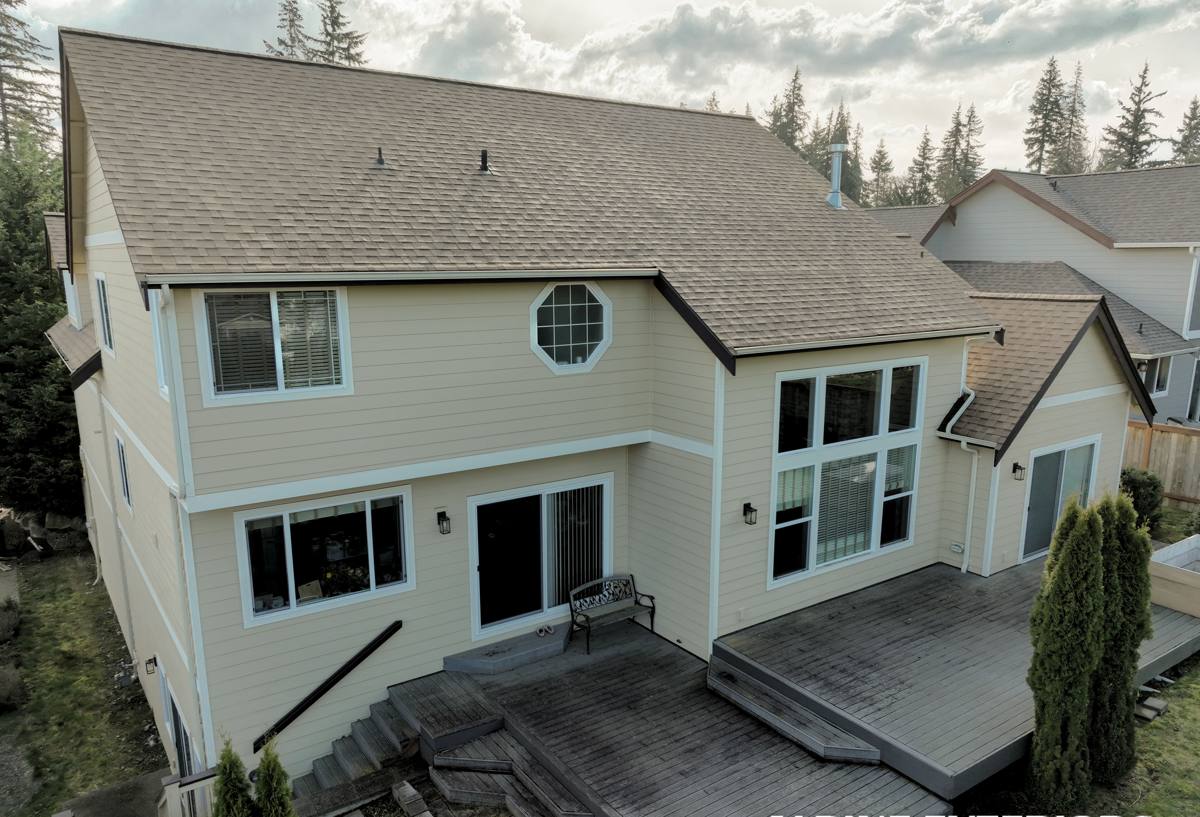
What South Hill's Climate Does to Siding
Three things define siding performance on this hill, and they compound each other.
Salt Air
Proximity to Bellingham Bay means airborne salt settles on exterior surfaces, especially on homes with more open exposure toward the water. Salt is corrosive to fasteners and hard on paint films — it accelerates the breakdown of finishes that aren't engineered to resist it, and it's part of why we pay close attention to fastener spec and factory-applied finishes rather than field-painted ones.
Driving Rain
Bellingham's rain doesn't just fall straight down — wind off the water and up the hill pushes it sideways into wall assemblies, testing every seam, lap, and penetration in the siding system. A house can look fine for years and still have water working its way behind the cladding if the flashing and overlap details weren't done right the first time.
Moss Season
Tree cover on much of South Hill keeps shaded wall sections damp for longer stretches than sun-exposed walls, which is exactly the environment moss and algae need to take hold. On the wrong siding material, that sustained moisture leads to swelling, soft spots, or paint failure. On the wrong installation — tight clearances, no drainage gap, siding buried in soil or mulch — it accelerates rot regardless of the material.
None of these three problems are dramatic on their own. Together, over enough winters, they're what separates a siding job that looks good for five years from one that holds up for thirty.
What a Correct Siding Installation Actually Involves
Siding is a system, not a single layer. A homeowner comparing quotes should understand that the visible board is the last of several steps, and skipping or rushing the earlier ones is where most premature failures start.
- Sheathing inspection and repair — any rot, delamination, or soft spots found when the old siding comes off get addressed before anything new goes up, not covered over.
- Weather-resistive barrier — a correctly lapped and taped water/air barrier installed shingle-style so water sheds down and out, never trapped behind the cladding.
- Flashing at every penetration — windows, doors, hose bibs, vents, and roof-to-wall transitions all get proper flashing so water is directed away from the wall assembly, not into it.
- Drainage gap — a rainscreen or furring strategy that lets any moisture that does get behind the siding drain and dry out instead of sitting against the substrate.
- Correct fastening — manufacturer-specified nail type, placement, and depth, adjusted for South Hill's exposure and the specific Hardie product being installed.
- Proper clearances — siding held up off grade, decks, patios, and roof lines per manufacturer minimums so it isn't wicking moisture from the ground or holding water at transitions.
Every one of these steps is invisible once the job is finished. That's exactly why the crew doing them matters more than the brand name on the piece of siding.
Why James Hardie Is the Only Siding We Install
We install James Hardie fiber cement exclusively. We don't do vinyl, LP SmartSide, Cemplank, Allura, primed spruce, or cedar, and that's a deliberate standard, not a lack of options.
Fiber cement is non-combustible and dimensionally stable in a way wood-based and engineered-wood products aren't — it doesn't swell, cup, or delaminate the way products with a wood or wood-fiber core can when they take on moisture over years of Pacific Northwest weather. James Hardie's ColorPlus factory finish is baked on under controlled conditions and backed by its own finish warranty, which matters directly on a site like South Hill where field-applied paint has to fight salt air and prolonged damp shade from day one.
Hardie also builds region-specific product engineering — its HZ5 line is formulated for the freeze-thaw and moisture patterns of the Pacific Northwest, which is the actual climate zone South Hill sits in. That's a meaningful difference from a generic siding product sold the same way in every region of the country.
We're not suggesting other products can't be installed correctly by someone. We're saying that after years of doing this work in this climate, we standardized on the one product line that gives homeowners the best combination of fire resistance, moisture performance, finish durability, and a strong transferable warranty — and we'd rather install one thing exceptionally well than several things adequately.
Our Installation Process
1. Site Walk and Assessment
We look at the home's exposure — how much direct sun it gets, how close it sits to mature trees, which walls face the water or prevailing wind — and use that to inform product selection, trim details, and drainage strategy before we ever price the job.
2. Removal and Substrate Check
Old siding comes off and the sheathing underneath gets inspected. On older South Hill homes this step regularly turns up moisture damage around old penetrations or at grade level that wasn't visible from outside — we address it before continuing rather than sealing it in.
3. Water Management Layer
Weather-resistive barrier, flashing, and drainage gap go in per manufacturer spec, with extra attention to any wall section that sits in shade for most of the day or takes wind-driven rain directly.
4. Hardie Installation
Boards, panels, or shingles are cut, fastened, and fitted to manufacturer specification — correct fastener pattern, correct clearances, correct caulking only where Hardie's install guide actually calls for it.
5. Trim, Caulk, and Final Detail
Trim work and sealant at transitions are finished last, and we walk the whole exterior looking specifically at the details that fail first in this climate: bottom clearances, deck and roof intersections, and anywhere two materials meet.
Hillside Detail Work That Matters
Homes on a shaded, sloped lot need a few things a flat, sun-exposed lot doesn't. This isn't an exhaustive list of every job condition, but it's where we spend extra attention on South Hill specifically.
| Condition | Why It Matters Here | What We Do |
|---|---|---|
| Tree-shaded walls | Stay damp longer, feed moss and algae growth | Confirm drainage gap and clearances are correct; discuss trim-back with homeowner where relevant |
| Grade and landscaping contact | Sloped lots often have soil, mulch, or plantings pushed against the wall | Hold siding to manufacturer minimum clearance from grade and hardscape |
| Wind exposure toward the bay | Salt air and driving rain hit these walls harder | Extra attention to flashing laps and fastener spec on exposed elevations |
| Older original construction | Sheathing and framing may have decades of prior moisture exposure | Full substrate inspection and repair before new siding goes up |
What Siding Installation Costs on South Hill
We don't publish flat pricing because every home's size, trim complexity, substrate condition, and product selection changes the number — but these are the real factors that move a South Hill quote up or down.
| Factor | How It Affects the Job |
|---|---|
| Substrate condition | Rot or moisture damage found under old siding adds repair scope before install can start |
| Home size and wall complexity | More corners, dormers, and trim detail means more labor per square foot |
| Product selection | Lap siding, shingle-style panels, and board-and-batten carry different material and labor costs |
| Access and lot slope | Steeper South Hill lots can require more staging and setup time |
| Trim and finish detail | Custom trim packages and color-matched accessories add cost over a standard trim spec |
Signs Your South Hill Home Needs New Siding
Some of these show up gradually enough that homeowners live with them for years before calling anyone. Worth a look if any apply to your house:
- Visible moss or algae staining on shaded walls that keeps returning after cleaning
- Soft spots, bubbling, or a flexing feel when you press on the siding
- Paint that's peeling, chalking, or failing faster than it should
- Visible gaps, warping, or boards separating at the seams
- Rising utility bills that suggest air or water infiltration behind the wall
- Siding sitting flush against soil, mulch, or hardscape with no visible clearance
Any one of these on its own might be minor. Several together, especially on a shaded or bay-facing wall, usually mean the water management behind the siding has already been compromised.
Why Hiring a Crew That Already Works This Neighborhood Matters
South Hill's mix of mature tree cover, elevation, and proximity to the bay creates exposure conditions that don't show up the same way on a flat, sun-exposed lot elsewhere in Whatcom County. A contractor who's done this work on the hill already knows which elevations need extra flashing attention, which lots hold moisture longest, and where original construction on older homes tends to have hidden substrate issues. That's not something you can fully substitute with a generic install checklist — it comes from having actually done the work on comparable homes in this specific setting.
It also matters for follow-through. A crew that plans to keep working in this neighborhood has a direct incentive to get the water management right the first time, because callbacks and reputation both travel fast in a tight-knit area.
Get a Free Estimate
If your South Hill home's siding is showing wear, or you're planning ahead for a replacement, we're happy to take a look and walk you through what your specific house and exposure actually need. The estimate is free, there's no pressure, and you'll get a straight answer about condition, scope, and options — use the form below to get started.