 Bellingham Exterior
 Sunnyland sits close enough to Bellingham Bay that salt-laden air reaches nearly every roof in the neighborhood, and it sits far enough into the Pacific Northwest's wet belt that moss has all winter and spring to get established. Add in the driving rain that comes sideways off a southwest wind during a fall storm, and you've got a roofing environment that punishes anything installed with shortcuts. Metal roofing, done correctly, handles all three of these conditions better than most alternatives — but "done correctly" is doing a lot of work in that sentence, and it's where a lot of installations in this area fall short.
This page covers what a metal roof actually needs to perform well on a Sunnyland home, what a correct installation looks like, and why local installation experience matters as much as the material choice itself.
Why Sunnyland's Climate Is Tougher on Roofs Than It Looks
Sunnyland isn't a coastal neighborhood in the dramatic sense, but it's close enough to the bay and Whatcom County's marine air that salt exposure is a real factor, not a theoretical one. Salt air accelerates corrosion at fasteners, flashing seams, and any point where dissimilar metals meet. It's slow and unglamorous — nothing fails in year one — but it's exactly the kind of thing that separates a roof that looks fine at year eight from one that's showing rust streaks and failing seams.
Layer on top of that the region's rainfall pattern: long stretches of steady rain rather than short intense downpours, punctuated by wind-driven storms that push water sideways under laps and around penetrations that would stay dry in a calmer climate. And because Bellingham winters stay cool and damp for months at a time, north-facing slopes and shaded areas under trees rarely get a chance to fully dry out. That's exactly the environment moss and lichen prefer, and once established, moss holds moisture against the roof surface and works into any seam or fastener that isn't sealed properly.
None of this makes metal roofing a bad choice for Sunnyland — it's actually one of the better-suited materials for this climate. But it does mean the installation details matter more here than they would in a drier region.
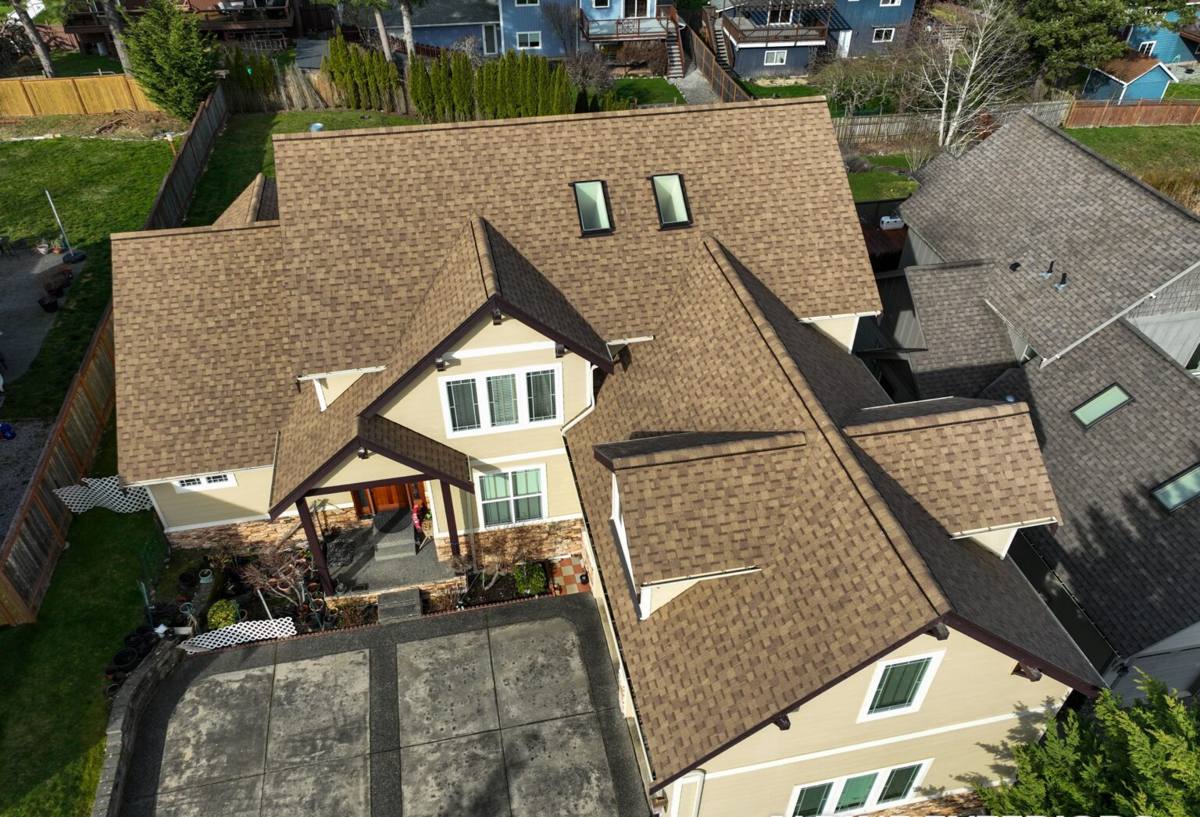
What a Correct Metal Roof Installation Involves
Underlayment and Moisture Barrier
A metal roof is only as good as what's underneath it. In a wet climate like Whatcom County's, we use synthetic or high-temp ice-and-water underlayment at eaves, valleys, and around every penetration — not just because code may call for it, but because those are the exact spots where wind-driven rain and ice dams (on the rare cold snap) find a way in. Skipping or skimping on underlayment is one of the most common shortcuts we see on older or budget installations, and it's invisible until the leak shows up inside the house.
Fastener and Flashing Compatibility
Galvanic corrosion — where two dissimilar metals in contact with each other accelerate rust — is a real risk near salt air. Every fastener, flashing piece, and trim component needs to be compatible with the panel metal, not just whatever's convenient or cheapest on the truck that day. This is a detail that's easy to get wrong and expensive to fix later, since it usually shows up as pinpoint rust stains working outward from fastener heads.
Panel Seams and Water Path
Standing seam profiles are built around the idea that water runs down the panel and off the roof without ever needing a sealant to stay out. That's part of why they perform so well in heavy-rain climates. Exposed-fastener panel systems can also work well, but they rely more on gaskets and sealant staying intact over time — which means more maintenance attention as the roof ages, especially with the freeze-thaw cycling and UV exposure Bellingham roofs see across a full year.
Ventilation
Metal roofs shed heat differently than asphalt, and proper attic ventilation keeps moisture from condensing on the underside of the deck — a problem that's worse in a consistently damp climate like this one. We check ventilation as part of any metal roof installation or tear-off, not just the panel work itself.
Metal Roofing Panel Types We Work With
| Panel Type | Best Suited For | Maintenance Considerations |
|---|---|---|
| Standing Seam | Homes wanting the longest service life and cleanest water-shedding profile | Low — concealed fasteners, minimal sealant dependency |
| Exposed-Fastener Panel | Budget-conscious projects, outbuildings, simpler rooflines | Moderate — fastener gaskets and sealant should be inspected periodically |
| Stone-Coated Steel | Homeowners wanting a shake or tile appearance with metal's durability | Low to moderate — coating integrity matters near salt air |
We'll walk through which profile fits your roofline, budget, and the specific exposure your home has to wind, salt air, and shade — a roof tucked under mature trees on a north slope has different priorities than one on an open, wind-exposed elevation just a few blocks away.
Moss: Prevention Matters More Than Removal
Moss doesn't damage metal roofing the way it damages asphalt shingles, but it's not harmless either. Moss holding moisture against seams, fasteners, and flashing accelerates the exact corrosion process that salt air already starts. On a metal roof, the goal is prevention — keeping panels clean and reducing organic buildup — rather than aggressive removal after the fact, since scraping or pressure-washing can scratch protective coatings and create the very entry points you're trying to avoid.
Zinc or copper strips at the ridge, proper overhangs that limit standing debris, and periodic gentle cleaning go a lot further than reactive moss treatment. This is part of what we cover during a site walk — every Sunnyland roof has a slightly different exposure to shade and debris depending on the trees around it.
Our Process for a Sunnyland Metal Roof Project
- On-site assessment — we look at your existing roof structure, decking condition, ventilation, and specific exposure (wind direction, shade, proximity to the bay).
- Panel and profile selection — matched to your roofline, budget, and the corrosion/moss factors specific to your property.
- Tear-off and deck inspection — we don't cover up rotten or compromised decking; it gets addressed before anything new goes on.
- Underlayment and flashing installation — built for this climate's rain patterns, not a generic spec.
- Panel installation — with fastener and flashing compatibility checked at every transition.
- Final walkthrough — we go over maintenance basics with you, including what to watch for as the roof ages.
What to Ask Before Hiring a Metal Roofing Crew
- Have they installed metal roofing on homes in this specific area, with this specific salt and moisture exposure?
- Do they specify corrosion-compatible fasteners and flashing, or use whatever's standard stock?
- What underlayment do they use at eaves, valleys, and penetrations — and why?
- How do they handle ventilation as part of the roofing scope, not as an afterthought?
- Can they explain the trade-offs between panel types honestly, rather than pushing one option?
- What does their warranty actually cover — material only, or workmanship too?
Why Local Installation Experience Matters Here
A metal roof installed to a generic national spec will often survive just fine in a mild, dry climate. Bellingham isn't that climate. The combination of salt air off the bay, sustained rainfall, and a moss season that runs most of the year means the details — fastener compatibility, underlayment placement, ventilation, seam design — carry more weight here than they would somewhere drier. A crew that's worked on roofs throughout Whatcom County, including neighborhoods like Sunnyland with this specific mix of exposure, knows which corners never to cut and which upgrades are worth the cost versus which ones aren't necessary for your particular property.
That's the difference between a metal roof that still looks and performs well after fifteen or twenty years of Pacific Northwest weather, and one that starts showing rust streaks and seam failures well before it should.
Cost Factors to Expect
| Factor | Why It Affects Cost |
|---|---|
| Panel type and gauge | Standing seam and heavier-gauge steel cost more upfront but reduce long-term maintenance |
| Roof complexity | Valleys, dormers, and multiple penetrations add labor and flashing detail |
| Tear-off vs. overlay | Full tear-off allows deck inspection and repair, which overlays skip |
| Ventilation upgrades | Older homes often need ventilation improvements as part of the reroof |
| Access and pitch | Steeper or harder-to-access roofs take more time and equipment |
We give straightforward, itemized estimates rather than a single number with no explanation, so you understand exactly what you're paying for and why.
If you're weighing a metal roof for your Sunnyland home, we're happy to walk the roof with you, talk through what your specific exposure calls for, and give you a free, no-pressure estimate — use the form below to get started.