 Bellingham Exterior
 Why Barkley Roofs Take a Different Kind of Beating
Barkley sits close enough to the water and to the tree cover around it that roofs here deal with a specific combination most inland homes never see: salt-laden air drifting in off Bellingham Bay, long stretches of driving rain through fall and winter, and shade patterns that keep parts of a roof damp for days after a storm passes. None of these things alone is unusual for Whatcom County. Together, on the same roof, year after year, they shorten the life of materials that aren't built to handle all three at once.
Asphalt shingles in this kind of environment tend to show their age early — granule loss from constant moisture cycling, moss taking hold in shaded valleys and north-facing slopes, and edges that curl once they've absorbed enough water over enough winters. Metal roofing doesn't eliminate the climate, but it changes how a roof responds to it. That's the case for metal in Barkley specifically, not as a universal upgrade, but as a good match for what this particular neighborhood's weather actually does to a roof.
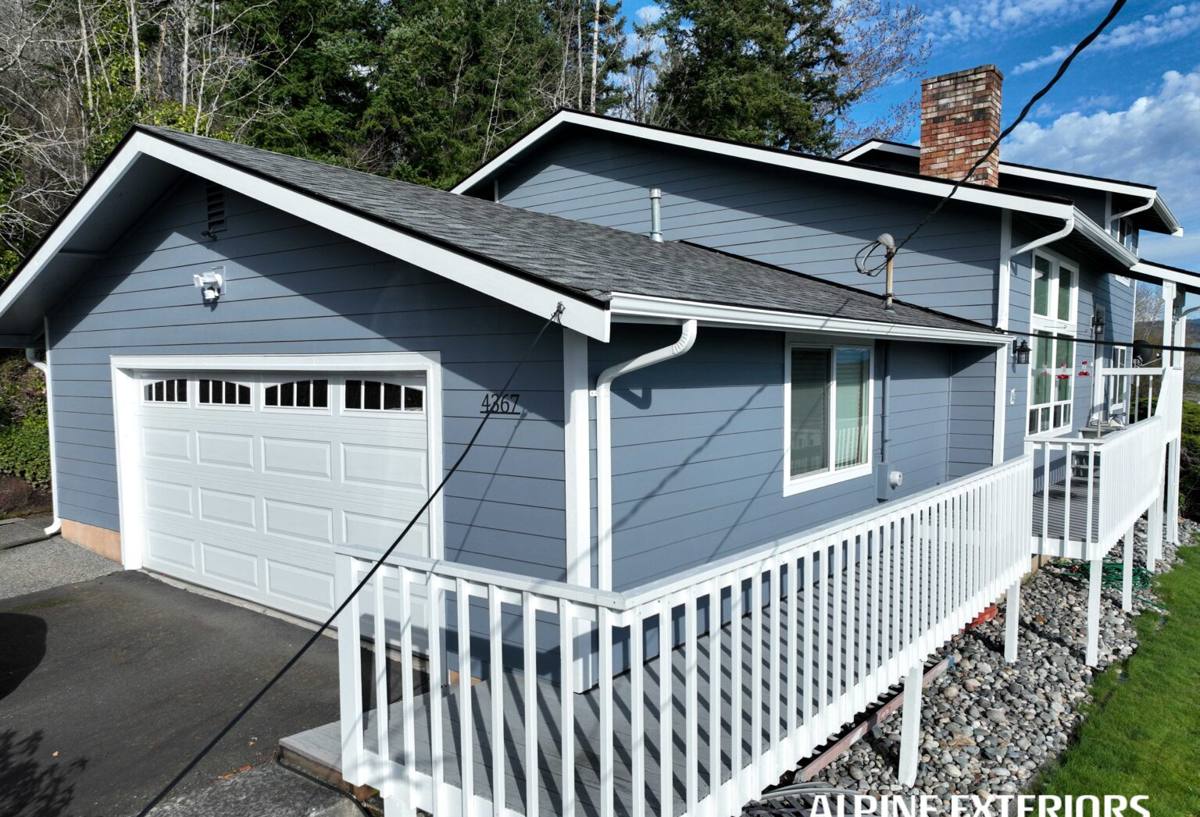
What Metal Roofing Solves for This Neighborhood
Moss and Standing Moisture
Moss needs three things to establish itself: shade, organic debris, and a surface it can grip. Shingle roofs give it all three — the granular texture holds spores and grit, and the material itself absorbs enough moisture to stay damp long after the rain stops. A properly installed metal roof sheds water fast and dries quickly because the surface itself doesn't hold moisture. Moss can still land on a metal roof if debris piles up in valleys or against a chimney, but it has nothing to root into. Regular debris clearing keeps it from ever getting a foothold.
Wind-Driven Rain
Storms coming off the water don't just drop rain straight down — wind pushes it sideways, under shingle tabs, and into any gap in flashing or fastening. A metal roofing system with properly lapped panels, sealed seams, and correctly installed flashing at every penetration handles wind-driven rain far better than a shingle roof relying on gravity and adhesive strips that can lose their bond over time.
Long-Term Salt Exposure
Salt air is corrosive to unprotected metal, which is exactly why panel choice and fastener quality matter more here than they would on a roof twenty miles inland. This isn't a reason to avoid metal roofing — it's a reason to be specific about which coatings and fasteners we use on a Barkley job versus a job further from the water.
Standing Seam vs. Exposed-Fastener Panels
Not all metal roofing is the same system, and the two most common options for Barkley homes perform differently in this climate.
| Factor | Standing Seam | Exposed-Fastener |
|---|---|---|
| How panels attach | Hidden clips under raised seams — no exposed screws | Screws driven through the panel face into decking |
| Weather sealing | Mechanically locked seams shed water without sealant | Relies on rubber-washered screws that can loosen or wear over time |
| Coastal durability | Better long-term performance near salt air since fasteners aren't exposed | Fasteners need periodic inspection and occasional re-torquing or replacement |
| Upfront cost | Higher material and labor cost | More affordable, especially on outbuildings and simpler rooflines |
| Best fit | Primary residences, complex rooflines, long-term ownership | Garages, shops, budget-conscious projects with simpler geometry |
We'll walk through both honestly during an estimate. Exposed-fastener systems aren't a lesser product — they're a different trade-off, and for some Barkley properties they're the right call.
What a Correct Metal Roof Installation Actually Involves
Metal roofing fails prematurely almost exclusively because of installation shortcuts, not the material itself. A correct job on a Barkley home includes:
- Deck inspection and repair before anything goes down — metal panels won't hide a soft or uneven substrate, they'll telegraph it
- A synthetic underlayment rated for high-moisture climates, not the minimum felt some crews default to
- Ice-and-water shield or equivalent membrane at eaves, valleys, and any low-slope transition where water lingers
- Panel fastening or seaming matched to the local wind exposure, not a generic spec sheet
- Custom-formed flashing at every chimney, skylight, vent pipe, and wall intersection — pre-bent stock flashing is where most leaks start
- Proper attic or roof-deck ventilation so condensation doesn't build up underneath the panels
- Fasteners and trim rated for coastal exposure, matched to the panel material to avoid galvanic corrosion between dissimilar metals
Any one of these skipped can undercut the whole system. A roof can look finished from the ground and still be one missed flashing detail away from a leak two winters later.
Our Process for a Barkley Job
1. On-Site Assessment
We look at the whole roof system, not just the surface — decking condition, existing ventilation, how water currently moves off the roof, and where shade and debris are likely to cause problems. We'll point out anything specific to your home's exposure, whether that's a shaded north slope prone to moss or a section that takes the brunt of storms coming off the water.
2. A Straight Written Estimate
You'll get a clear breakdown of panel system, gauge, coating, and what's included in flashing and ventilation work — not a vague lump sum. We'll explain trade-offs in plain terms if there's a decision to make, like standing seam versus exposed-fastener for your specific roofline and budget.
3. Tear-Off, Deck Repair, and Install
We remove the old roofing down to the deck, replace any damaged sheathing, and install underlayment and flashing before panels go up. Nothing gets covered until it's done right, because once panels are on, deck and flashing issues are expensive to revisit.
4. Final Walkthrough
Before we consider the job finished, we walk the roof and the property with you, cover basic maintenance expectations for this climate, and make sure everything matches what was in the estimate.
Cost Factors on a Barkley Metal Roof
Every roof is different, but these are the variables that move the price most on jobs in this area:
| Factor | Why It Matters |
|---|---|
| Roof pitch and complexity | Steep or cut-up rooflines with multiple valleys and dormers take more labor and flashing work |
| Panel system | Standing seam costs more upfront than exposed-fastener panels, largely due to labor |
| Deck condition | Rot or soft sheathing found during tear-off adds repair cost that can't always be quoted sight-unseen |
| Coating and gauge | Heavier gauge and marine-grade coatings cost more but hold up longer against salt air |
| Tear-off vs. overlay | Full tear-off costs more than an overlay but is usually the right call on an older roof with hidden moisture damage |
| Access and site conditions | Steep lots, mature trees, or limited driveway access can affect setup and disposal costs |
We don't quote a price without seeing the roof, but we'll give you a realistic range and explain exactly what's driving it.
Living With a Metal Roof Through Moss Season
A metal roof cuts down maintenance significantly, but it isn't zero-maintenance. In Whatcom County's wetter months, debris still collects in valleys and against any vertical surface — a chimney, a wall intersection, a skylight curb. Left alone, that debris holds moisture and gives moss and lichen the organic material they need even on a surface they can't root into directly. Clearing debris once or twice a year, especially after fall leaf-drop and before the heaviest winter rains, keeps a metal roof performing the way it's designed to. Gutters matter just as much — a metal roof sheds water quickly, and a clogged gutter turns that efficiency into overflow at the fascia.
Why a Crew That Already Works Barkley Matters
Metal roofing done wrong is worse than no upgrade at all — it can trap moisture, corrode fasteners early, or leak at flashing points that look fine until they don't. A crew that regularly works in Bellingham's coastal microclimates knows which details can't be skipped here: the underlayment spec that makes sense for this rain pattern, the flashing approach that holds up against wind off the bay, the fastener and coating choice that won't corrode early in salt air. That local pattern recognition is the difference between a roof that's still solid in fifteen years and one that needs flashing repairs after the first few hard winters.
We're not asking you to take that on faith. Ask any contractor bidding your roof how they'd handle flashing at a chimney in a high-wind, high-rain exposure, or what coating they'd spec for a roof this close to the water. The answer tells you a lot about whether they've actually worked this kind of job before.
Get a Straight Answer for Your Roof
If you're weighing metal roofing for a home in Barkley, we're glad to take a look and give you an honest read on what your roof actually needs — no pressure, no inflated urgency. Use the form below to request a free estimate, and we'll walk the roof, answer your questions, and give you a clear, itemized quote.