 Bellingham Exterior
 Why Barkley Roofs Wear Differently Than Roofs Inland
Barkley sits close enough to Bellingham Bay and the wooded corridors around Whatcom Falls Park that its homes deal with a specific combination of stresses most inland Whatcom County properties never see. You get salt-laden air moving in off the water, long stretches of driving rain that comes in sideways more often than straight down, and heavy tree cover that keeps roof surfaces shaded and damp well after a storm has passed. None of these things alone is unusual for Western Washington. Together, on a consistent basis, they shorten the useful life of a poorly installed roof and accelerate problems on an aging one.
A new roof installation in this neighborhood isn't just a matter of swapping old shingles for new ones. It's an opportunity to correct whatever the original roof got wrong and to build in the details that actually matter for this specific stretch of Bellingham — proper ventilation, the right underlayment strategy, and flashing work that won't fail the first time wind-driven rain gets pushed uphill under a shingle edge.
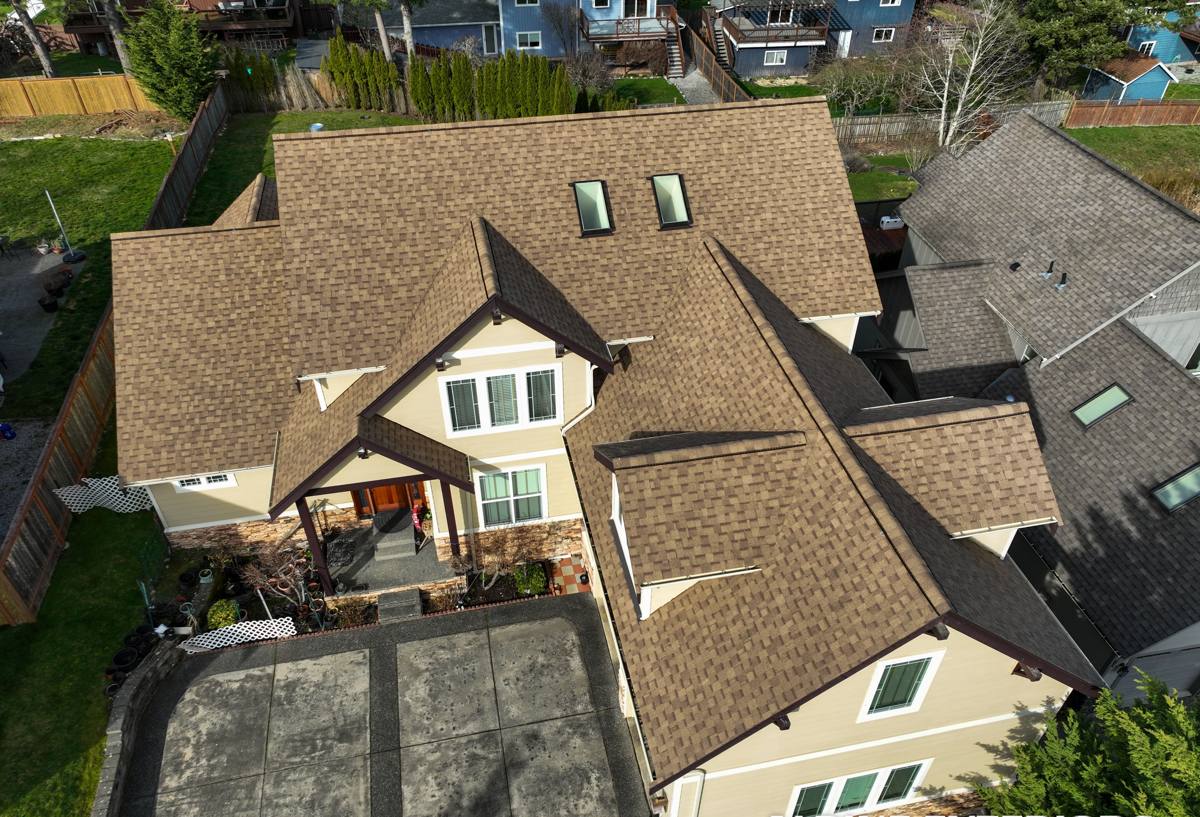
What Bellingham's Climate Actually Does to a Roof
Moss and Sustained Moisture
Whatcom County's moss season isn't a few weeks in spring — on shaded, north-facing, or tree-covered roof sections it can run most of the year. Moss holds moisture against the roofing material long after the surrounding air has dried out, which softens shingle mat, degrades granule adhesion, and on older wood or poorly ventilated roofs, can work its way under tabs and into the deck itself. Homes in Barkley with mature landscaping or proximity to tree cover tend to see this show up faster than homes in more open, sun-exposed parts of the city.
Wind-Driven Rain
Rain that falls straight down is relatively easy to shed. Rain that's being pushed sideways by wind coming off the bay is a different problem — it finds its way under shingle tabs, around vent boots, and into any flashing detail that was installed to code minimums instead of installed correctly. This is the single biggest reason a "fine on paper" roof leaks in this area while an identical roof inland stays dry.
Salt Air and Metal Components
Even a few miles from the water, airborne salt accelerates corrosion on exposed metal — flashing, fasteners, vent caps, and gutter hardware. Standard galvanized fasteners and mill-finish flashing hold up fine in a lot of the country. Closer to Bellingham Bay, they can start showing rust streaks and pitting years before they would elsewhere, which is why material choice at every metal touchpoint matters more here than a generic spec sheet would suggest.
Signs a Barkley Home Needs Replacement, Not Another Repair
Repairs make sense when a roof is fundamentally sound and the problem is isolated. Replacement makes sense once the damage is spread out or the roof is old enough that fixing one area just shifts attention to the next. Before we recommend a full new roof, we look for:
- Granule loss heavy enough to see bald patches or granules collecting in gutters
- Shingles that are curling, cracking, or lifting at the edges across multiple roof planes
- Moss or algae growth that's returned quickly after a previous cleaning
- Soft spots, sagging, or visible deflection when walking the roof deck
- Daylight visible through the roof deck from inside the attic
- Water staining on interior ceilings or in the attic, especially near valleys or chimneys
- Flashing that's rusted, separated, or was never properly integrated with the roofing material
- A roof already at or past the manufacturer's expected service life for this climate
If a roof shows two or three of these signs in isolated spots, a repair is often still the right call. When they're showing up across the whole roof, patching individual areas usually costs more over a few years than doing the job right once.
What a Correct New Roof Installation Actually Involves
Tear-Off and Deck Inspection
We remove the existing roofing down to the deck rather than layering over it. That's the only way to actually see what's underneath — soft or delaminated sheathing, undersized or rusted fasteners, and framing issues that a roof-over would simply hide for another decade. Any damaged decking gets replaced before anything new goes down; installing new roofing over a compromised deck is one of the most common causes of early failure we see on older Bellingham homes.
Underlayment and Water-Resistive Barrier
This layer is your roof's real defense against wind-driven rain, not the shingles themselves. In a climate like Bellingham's, we treat synthetic underlayment as the baseline, with self-adhering ice-and-water membrane in the areas that see the most concentrated water — eaves, valleys, around chimneys and skylights, and low-slope transitions. This is the detail that most separates a roof that stays dry through a coastal windstorm from one that doesn't.
Flashing Done Right, Not Done Fast
Flashing failures cause more leaks than worn-out shingles do. Step flashing at walls and chimneys, properly lapped valley flashing, and correctly integrated vent boots all have to be installed in the right sequence with the underlayment and roofing material — not caulked into place after the fact as a shortcut. We use corrosion-resistant materials at these points specifically because of the salt air this area sees.
Ventilation That Matches the Home
A roof that can't breathe traps moisture in the attic, which speeds up moss growth from underneath the deck and shortens the life of the roofing material regardless of quality. Balanced intake and exhaust ventilation, sized correctly for the home's attic volume, is part of every new roof we install — not an upsell.
Choosing the Right Roofing Material for This Climate
There's no single "best" roofing material — there's a best fit for your home, your budget, and how much long-term maintenance you want to take on. Here's how the common options stack up for a home in Barkley's conditions:
| Material | Moss/Moisture Resistance | Salt Air Durability | Typical Lifespan Here | Maintenance |
|---|---|---|---|---|
| Architectural asphalt shingle | Good, with proper ventilation and periodic cleaning | Good when quality flashing/fasteners are used | 25–30 years | Moderate — periodic moss treatment |
| Standing seam metal | Excellent — sheds moisture, little surface for moss to grip | Requires coated or corrosion-resistant panels near the water | 40–50+ years | Low |
| Synthetic composite (shake/slate look) | Very good, doesn't absorb moisture like natural wood | Good | 30–50 years | Low to moderate |
| Cedar shake | Fair — natural wood holds moisture and needs consistent upkeep in this climate | Fair, hardware needs to be corrosion-resistant | 20–30 years with diligent maintenance | High |
We install a range of these depending on the home's style, budget, and roof geometry. Our job is to walk you through the real trade-offs — including upfront cost versus lifespan, and how much moss upkeep you're realistically willing to stay on top of — rather than pushing one product because it's what we have on the truck.
Our New Roof Installation Process, Start to Finish
- On-site assessment: We inspect the existing roof, deck condition, ventilation, and any problem areas specific to your home's exposure and tree cover.
- Written estimate: A clear scope of work and price — materials, underlayment strategy, flashing details, and ventilation plan spelled out, not buried in vague line items.
- Material selection: We help you weigh options against your budget and how the roof will actually perform in Barkley's conditions.
- Scheduling around weather: We plan installation around realistic dry-weather windows rather than rushing a tear-off into a forecast that doesn't support it.
- Tear-off and deck repair: Full removal of old roofing, deck inspection, and repair of any compromised sheathing before anything new is installed.
- Underlayment, flashing, and roofing installation: Installed in the correct sequence, with extra water-resistive membrane at vulnerable points.
- Ventilation and final details: Intake and exhaust ventilation confirmed, all penetrations sealed and flashed correctly.
- Final walkthrough: We review the finished roof with you, including gutters and any cleanup, before calling the job complete.
Why a Crew That Already Works Barkley Matters
A roofing crew that's worked this specific part of Bellingham knows which roof orientations in the neighborhood hold moisture longest, which older homes tend to have undersized original ventilation, and how the local building department handles permitting for a full re-roof. That's not something you get from a crew that mainly works drier, more inland parts of the county. It also means we're not guessing at underlayment strategy or flashing details — we're applying what consistently holds up on homes with the same exposure as yours.
Being local also means accountability. If something needs a look after a hard windstorm off the bay, we're not driving in from another county — we're already working in Bellingham and Whatcom County on a regular basis.
Protecting Your New Roof After Installation
A correctly installed roof still benefits from basic upkeep, especially in a climate that grows moss well. A few habits go a long way:
- Keep gutters clear so water isn't backing up under the roof edge during heavy rain
- Trim back tree limbs that keep sections of the roof shaded and damp
- Address moss growth early with an appropriate treatment rather than letting it establish
- Have the roof looked at after any major windstorm, even if nothing looks obviously wrong
- Schedule a periodic visual inspection rather than waiting for an interior leak to show up
None of this is intensive, but skipping it is how a well-installed roof ends up with preventable problems a decade in.
What Drives Cost on a Barkley Re-Roof
Every home is different, but the same handful of factors move the price on most new roof installations in this area:
| Factor | Why It Matters |
|---|---|
| Roof size and complexity | More valleys, dormers, and roof planes mean more labor and more flashing work |
| Deck condition | Rotted or soft sheathing found during tear-off adds material and labor to replace |
| Material choice | Asphalt, metal, and composite products differ significantly in upfront cost and lifespan |
| Ventilation upgrades | Homes with inadequate original ventilation may need added intake/exhaust vents |
| Access and pitch | Steep or hard-to-access roofs require more safety equipment and time |
We won't quote a price without seeing the roof — anyone who does is guessing. What we can promise is a written estimate that breaks down what you're actually paying for, so you can compare it against other quotes line by line.
If your Barkley home's roof is showing its age or you're planning ahead rather than waiting for a leak, we're happy to take a look and walk you through your options. Fill out the form below for a free, no-pressure estimate.