 Bellingham Exterior
 Fiber Cement Siding Built for York's Weather
York sits close enough to Bellingham Bay and the Whatcom County waterways that its homes take on a specific mix of punishment most siding products were never designed to handle: salty, moisture-laden air rolling in off the water, wind-driven rain that hits walls sideways instead of falling straight down, and a shoulder season that stretches from October well into May where surfaces rarely get more than a day or two to fully dry. Add tree cover common to older, established neighborhoods in this part of Bellingham, and you get long stretches of shade that keep siding damp and feed moss and algae growth. Any siding material installed in York has to survive that combination year after year, not just look good on installation day.
This page is about fiber cement siding specifically for York homes — what the local climate demands from it, what a correctly installed job actually involves, and why we install only James Hardie fiber cement rather than the cheaper alternatives on the market.
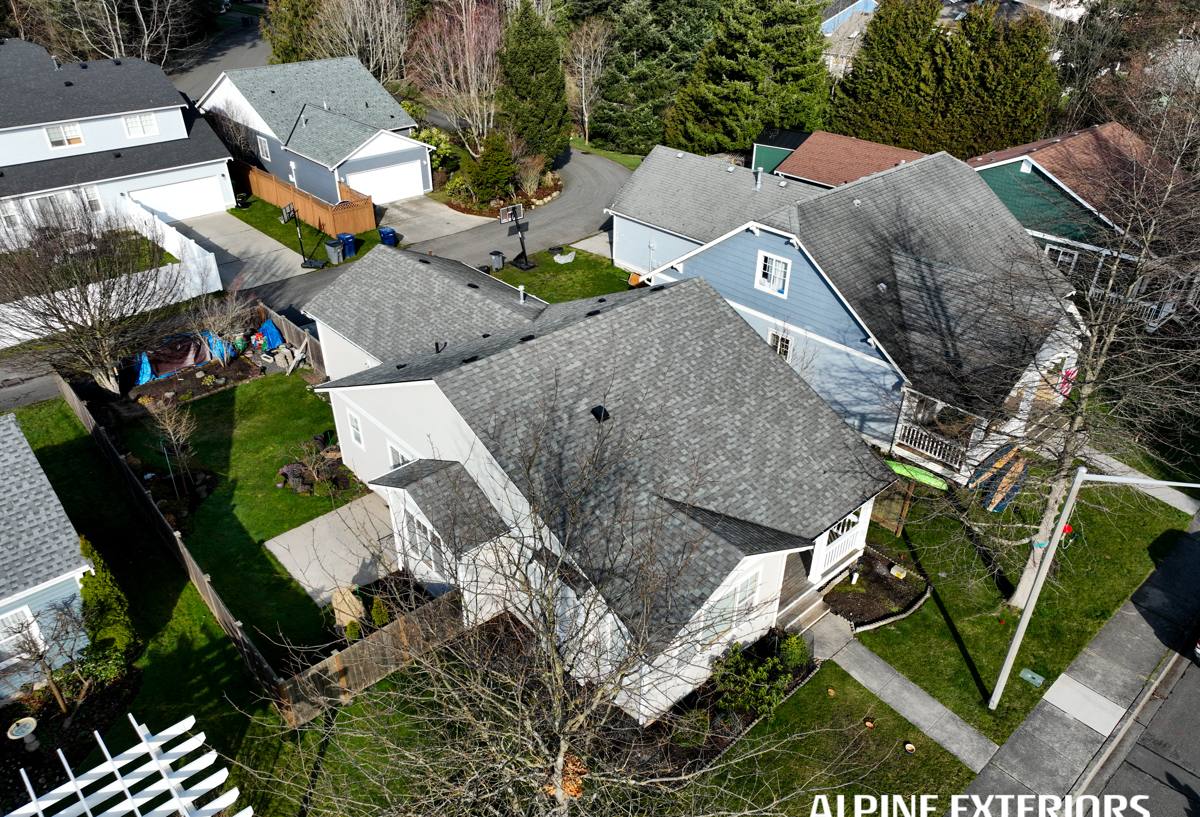
What Salt Air, Driving Rain, and Moss Season Do to Siding
Salt Air and Coastal Moisture
Even a few miles inland from the bay, airborne salt accelerates the breakdown of paint films and corrodes exposed metal fasteners over time. Siding that isn't dimensionally stable will expand and contract as it absorbs that moist, salty air, which stresses joints, caulk lines, and paint adhesion. Over a decade or two, that stress is what shows up as cracking, peeling, and gapped seams.
Driving Rain and Wind-Driven Water
Whatcom County storms don't just drop rain straight down — wind pushes it sideways and up under laps, trim, and butt joints. A siding system depends as much on what's happening behind the surface, at the water-resistive barrier and flashing details, as on the material itself. Get that water management wrong and it doesn't matter how good the siding looks; moisture will find its way to the sheathing and framing.
The Long Moss Season
Bellingham's wet, mild winters and shaded lots create ideal conditions for moss and algae to colonize siding, especially on north-facing walls and anywhere overhangs or landscaping limit sun and airflow. Moss holds moisture directly against the surface for months at a time. On materials that swell, absorb water, or rely on a field-applied paint film, that constant dampness is where rot and coating failure start.
Why We Install Only James Hardie Fiber Cement
We standardized on James Hardie fiber cement and don't install vinyl, LP SmartSide, Cemplank, Allura, primed spruce, or cedar. That's not a marketing position — it's a decision based on what holds up under exactly the conditions York deals with. Fiber cement is non-combustible, doesn't expand and contract with humidity the way wood-based or vinyl products do, and Hardie's ColorPlus factory-applied finish is baked on and warranted separately from field-painted alternatives, which matters in a climate where paint gets tested hard every winter. Hardie also engineers specific product lines — HZ5 and HZ10 — for different climate zones, and the Pacific Northwest's wet, moderate-temperature conditions fall squarely into HZ5 territory. That's the product we specify for York homes.
We'll go into more detail on the trade-offs of other siding materials on our other pages. On this page, the short version is: fiber cement done right, in the product line engineered for this climate, is what we believe gives York homeowners the best long-term result for their money.
What a Correct Fiber Cement Installation Involves
Fiber cement siding is only as good as the installation behind it. A rushed or corner-cut job can fail in this climate faster than a well-installed lower-cost product would. Here's what we consider non-negotiable on every job.
Water Management Behind the Siding
Before a single piece of siding goes up, the wall needs a properly lapped weather-resistive barrier, correctly integrated flashing at every window, door, and penetration, and a drainage plane that lets any water that does get behind the cladding find its way back out instead of sitting against the sheathing. This is the part of the job nobody sees once it's finished, and it's the part that determines whether the siding lasts 10 years or 40.
Fastening and Clearances
Hardie publishes specific fastening patterns, nail types, and minimum clearances — from the ground, from roof lines, from decks and patios — and those specs exist for a reason in a climate this wet. Siding installed too close to grade or with the wrong fasteners will show problems years earlier than siding installed to spec.
Finishing and Caulking
Cut edges need to be sealed, joints need the right caulk in the right places (and, just as important, not caulked where they shouldn't be, so the assembly can still drain and breathe as designed), and factory-finished ColorPlus panels need touch-up product matched to the specific color line, not generic exterior paint.
Our Process for York Projects
- Walk-through and assessment: we look at your current siding, trim, and any moisture or moss issues, and check for signs of underlying damage before we talk product or price.
- Written estimate: a clear scope covering product line, color, trim details, and what tear-off or repair work is included — no vague allowances.
- Prep and protection: landscaping, walkways, and outdoor fixtures are protected before removal starts.
- Removal and sheathing check: old siding comes off and we inspect the sheathing underneath for rot or damage before closing anything back up.
- Water-resistive barrier and flashing: installed and inspected before any cladding goes on.
- Hardie installation: panels, planks, or shingles installed to manufacturer fastening and clearance specs.
- Trim, caulking, and touch-up: finish details completed and checked against Hardie's finishing guidelines.
- Final walk-through: we go over the finished work with you before calling the job done.
Choosing the Right Hardie Product for This Climate
James Hardie makes several product lines, and the right choice depends on your home's style, exposure, and budget. Here's how the main options compare for a York application.
| Product Line | Typical Use | Why It Fits This Climate |
|---|---|---|
| HardiePlank Lap Siding | Traditional horizontal siding, most common residential choice | HZ5 formulation resists moisture absorption and holds paint/finish longer in wet winters |
| HardiePanel Vertical Siding | Modern vertical look, often paired with board-and-batten trim | Fewer horizontal laps mean fewer water-catching joints on exposed elevations |
| HardieShingle Siding | Accent gables, dormers, or full shingle-style homes | Non-combustible, dimensionally stable alternative to cedar shingle that won't cup or split with repeated wetting |
| HardieTrim Boards | Window/door trim, corner boards, fascia | Matches the siding's stability so trim doesn't move independently and open up caulk joints |
What Fiber Cement Siding Costs in York
We don't publish fixed prices because every home is different, but these are the main factors that move the number up or down on a typical project:
| Factor | Why It Affects Cost |
|---|---|
| Tear-off vs. new construction | Removing and disposing of existing siding adds labor and dump fees |
| Sheathing or framing repair | Hidden rot found during removal has to be fixed before new siding goes on |
| Home height and roofline complexity | Multi-story homes and steep or cut-up rooflines require more scaffolding, staging, and cutting |
| Product line and profile | Lap width, shingle vs. plank, and vertical panel details all price differently |
| Trim scope | Full trim replacement costs more than reusing sound existing trim |
| Color selection | Factory ColorPlus finishes and premium colors carry a different cost than standard primed panels |
The only way to get an accurate number for your home is a site visit, which is why our estimates start with a walk-through, not a phone quote.
Signs Your Current Siding Needs Attention
Before you decide whether you need a full replacement or a repair, it helps to know what to look for. On a walk around your home, check for:
- Soft or spongy spots when you press on siding, especially near the bottom courses or under windows
- Persistent moss or algae growth that comes back within weeks of cleaning
- Paint that's peeling, bubbling, or chalking heavily, particularly on north- or west-facing walls
- Visible warping, cupping, or gaps at seams and butt joints
- Staining or streaking below nail heads, which can indicate fastener corrosion
- Rising utility bills that might point to moisture getting into wall insulation
- Any wood siding that's been repainted multiple times but keeps failing in the same spots
Why Hiring a Crew That Already Works in York Matters
Fiber cement installation isn't forgiving of shortcuts, and a crew that regularly works around Bellingham Bay and Whatcom County's moisture patterns has already worked through the details that matter here — how tight to run clearances given local rainfall, which elevations need the most attention for moss and shade, and how to sequence a job around a wet forecast instead of guessing. A crew unfamiliar with this specific climate is more likely to treat the manufacturer's minimum specs as the target instead of the floor, which is exactly where problems start showing up five or ten years down the road.
Caring for Your New Siding
Correctly installed Hardie siding is low-maintenance, not zero-maintenance. A soft wash once or twice a year keeps moss and algae from getting a foothold, especially on shaded elevations. Keep an eye on caulk lines at trim and penetrations, and address any touch-up paint needs promptly rather than letting bare fiber cement sit exposed. Trim back vegetation that's holding moisture against the wall or blocking airflow. None of this is heavy work, but staying ahead of it is what lets the material reach its full lifespan in a climate that doesn't give siding much of a break.
If you're weighing your options for your York home, we're happy to take a look and give you a straight answer about what your siding needs — whether that's a full replacement, targeted repairs, or just a maintenance plan. Reach out for a free, no-pressure estimate using the form below.