 Bellingham Exterior
 Siding Built for Sudden Valley's Conditions
Sudden Valley sits in one of the shadier, damper corners of Whatcom County. Between the tree canopy around Lake Whatcom, the humidity that settles into the wooded lots, and the moisture that blows in off Bellingham Bay through the winter and spring, exterior siding here works harder than it does in a lot of neighborhoods. Homes tucked under fir and cedar cover stay wet longer after a storm, get less direct sun to dry out, and grow moss and algae faster than homes out in the open. Add in the driving rain that Whatcom County sees for a good chunk of the year, and you have a climate that finds every weak point in a siding system.
That combination is exactly why we install James Hardie fiber cement siding and nothing else. It's not the cheapest material on the market, and it's not the easiest to install, but it holds up to sustained moisture and shade in a way that other common siding options simply don't.
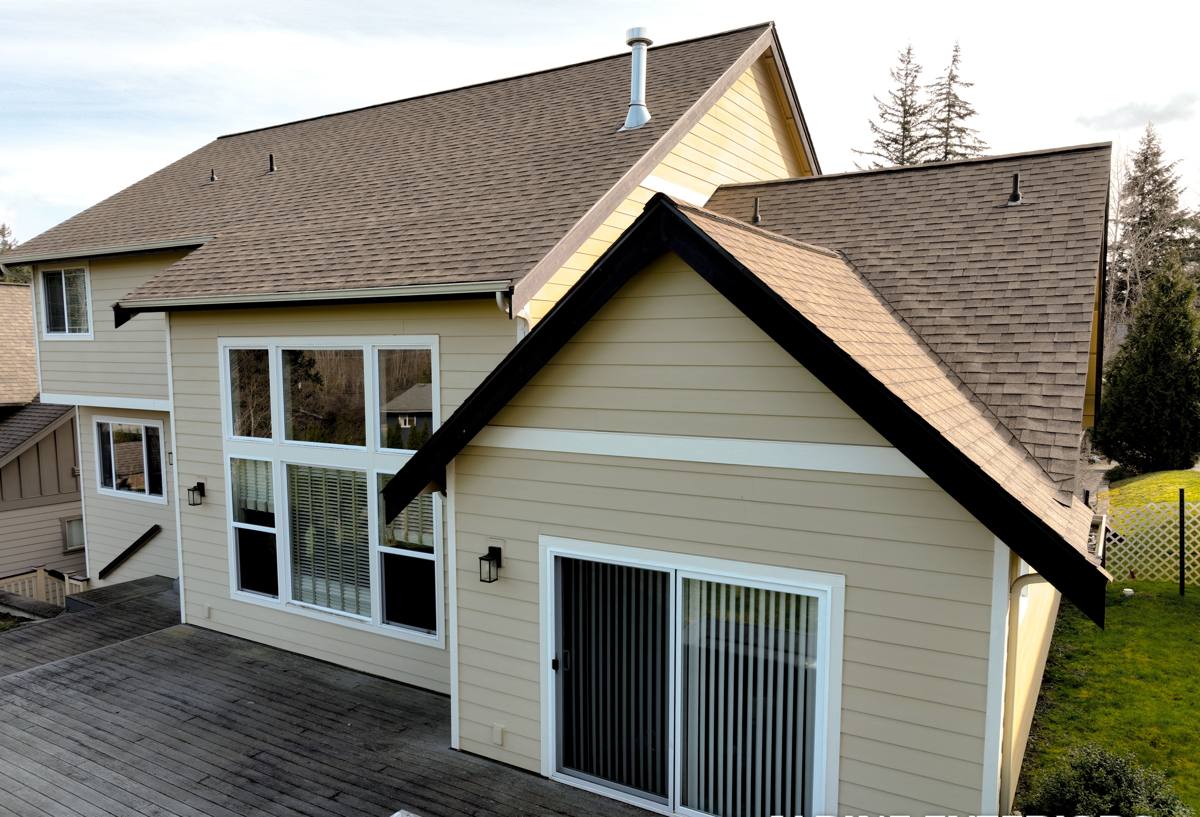
What Lake Whatcom's Microclimate Does to Exterior Materials
Extended Moss and Algae Season
Shaded, damp siding is a moss magnet. On wood-based products, moss and algae don't just sit on the surface — they hold moisture against the material, and over time that moisture finds its way into seams, fastener holes, and butt joints. Once a wood-based panel starts absorbing water repeatedly, swelling, splitting, and soft spots follow. Fiber cement doesn't feed that cycle the same way; it's not an organic material, so moss sits on the surface rather than breaking down the substrate underneath it.
Driving Rain and Wind-Driven Moisture
Storms coming off the Strait tend to push rain sideways, not straight down. That matters more than people expect — it means water gets forced up under laps, into trim joints, and behind poorly flashed windows and doors. A siding job that only accounts for rain falling straight down will eventually leak here.
Humidity That Doesn't Fully Dry Out
Even on clear days, homes set back in the trees around Sudden Valley get less sun exposure and less air movement than homes on open lots closer to the water. That means siding stays damp longer after every rain event, which shortens the life of anything that isn't engineered to handle repeated wet-dry cycling.
Why Fiber Cement Is the Right Call Here
James Hardie fiber cement is a mix of cement, sand, and cellulose fiber, fired and cured into a rigid, dimensionally stable board. It doesn't rot, it isn't a food source for moss or fungus the way wood-based products are, and it holds its shape through Whatcom County's wet winters and warm, dry summers without the swelling and shrinking that causes gaps and cracked caulk lines on other materials. Hardie also builds specific product lines for different climate zones — HardieZone HZ5, which covers this region, accounts for freeze-thaw cycling and sustained moisture exposure in a way a one-size-fits-all product doesn't.
We standardized on Hardie because we were tired of getting called back to homes with siding that looked fine at installation and failed within a decade — swollen panels, moss-stained vinyl that never really cleaned up, cracked caulk joints letting water behind the wall. Fiber cement, installed correctly, is a genuine long-term answer for a climate like this one.
What a Correct Fiber Cement Installation Actually Involves
Fiber cement is only as good as the installation behind it. A rushed or undersized crew can install Hardie siding in a way that traps moisture just as badly as a bad wood installation. The details that matter most in a wet, shaded environment like Sudden Valley:
- Proper clearance and flashing: siding held off decks, patios, and grade with the correct gap, and flashed above every window, door, and horizontal trim board so water sheds outward instead of behind the panel
- Correct fastening: corrosion-resistant fasteners driven to Hardie's spec, not overdriven or underdriven, which affects how the panel handles expansion and contraction
- Rain screen or drainage plane behind the siding: a gap that lets any moisture that does get behind the cladding drain and dry out instead of sitting against the sheathing
- Sealed and caulked joints at penetrations: vents, hose bibs, light fixtures, and anywhere else something punches through the wall assembly
- Factory-finished ColorPlus panels where possible: a baked-on finish holds up to shade and moisture far longer than field-applied paint, and it doesn't need repainting on the same schedule
Skip any one of these and you can end up with a wall assembly that traps water behind good-looking siding — which is worse than not upgrading at all.
Our Process on a Sudden Valley Home
Every home in this area is a little different depending on tree cover, slope, and how much sun a given wall actually gets, so we start with a walk-through rather than a generic quote.
1. Site and Wall Assessment
We look at the current siding, check for soft spots, moisture damage, and failed flashing, and evaluate how much shade and moss exposure each side of the house is actually dealing with. North- and west-facing walls under heavy tree cover often need extra attention to drainage detailing.
2. Removal and Sheathing Check
Old siding comes off and we inspect the sheathing underneath. In a climate this damp, it's common to find some moisture-related deterioration behind older siding — we address that before anything new goes up, not after.
3. Weather-Resistive Barrier and Drainage Plane
A properly lapped weather barrier goes on, along with a drainage gap where the wall assembly calls for it, so any moisture that gets behind the cladding has somewhere to go.
4. Flashing at Every Penetration
Windows, doors, hose bibs, vents, and horizontal trim all get flashed before siding goes over them — this is the step that determines whether the job holds up in year eight or fails quietly behind the wall.
5. Installation to Manufacturer Spec
Panels are installed with correct clearances, fastening, and joint treatment, using James Hardie's published installation requirements — which is also what keeps the manufacturer's warranty valid.
6. Trim, Caulk, and Final Walkthrough
Trim boards, caulking, and touch-up finish work close out the job, followed by a walkthrough so you know exactly what was done and what to expect going forward.
Comparing Siding Options for a Home Like This
| Material | Behavior in Shade & Moisture | Moss/Algae Resistance | Typical Maintenance | Fire Resistance |
|---|---|---|---|---|
| Vinyl | Can warp or buckle with heat/cold cycling; doesn't rot but traps moisture behind it if installed poorly | Moss and algae staining is common and hard to fully remove | Occasional washing; panels can't be spot-repaired invisibly | Combustible; can soften/melt near heat sources |
| Cedar / primed wood | Absorbs moisture readily; prone to rot and swelling in shaded, damp conditions | Low — organic surface feeds moss and fungus growth | Repainting/staining every few years; ongoing rot inspection | Combustible |
| LP SmartSide (wood strand) | Engineered to resist moisture better than raw wood, but edges and cut ends remain vulnerable if not sealed and maintained | Moderate — still an organic substrate | Regular caulk/paint upkeep, especially at joints | Combustible |
| James Hardie fiber cement | Dimensionally stable; doesn't swell, rot, or absorb water into the substrate | High — inorganic surface doesn't feed growth | Periodic washing; ColorPlus finish extends time between repaints | Non-combustible |
We don't install vinyl, LP SmartSide, cedar, or primed wood siding — not because these products have no merit anywhere, but because for a shaded, wet property in this part of Whatcom County, they consistently ask more of the homeowner in upkeep and carry more long-term moisture risk than fiber cement does.
Signs Your Current Siding Is Struggling
Before you commit to a full replacement, it's worth knowing what to look for. Walk your home's exterior and check for:
- Bubbling, peeling, or cracked paint, especially on shaded walls
- Soft or spongy spots when you press on siding near the bottom edges or under windows
- Persistent moss or dark streaking that comes right back after cleaning
- Visible gaps, warping, or separation at panel joints and trim boards
- Musty smell or discoloration on interior walls that share an exterior wall
- Caulk that's cracked, shrunk, or missing at windows, doors, and corners
Any one of these on its own might just need a repair. Several at once, especially on the shaded side of the house, usually points to a moisture problem building behind the siding.
Why Local Experience in Sudden Valley Matters
Wooded, sloped lots around Lake Whatcom present real logistical differences from a flat in-town job — narrow driveways, limited staging space, tree cover to work around, and in many cases a community association whose exterior guidelines are worth checking before work begins if your property falls under one. A crew that's worked this area knows to plan for those constraints up front instead of discovering them mid-project. Just as important, a crew that's evaluated a lot of homes under this kind of shade and moisture load has a good eye for where drainage detailing needs extra attention — the north wall behind a stand of trees isn't going to age the same way the sun-exposed side of the house does, and the installation should reflect that.
Maintenance After Installation
Fiber cement isn't maintenance-free, but it's low-maintenance compared to the alternatives. In a shaded, humid setting like Sudden Valley, plan on an occasional gentle wash to keep moss and organic buildup from accumulating on the surface, a yearly check of caulking at trim and penetrations, and keeping vegetation trimmed back so siding gets what airflow and sun it can. Factory-applied ColorPlus finishes hold their color and resist fading far longer than field-painted siding, which cuts down on repainting cycles significantly.
If your siding is showing its age or you're planning ahead for a replacement, we're happy to walk your property, point out what we see, and give you a straightforward, no-pressure estimate for James Hardie fiber cement siding built for Sudden Valley's conditions. There's no obligation — just a real look at what your home needs.