 Bellingham Exterior
 Why Happy Valley Roofs Take a Different Kind of Beating
Happy Valley sits close enough to Bellingham Bay to catch salt-laden air off the water, and close enough to the hills and mature tree cover around it to stay damp and shaded for long stretches of the year. That combination is harder on a roof than either factor alone. Salt air accelerates corrosion on exposed metal fasteners, flashing, and vents. Driving rain off the Sound doesn't just fall straight down here — wind pushes it sideways under shingle edges and into any gap in the flashing. And the long moss season that Whatcom County is known for means organic growth gets a real foothold on roofs that don't dry out quickly between storms.
None of that means a Happy Valley roof is doomed to fail early. It means the replacement has to be specified and installed with those specific stressors in mind, not treated like a generic reroof. That's the difference between a roof that looks fine for a year or two and one that actually holds up through a full Bellingham winter cycle after cycle.
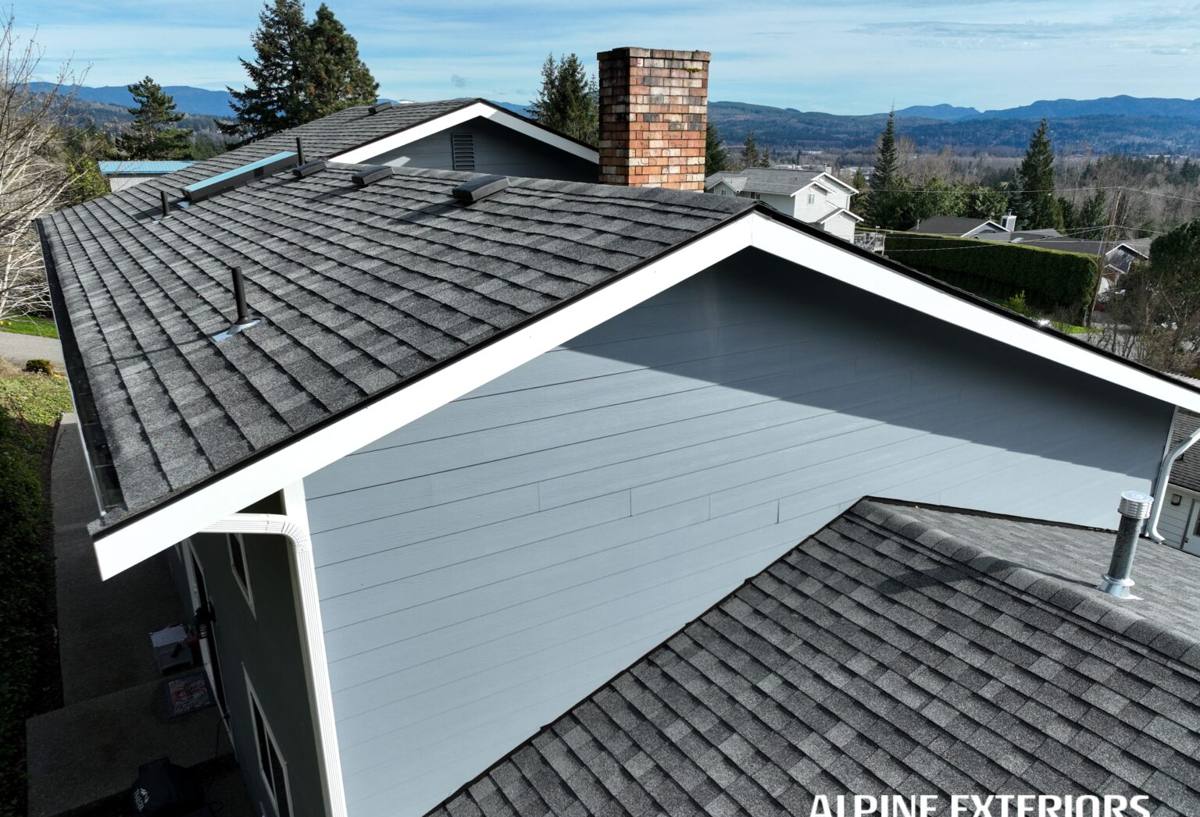
Signs a Happy Valley Roof Is Actually Due for Replacement
What you'll notice inside the house
- Water stains or discoloration on ceilings, especially near exterior walls or valleys
- Daylight visible through the attic roof deck
- Musty smell in the attic that doesn't clear up, a sign of trapped moisture
- Sagging or soft spots you can feel underfoot in the attic
What you'll notice from the outside
Look for shingles that are cupping, cracking, or missing granules in patches — granule loss shows up as bare, shiny-looking spots. Moss isn't automatically a replacement trigger; a light moss film on an otherwise sound roof can often be cleaned and treated. But moss that's built up thick mats, especially along north-facing slopes or under tree cover, holds moisture against the shingle surface and accelerates the shingle's breakdown from underneath. If that's been going on for several seasons, the roof underneath the moss is usually further along in wear than it looks from the ground.
What a Correct Roof Replacement Involves Here
A roof replacement done right in this climate is not just "old shingles off, new shingles on." A few things matter more here than they would in a drier, calmer part of the state.
Full tear-off and deck inspection
We remove the old roofing down to the deck rather than layering over it. That's the only way to actually see the condition of the plywood or board sheathing underneath — rot, soft spots, or old water damage from past leaks won't show up until the old material is off. Any compromised decking gets replaced before anything new goes down; skipping this step is one of the most common shortcuts that leads to early failure.
Underlayment built for wind-driven rain
Given how much of Bellingham's rain arrives at an angle rather than straight down, we pay close attention to underlayment coverage at eaves, valleys, and any low-slope transitions, along with self-adhering waterproof membrane in the areas most exposed to wind-driven moisture. This is the layer that saves a roof when a storm pushes water somewhere the shingles alone wouldn't stop it.
Flashing and fasteners suited to salt exposure
Around chimneys, skylights, sidewalls, and vent penetrations, we use flashing and fasteners rated to hold up against the corrosive effect of salt air rather than the cheapest option that would be fine further inland. Corroded flashing is one of the most common causes of a leak that shows up years after installation, long after the shingles themselves still look fine.
Choosing a Roofing Material for This Climate
There's no single "best" material for every Happy Valley home — it depends on your roof's pitch, your budget, and how much moss and moisture resistance you want to prioritize. Here's how the common options compare for this specific climate:
| Material | Moss & moisture behavior | Relative upfront cost | Notes for this area |
|---|---|---|---|
| Standard 3-tab asphalt shingle | Traps moisture in flat surface, moss-prone | $ | Shortest lifespan under heavy tree cover and salt air |
| Architectural (dimensional) shingle | Better runoff than 3-tab, still needs moss upkeep | $$ | Most common choice; good balance of cost and durability |
| Standing seam metal | Sheds water and moss build-up well | $$$ | Strong long-term option but needs corrosion-rated fasteners near the water |
| Synthetic/composite shingle | Resists moisture absorption, moss-resistant coatings available | $$–$$$ | Good option where appearance of natural shake is wanted without the maintenance |
Cost for a full replacement varies a lot based on roof size, pitch, number of layers being removed, and how accessible the roof is — steep or tree-crowded sections take longer to work safely and that shows up in labor time. We'll walk your specific roof with you and explain where your money is actually going before you commit to anything.
Our Replacement Process, Step by Step
- On-site inspection — we get on the roof (not just a ground look) and check the deck, flashing, ventilation, and any problem areas before quoting anything.
- Written scope and material selection — you get a clear breakdown of what's being replaced, what material options fit your budget and roof type, and a realistic timeline.
- Protection of the property — landscaping, siding, and gutters get covered or protected before tear-off starts, and we run magnetic sweeps for nails afterward.
- Full tear-off and deck repair — old roofing comes off, decking is inspected and repaired where needed.
- Underlayment, flashing, and ventilation install — the parts that actually determine how the roof performs in wind and rain, not just how it looks.
- New roofing material installed to manufacturer spec — proper nailing pattern, exposure, and fastener spacing, since shortcuts here are what void warranties.
- Final walkthrough — we go over the finished roof with you, including care and maintenance specific to your material and site.
The Ventilation and Moisture Detail Most Homeowners Miss
A new roof with poor attic ventilation will grow moss again faster than one that breathes properly, no matter how good the shingles are. Warm, moist air trapped in an attic condenses against the underside of a cool roof deck, and that trapped moisture works from the inside out — softening decking and encouraging exactly the kind of growth on the roof surface that a long moss season already pushes toward. Part of a correct replacement is checking that intake and exhaust ventilation are balanced, not just adding a vent or two because it's expected. On homes with a lot of tree shade, this matters even more, since those roof sections dry out slower to begin with.
Why It Matters That We Already Work This Neighborhood
A roofing crew that's spent time in Happy Valley specifically — not just Bellingham generally — knows a few things that save homeowners headaches. We know which streets have tight staging room for a dumpster or material delivery, which lots have steep grades or mature trees that change how a crew has to rig safety equipment, and how City of Bellingham permitting and inspection timing typically runs for reroofs in this part of town. That local familiarity translates into fewer surprises, fewer delays, and a crew that isn't learning the neighborhood's quirks on your dime.
It also means we've seen, firsthand, how roofs in this specific pocket of Whatcom County actually age — which materials hold up under the tree cover and salt air here, and which ones we've stopped recommending because we've seen them struggle in this exact climate, not because of a manufacturer's marketing claims either way.
Questions Worth Asking Before You Sign a Roofing Contract
- Is the bid based on a physical roof and attic inspection, or just a satellite measurement?
- Does the quote specify underlayment type and coverage, not just "standard felt"?
- Is a full tear-off included, or is this a layover?
- Are ventilation upgrades addressed, or only the shingles themselves?
- What's the manufacturer's warranty, and does it require a certified installer to stay valid?
- Is the contractor licensed and insured to work in Washington State, and can they show proof?
- Who handles cleanup and nail sweep, and is it included in the price?
Protecting the Roof After Replacement
A new roof still needs a little seasonal attention in this climate. Keep gutters clear so water actually drains instead of backing up under the eaves during heavy rain. Have moss growth treated before it builds into thick mats, ideally as part of a light annual check rather than waiting until it's visibly heavy. And if branches overhang the roof, keeping them trimmed back reduces both moss-friendly shade and the risk of debris damage during Bellingham's windier storms. None of this is difficult, but skipping it is how a well-installed roof loses years off its expected lifespan.
If your Happy Valley home is due for a new roof, or you're just not sure whether repair or full replacement makes more sense, we're happy to take a look and give you a straight answer. Use the form below to request a free, no-pressure estimate.