 Bellingham Exterior
 Siding Repair in Happy Valley: A Neighborhood With Its Own Weather Problems
Happy Valley is one of Bellingham's older, well-established residential neighborhoods, and that means a lot of the homes here are carrying siding that's been through decades of Pacific Northwest weather. Whatcom County doesn't get the wild temperature swings you'd see inland, but it makes up for it with something harder on exterior materials: near-constant moisture. Salt-laden air off the bay, long stretches of driving rain, and a moss season that can run most of the year all work on siding in slow, cumulative ways. Most homeowners don't notice the damage until it shows up as a soft spot under a hand, a paint film that's bubbling, or a corner board that's gone spongy.
Siding repair in a climate like this isn't just "patch the hole and move on." Done right, a repair has to account for why the damage happened in the first place, what's happening behind the siding where you can't see it, and whether the surrounding material is healthy enough to tie a repair into. This page is specifically about siding repair work for Happy Valley homes — not a general repair overview, but what we actually look for and do when we're called out to this part of Bellingham.
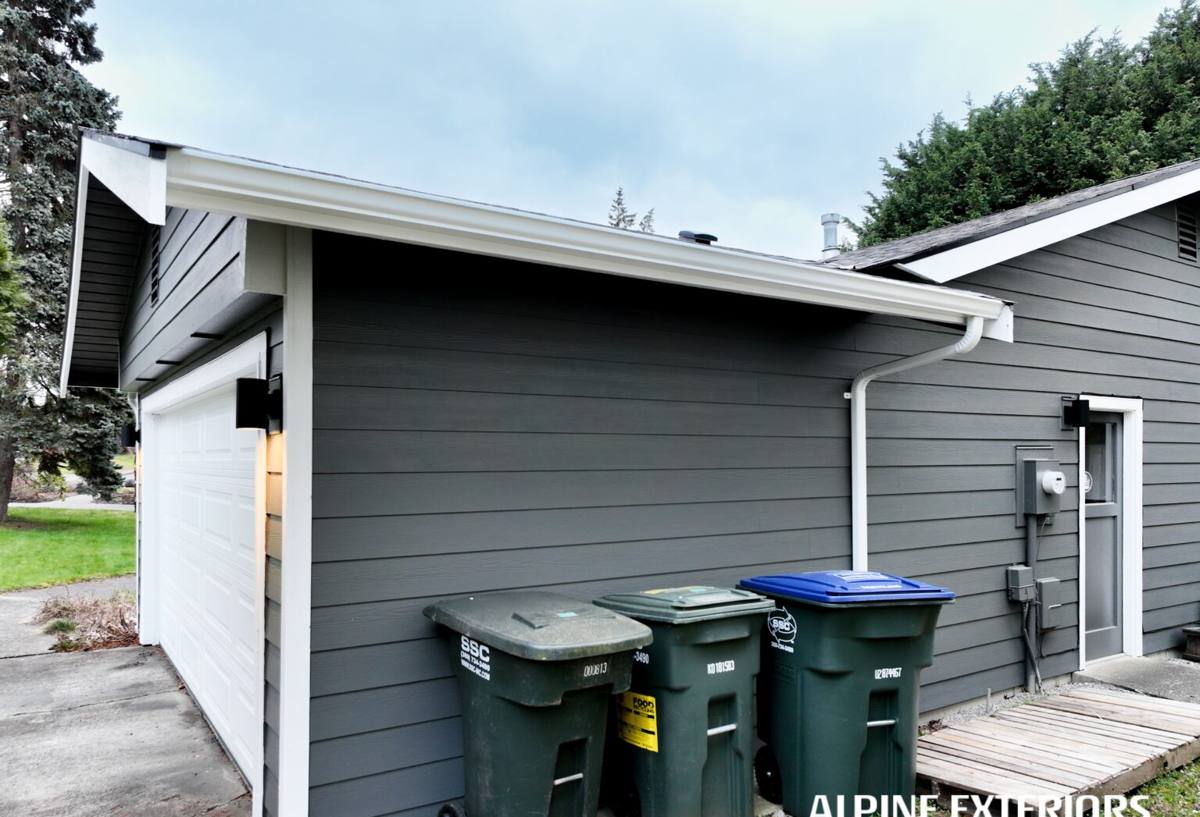
Signs a Happy Valley Home May Need Siding Repair
Because moisture damage in this climate tends to be gradual, the early signs are easy to write off as cosmetic. A few things worth taking seriously:
- Paint that's peeling, bubbling, or alligatoring in one section while the rest of the house looks fine — usually a sign of moisture trapped behind that spot, not just old paint
- Soft or spongy siding when you press on it, especially near the bottom courses, around window and door trim, or at inside corners
- Visible cracking, splitting, or delamination on individual boards or panels
- Persistent moss or algae growth that keeps coming back on the same section no matter how often it's cleaned
- Gaps opening up at seams, corners, or trim joints where caulking has failed
- Staining or discoloration streaking down from a specific point, which often traces back to a flashing or gutter issue rather than the siding itself
- A musty smell or visible interior staining on an exterior wall, which usually means the problem has already gotten past the siding
One or two of these on an otherwise sound house is a repair situation. Widespread soft siding, damage on multiple elevations, or damage tied to a systemic moisture problem is a different conversation — and we'll tell you honestly which one you're in.
What a Correct Siding Repair Actually Involves
Diagnosing the Cause, Not Just the Patch
Anyone can cut out a damaged board and nail in a new one. The part that actually matters is figuring out why that board failed. Was it a caulk joint that opened up and let water track behind the siding? A downspout dumping water against a wall? A flashing detail that was never installed correctly? If we just replace the visible damage without fixing the underlying cause, the repair fails again — often faster than the original damage took to show up, because the water intrusion point is still there.
A real repair starts with pulling back enough material to see the water-resistive barrier and framing underneath. If that's compromised, the repair scope grows to include it. If it's intact, we're usually looking at a straightforward siding and trim repair.
Matching Material and Finish
Once the cause is addressed, the repair itself needs to blend in and perform like the surrounding siding — not just cosmetically, but structurally. That means matching board profile, reveal, and fastening pattern, and getting the joint details (caulking, flashing, overlaps) done the way they should have been done originally, even if the original installation cut corners.
Why We Repair Using James Hardie Only
We install and repair exclusively with James Hardie fiber cement siding. When we're called to a Happy Valley home that already has Hardie siding, that's a straightforward match — we can source the correct HZ5 product line and ColorPlus finish and tie the repair in cleanly.
When a home has a different material — vinyl, LP SmartSide, cedar, or a primed wood product — we'll be upfront: we don't stock or install those materials, including for patch repairs. In cases where the damage is limited and the existing material is otherwise sound, we can often make a clean repair using compatible material sourced to match. But if the surrounding siding is failing broadly, or the repair would mean patching a material we don't stand behind long-term, we'll tell you that plainly and explain what replacing that section (or the elevation) with Hardie would look like instead — no pressure, just the honest tradeoff between a short-term patch and a long-term fix.
Repair vs. Replacement: How We Help You Decide
Not every damaged section needs a full re-side, and not every repair is worth doing instead of replacement. Here's roughly how we sort it out on a Happy Valley job:
| Situation | Repair Usually Makes Sense | Replacement Usually Makes Sense |
|---|---|---|
| Extent of damage | Isolated to one or two boards/panels or a single elevation | Multiple elevations, or damage found in more than one spot during inspection |
| Age and condition of remaining siding | Siding is under 15-20 years old and otherwise sound | Siding is at or past its expected service life, or shows widespread wear |
| Underlying moisture barrier | Intact behind the damaged section | Compromised, with signs of ongoing water intrusion |
| Material | James Hardie, or a compatible material we can match cleanly | A discontinued profile/color, or a material we don't install |
| Root cause | A fixable, contained issue (failed caulk joint, one bad flashing detail) | A systemic issue (poor original installation, chronic drainage problem) |
We'll walk you through where your specific situation lands on this before we recommend anything.
Our Process for a Happy Valley Repair Call
- Inspection. We look at the damaged area and the rest of the exterior, since siding problems are rarely isolated to just the spot you called about.
- Diagnosis. We identify the cause of the damage — not just the symptom — before we talk about scope.
- Honest scope and estimate. You get a clear explanation of what's a true repair, what's borderline, and what we'd recommend replacing instead, with reasoning you can evaluate.
- The repair itself. Damaged material comes out, the underlying issue gets addressed, and new material goes in matched to profile, reveal, and finish.
- Sealing and detailing. Joints, corners, and trim get finished to the same standard as new work — this is where a lot of repairs cut corners, and where they fail again if they do.
After the Repair: Keeping Happy Valley Siding Ahead of the Weather
A good repair buys you years, but this climate doesn't let siding coast. A short annual routine keeps small issues from becoming repair calls again:
- Rinse moss and algae off siding surfaces before it gets a grip, especially on north-facing and shaded walls
- Walk the exterior once a year and press-test any spot that looks discolored or where paint is failing
- Check that gutters and downspouts are clear and directing water away from walls, not onto them
- Look at caulk joints around windows, doors, and trim for cracking or separation
- Keep vegetation and sprinklers from spraying directly onto siding
- Address small issues — a cracked board, an open joint — before the next wet season, not after
Why Hiring a Crew That Already Works This Neighborhood Matters
Happy Valley's housing stock, exposure, and moisture patterns aren't identical to every other part of Bellingham. A crew that's worked repair calls in this neighborhood has a feel for where problems tend to start on these homes — which elevations catch the worst of the driving rain, where moss builds up fastest, which older installation details tend to fail first. That's the kind of pattern recognition that comes from being on the ground here repeatedly, not from a one-time drive-by estimate. It also means someone local to check on the repair down the road if a question comes up, rather than chasing down an out-of-area company.
If you've got a section of siding on your Happy Valley home that's showing damage, we're happy to take a look, tell you honestly whether it's a repair or something bigger, and give you a straightforward, no-pressure estimate. Use the form below to get started.