 Bellingham Exterior
 Building New on South Hill? The Windows Have to Work With the Hill, Not Against It
South Hill sits up above the flats of Bellingham, which means new construction here deals with a slightly different mix of exposure than a lot inside the flatter parts of town. More wind off the bay, more direct rain on certain slope faces, and mature tree cover that keeps roofs, walls, and window sills damp longer after a storm passes. None of that is dramatic on its own, but it adds up over the life of a house, and windows are one of the first assemblies to show the wear if they weren't installed correctly the first time.
New-construction windows are a different job than replacement windows, and worth treating that way. On a new build or an addition, the window goes in before the siding closes up the wall, which means there's a real, one-time opportunity to get the water management right at the stud level. Get it right during framing and the window performs quietly for decades. Get it wrong and the problems don't show up until the drywall's already painted and the siding's already on — at which point fixing it means opening the wall back up.
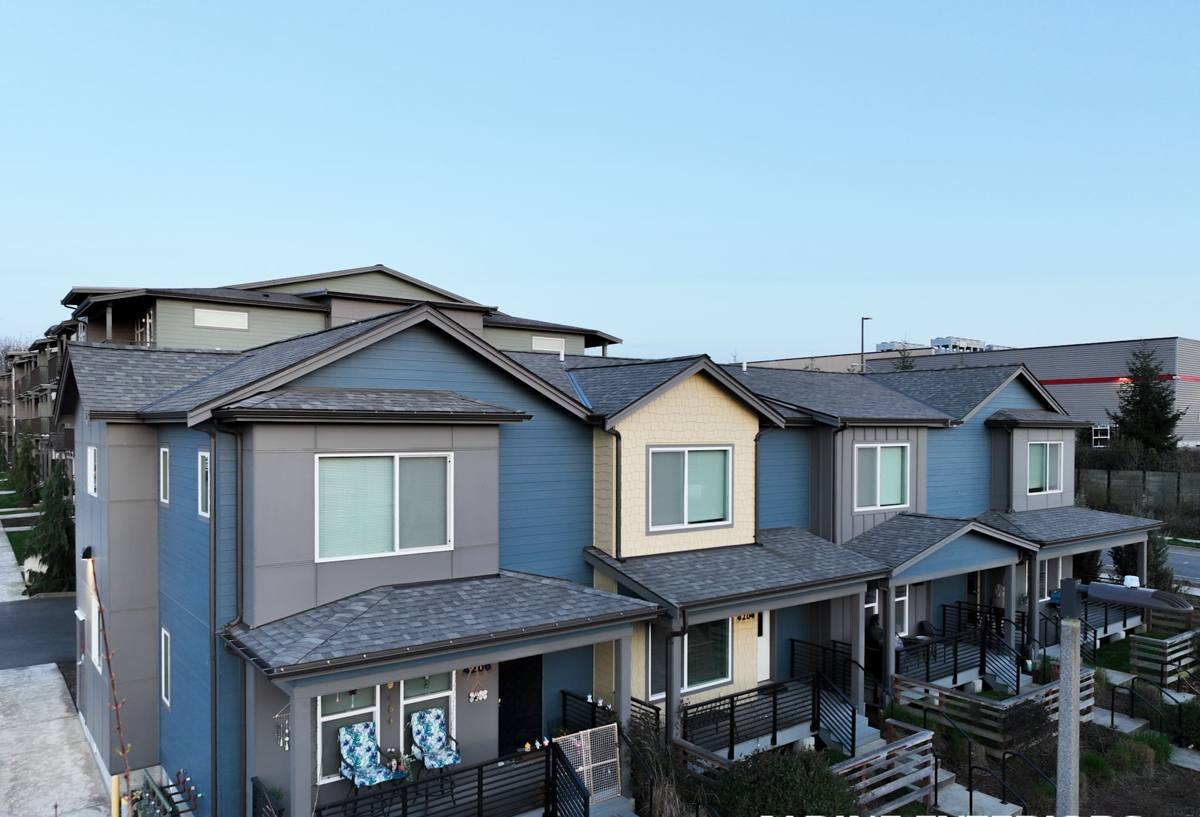
New-Construction vs. Replacement: Why the Distinction Matters
A true new-construction window has a nailing fin (sometimes called a nail flange) around the perimeter of the frame. That fin gets integrated into the wall's weather-resistive barrier (WRB) and flashing system before the siding goes on, so the window becomes part of the drainage plane rather than something bolted into an already-finished wall. Replacement or "insert" windows, by contrast, fit into an existing frame with no fin, relying on the old opening's flashing (whatever condition it's in) and a bead of sealant.
On a South Hill new build, there's no excuse to treat a new-construction window like an insert. The framing is open, the sheathing is exposed, and the flashing sequence can be done in the correct order — sill pan first, then WRB laps, then the window, then head flashing over the top. Skipping steps here to save an hour on install day is the single most common source of window callbacks we see, and it's entirely avoidable when the sequence is followed on a new opening.
What Bellingham's Climate Specifically Asks Of a Window Install
Whatcom County doesn't get extreme heat or extreme cold, so window performance here isn't primarily about insulation value — it's about water. Long stretches of low-intensity rain, wind-driven rain during fall and winter storms, and a moss season that can run from October into May all put moisture pressure on a wall assembly for months at a time. A window that's watertight in a light afternoon shower can still leak in a sustained, wind-driven Bellingham storm if the flashing details weren't done correctly.
- Sill pan flashing that sheds water forward, not just a bead of caulk under the frame
- Proper shingle-lap sequencing so upper flashing always laps over lower flashing, never the reverse
- A drainage gap or capillary break so incidental water can get back out of the wall instead of pooling
- Corrosion-resistant fasteners and hardware, given the salt content in air coming off Bellingham Bay
- Sealants and backer rod rated for sustained UV and moisture exposure, not interior-grade product
Choosing the Right Window Frame Material for This Site
Frame material matters more on an exposed or elevated lot than it does in a sheltered one. South Hill isn't the windiest spot in Whatcom County, but salt air and sustained damp weather are harder on some materials than others. This is a professional judgment call based on maintenance burden and moisture behavior — not a claim that any one product is defective.
| Frame Material | Coastal/Marine Durability | Maintenance | Typical Cost Position |
|---|---|---|---|
| Vinyl | Good — won't corrode or rot, but can flex in temperature swings | Low | Lower |
| Fiberglass | Very good — dimensionally stable, holds paint/finish well | Low to moderate | Mid to upper |
| Wood-clad (exterior clad, wood interior) | Good exterior durability if clad seams are sealed; interior wood needs a dry wall behind it | Moderate | Upper |
| Aluminum | Fair — needs a thermal break and marine-grade finish near salt air | Low, but finish can chalk over time | Mid |
For most South Hill new builds, we steer clients toward vinyl or fiberglass for standard openings, reserving wood-clad for street-facing elevations where the interior wood look is a design priority and the client understands the added care involved. We'll talk through the trade-offs for your specific elevations rather than defaulting to one product across the whole house.
What a Correct New-Construction Install Actually Involves
This is the sequence we follow, and it's worth knowing as a homeowner or GC so you can ask any contractor the same questions:
- Rough opening is checked for square, level, and correct sizing before the window ever shows up on site
- Sill pan flashing is installed and sloped to shed water outward, not just laid flat
- WRB is cut and lapped so water sheds down and over each layer below it
- Window is set, shimmed level and plumb, and fastened through the nailing fin per manufacturer spec
- Head flashing is installed last, lapping over the WRB and side flashing beneath it
- Interior shim space is insulated (not packed solid) and air-sealed with an appropriate sealant
- Exterior trim or siding is only closed in once the flashing has been visually verified
Every one of those steps is inspectable before the wall closes up. That's the advantage of new construction over a retrofit — and the reason it's worth having a second set of eyes check the sequence before siding crews cover it for good.
How We Work With Builders and GCs on South Hill Projects
Most of our new-construction window work on South Hill comes in through coordination with a general contractor or framing crew rather than directly replacing a homeowner's existing windows. That means our process is built around fitting into someone else's schedule without becoming the bottleneck:
- We confirm rough openings against the window order before the windows are manufactured, not after
- We schedule install for right after the WRB goes on and before siding crews mobilize
- We document flashing at each opening with photos before it's covered, so there's a record if a question ever comes up later
- We communicate directly with the GC or site super on timing changes — weather delays on a hill lot are common and we plan around them rather than rushing the flashing to hit a date
If you're a homeowner managing your own build, we're glad to work either through your GC or directly with your framing schedule — just let us know how the job is structured.
Why a Crew That Already Works South Hill Is Worth Hiring
South Hill isn't a huge neighborhood, but lots here vary a lot — slope, tree cover, and orientation to wind off the bay all change from one street to the next. A crew that's already installed windows on several South Hill builds has a feel for which elevations need extra attention on flashing and which ones are more forgiving. That's not something you can fully get from a spec sheet; it comes from having stood on the hill in a January storm and seen where the water actually goes.
There's also a practical side: familiarity with how the local building department here handles new-construction inspections, what they look for on window rough-in and flashing, and how to sequence work so an inspection doesn't hold up the rest of the build. A contractor who's done that dance before on South Hill saves everyone time.
What Goes Wrong When It's Not Done Right
The failures we get called about later are almost always the same handful of things, and they're all preventable at install time:
- Water staining or bubbling drywall below a window sill, months or years after move-in, from a sill pan that wasn't sloped correctly
- Moss and algae building up on sills and trim faster than the rest of the wall, which usually points to a spot where water isn't draining away like it should
- Corroded hardware or streaked finish on aluminum components that weren't rated for the salt content in coastal air
- Drafts or condensation at the frame edge from insulation that was packed too tight in the shim space, cutting off the intended air seal
Nearly all of these trace back to a shortcut taken during the flashing sequence, not to the window product itself. That's why we treat the install steps as non-negotiable, even when it means the crew takes longer on a given opening.
Caring for New Windows Through Bellingham's Wet Season
Once the windows are in and the house is finished, upkeep is simple but worth doing. Clear debris and moss buildup off sills and tracks a couple of times a year, especially heading into fall. Check exterior caulking lines annually for cracking or gaps, since sealant is a maintenance item, not a permanent one. And keep an eye on any exterior trim paint or finish where it meets the window frame — that's usually the first place weather exposure shows up, and catching it early is far cheaper than dealing with water damage behind it.
If you're planning a new build or addition on South Hill and want windows installed the right way the first time, we're happy to walk your plans, talk through frame material options for your specific lot, and put together a free, no-pressure estimate. There's a form below — reach out and we'll get back to you.