 Bellingham Exterior
 Building New in Sudden Valley: What the Site Actually Demands
Sudden Valley sits back in the trees along the south shore of Lake Whatcom, and that setting shapes almost every decision that goes into a new-construction window package. Steep, wooded lots mean more shade and slower drying times after a storm. Proximity to the lake and the surrounding forest canopy keeps humidity higher, longer, than you'll find on an open lot closer to town. Add in Whatcom County's normal winter pattern of driving rain off the Sound, and a long stretch of the year where north-facing walls and shaded trim simply don't dry out, and you've got a moss season that runs far longer than most homeowners moving from other regions expect. None of that is a reason to avoid building here — it's just the baseline you design and install against.
For a brand-new home, this is the easy part to get right, because the wall assembly hasn't been closed up yet. Everything we talk about below — flashing sequence, glass selection, frame material — is far cheaper and far more effective to handle correctly during framing than to retrofit five or ten years later once moisture has already found its way behind the siding.
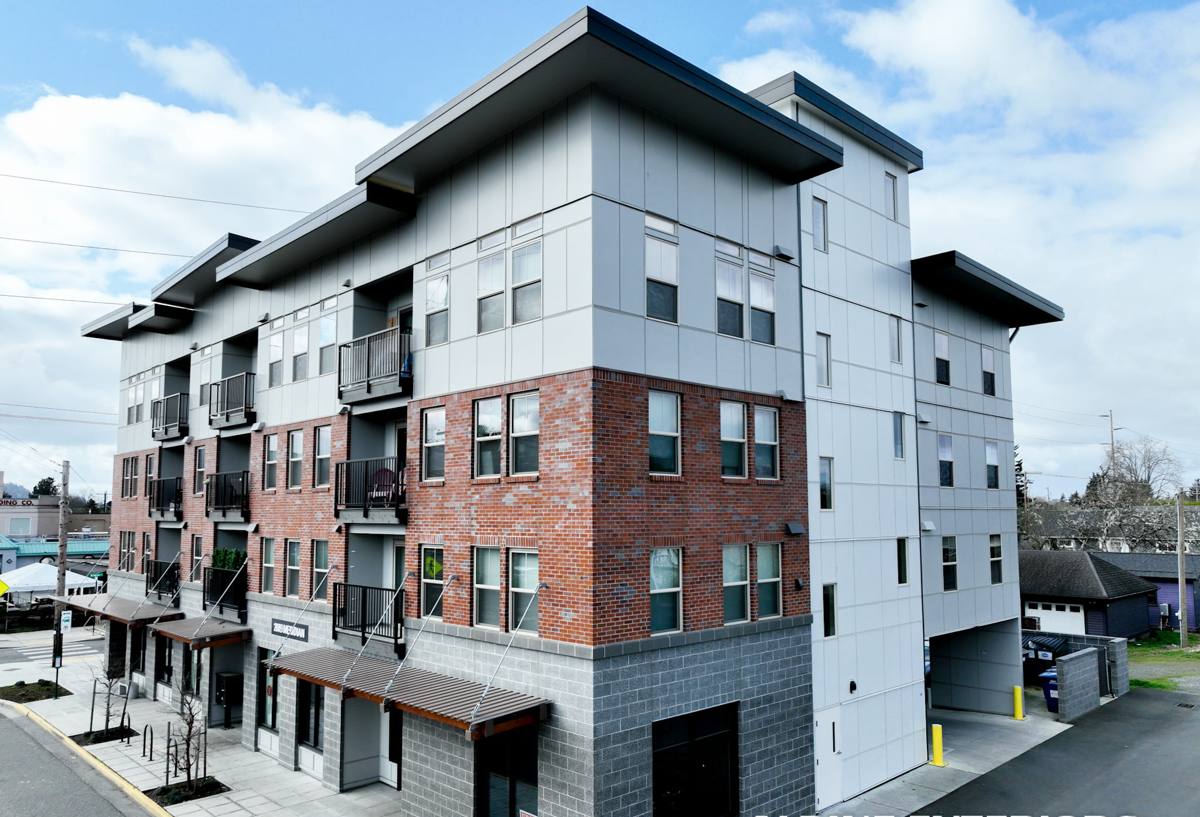
Why New Construction Is the Best Time to Get Windows Right
On a remodel or replacement job, we're working around existing siding, existing trim, and whatever flashing decisions the original builder made — good or bad. New construction removes that constraint. The rough openings are square, the weather-resistive barrier is exposed and accessible, and there's no old sealant or rot to cut out first. That means the window opening can be built as a single, continuous drainage plane from the start, which matters enormously in a climate that gets sustained, wind-driven rain rather than just the occasional downpour.
It's also the cheapest point in the build to size window openings for larger glass, upgrade to a better performance package, or plan overhangs and trim details that keep the moss and algae growth on window surrounds to a minimum later. Decisions made here get locked into the house for decades.
What a Correct New-Construction Window Installation Involves
"New construction windows" isn't just a product category — it describes the whole method of setting a window into a raw opening before siding goes on, using a nailing-fin frame that gets integrated into the wall's water management system rather than face-mounted after the fact. Done right, the sequence looks like this:
- Rough opening checked for square, level, and correct dimension before the window ever shows up on site
- Sill pan flashing installed first, sloped to shed any water that gets past the window back out to the exterior — this is the single most important step for a wet climate and the one most often skipped or done poorly
- Window set into the opening, shimmed for level and plumb, and fastened through the nailing fin per the manufacturer's schedule (not just "a few screws where convenient")
- Flashing tape or self-adhered membrane run up the sides and across the head in the correct shingle-lap order, so water is always directed down and out, never trapped behind the fin
- Head flashing integrated with the weather-resistive barrier above the opening, lapped correctly with the housewrap
- Backer rod and exterior sealant at the trim joint — sized and installed so the joint can flex with the building without failing in year three
- Interior air-sealing with low-expansion foam or backer rod, separate from the exterior weatherproofing, so the window performs both as a water barrier and an air barrier
Every one of those steps matters more here than it would in a drier climate, because a mistake doesn't just show up as a draft — it shows up as water intrusion, and in a heavily shaded, high-humidity setting like Sudden Valley, trapped moisture behind siding can sit for a long time before anyone notices it from the inside.
Choosing Windows for a Forested, Lake-Adjacent Lot
Frame material
Vinyl, fiberglass, and wood-clad frames all show up in new construction, and each behaves differently in a wet, shaded environment. We size the recommendation to the specific elevation of the house — south and west walls that get real sun exposure have different needs than a north wall tucked under a tree canopy that barely dries out between storms.
| Frame Type | How It Handles This Climate | Trade-Off to Know |
|---|---|---|
| Vinyl | Won't rot; handles constant moisture without material degradation | Can look and perform differently across brands — dimensional stability and hardware quality vary |
| Fiberglass | Very stable in temperature and humidity swings; strong long-term performer near the lake | Higher upfront cost than vinyl |
| Wood-clad (exterior clad) | Warm interior look; exterior cladding protects the wood from direct weather | Any gap or failure in the cladding or sealant lets moisture reach wood underneath — installation quality is non-negotiable |
Glass package
Whatcom County's energy code sets a performance floor, but for a shaded, cooler lot we usually push past the minimum on both the U-factor (heat loss) and the solar heat gain coefficient, since a home tucked into trees rarely needs help staying cool and benefits more from retaining warmth through our long wet winters. Double-pane, low-E glass is the standard baseline; triple-pane is worth discussing for north-facing rooms or homes further back from any winter sun exposure at all.
Our New-Construction Window Process
We coordinate directly with your builder or general contractor rather than working in isolation, because window timing has to line up with framing, housewrap, and siding schedules.
- Plan review — we go over the window schedule against the actual framed openings before ordering, catching sizing mismatches while they're still a phone call instead of a change order
- Site verification — every rough opening is measured and checked on site, not assumed from plans
- Sill pan and flashing installation — built to shed water regardless of what happens at the window itself
- Window setting — leveled, shimmed, and fastened to manufacturer spec
- Flashing integration — tied into the weather-resistive barrier so the whole wall works as one drainage system
- Interior and exterior sealing — air sealed inside, weatherproofed outside, as two separate jobs done correctly
- Final walkthrough — operation, hardware, and finish check before the crew leaves the site
Mistakes We Commonly See From Rushed New-Construction Installs
Most window failures we get called out to inspect on newer homes trace back to a handful of repeatable errors — usually from crews moving fast to keep a build schedule rather than following the manufacturer's flashing instructions to the letter.
- No sill pan flashing, or a flat one instead of a sloped one — water sits instead of draining out
- Flashing tape applied out of shingle-lap order, so water gets funneled behind the fin instead of over it
- Housewrap cut and taped around the window as an afterthought instead of integrated during the flashing sequence
- Nailing fins under-fastened to "save time," leaving the window loose in the opening
- Exterior sealant used as the only line of defense, with no mechanical flashing behind it — sealant alone always fails eventually
- Interior foam or sealant skipped, leaving a real air leak even though the window looks finished from outside
Permits, Codes, and Inspections in Whatcom County
New construction windows are part of the building permit process, not a separate add-on — they get reviewed for egress sizing (bedrooms need a code-compliant escape opening), energy code compliance, and general structural attachment. We build our installation to pass inspection the first time, and we keep our documentation (window schedules, U-factor and SHGC labels) organized so nothing holds up your builder's inspection timeline. If you're owner-building or acting as your own general contractor, we can walk you through exactly what the inspector will be checking before they show up.
Why It Matters to Hire a Crew That Already Works in Sudden Valley
Sudden Valley is a private, gated community with its own architectural review and community association covering exterior changes and new construction — window style, color, and sometimes glazing choices can be part of that review depending on your lot and the current guidelines. A crew that's already worked in the community knows to check that early rather than after windows are ordered. Beyond the paperwork, familiarity with the neighborhood's terrain — steep driveways, limited staging space on wooded lots, gate and access logistics — keeps the job moving instead of losing a day to problems a first-time visitor to the area would hit cold.
Local experience also means we've seen how homes in this specific setting actually perform two, five, and ten years after the crew leaves — which shaded elevations collect the most moss, which trim details hold up, and which don't. That's knowledge you can't get from a manufacturer's install manual alone.
After Your Windows Are In
New-construction windows are close to maintenance-free for the first several years, but a wet, wooded setting still benefits from a simple annual check: clear debris and moss from sills and trim before it holds moisture against the frame, confirm exterior caulk lines are still intact, and test that weep holes (on vinyl and fiberglass frames) aren't clogged with pollen or dirt. A five-minute look each fall goes a long way toward protecting the installation for the long haul.
If you're planning a new build or an addition in Sudden Valley and want windows installed correctly the first time — flashed right, sized right, and coordinated with your builder's schedule — we're happy to take a look at your plans and put together a straightforward, no-pressure estimate. There's a form below to get that conversation started.