 Bellingham Exterior
 Roofing in Birchwood: Built for Salt Air, Rain, and a Long Moss Season
Birchwood homes sit in one of the more demanding roofing climates in Whatcom County. It's not any single factor that wears a roof out here — it's the combination. Moist marine air off the water carries salt that slowly breaks down metal flashing and fasteners. Rain falls often enough, and lightly enough, that shingles rarely get a hard, fast dry-out between storms. And the tree cover that makes Birchwood a nice place to live also means shaded rooflines that hold moisture long after the sun comes out, which is exactly what moss and algae need to take hold.
None of that means asphalt shingles are the wrong choice for a Birchwood home. They're still the most practical, cost-effective option for the vast majority of roofs in this neighborhood. What matters is that the roof is designed and installed with this specific climate in mind — not installed the same way it would be in a dry inland market and hoped to hold up.
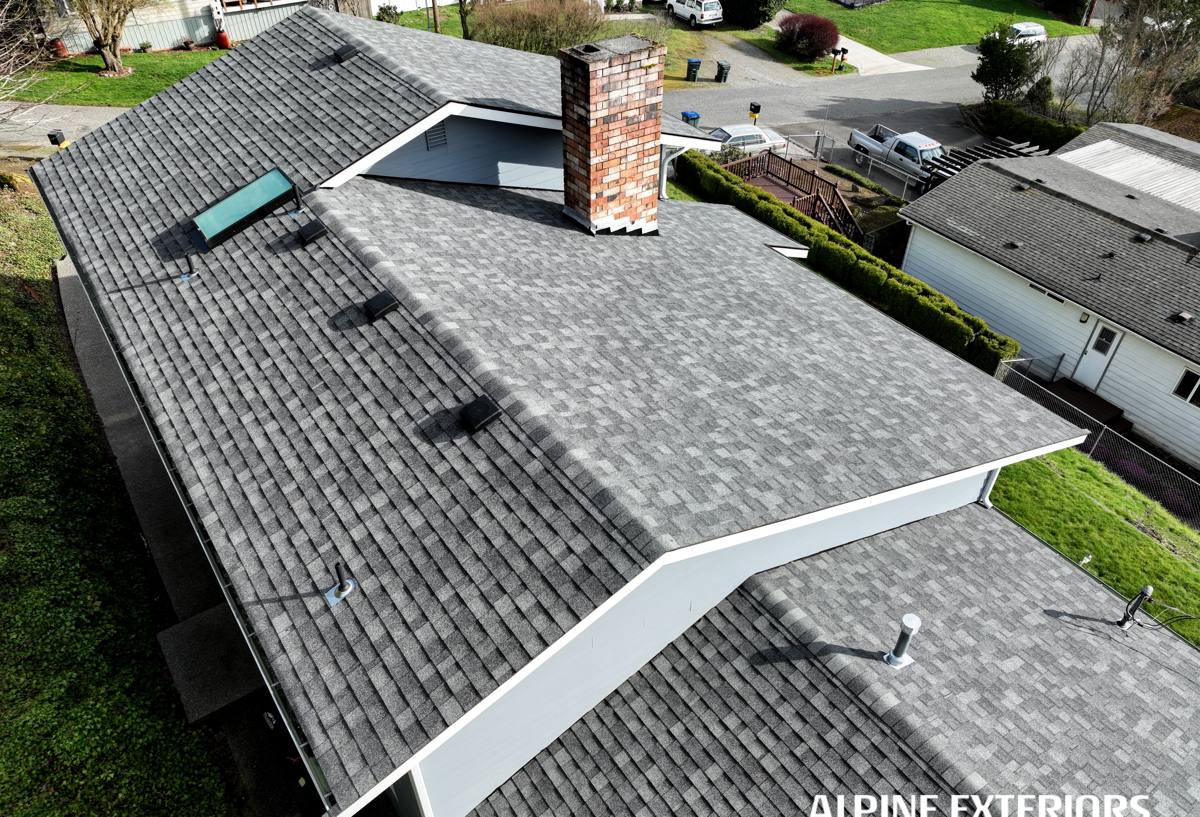
What a Correct Asphalt Shingle Roof Involves Here
Underlayment and water protection
In a climate where rain is frequent and wind-driven, the underlayment matters as much as the shingle on top of it. We use synthetic underlayment as the standard layer across the deck, with self-adhered ice-and-water membrane at the eaves, valleys, and around any roof penetration — chimneys, skylights, plumbing vents. Valleys in particular take a beating in Bellingham's wetter months; water concentrates there and moves fast, and a valley that relies only on shingle overlap instead of a proper membrane underneath is one of the first places a roof starts to leak.
Ventilation that actually balances
A shingle roof lasts as long as its ventilation lets it. Warm, moist attic air that has nowhere to go condenses on the underside of the deck, which rots sheathing from the inside and shortens shingle life from below at the same time moss is working on it from above. We check intake at the soffits and exhaust at the ridge or roof vents as a pair — adding exhaust vents without matching intake, which we see on older Birchwood re-roofs, can actually make ventilation worse, not better.
Flashing that resists salt-air corrosion
Because Birchwood sits close enough to the water to get real salt exposure, we pay attention to flashing material, not just flashing placement. Bare steel flashing corrodes faster here than it would twenty miles inland. We favor aluminum or properly coated flashing at chimneys, walls, and roof-to-wall transitions, and we make sure fastener heads are sealed rather than left exposed to the weather.
Signs Your Birchwood Roof Needs Attention
Most roof failures we get called out for didn't happen overnight — there were signs for months, sometimes years, before a leak showed up inside the house. Worth checking for, especially if your roof is more than 12-15 years old:
- Dark streaking or green-black staining on north-facing or shaded slopes — early algae growth, not just dirt
- Visible moss clumps at the shingle edges or in valleys, especially under overhanging branches
- Granules collecting in gutters or at downspout outlets — a sign shingles are wearing thin
- Shingle edges curling up or tabs that look cupped rather than lying flat
- Rusty streaking below metal flashing or exposed fastener heads
- Soft spots or sagging when walked on (we check this, not something to test yourself)
- Daylight visible through the attic roof deck, or damp insulation near the eaves
Any one of these on its own isn't necessarily an emergency. Several at once, or moss that's built up thick enough to hold water against the shingle mat, usually means it's time for a real inspection rather than another patch.
Choosing the Right Shingle for This Climate
Not every shingle line is built the same, and the difference matters more here than in a dry climate where moss and algae aren't in play. The table below reflects the general tiers we work with and how they tend to perform under Whatcom County's wet, shaded conditions.
| Shingle Tier | Typical Lifespan | Algae/Moss Resistance | Best Fit For |
|---|---|---|---|
| Standard 3-tab | 15-20 years | Low unless treated | Budget re-roofs, low-slope accessory structures |
| Architectural / laminate | 25-30 years | Moderate to good with algae-resistant granules | Most Birchwood homes — the common default |
| Algae-resistant (copper/zinc granule) | 25-30+ years | Best available in asphalt | Heavily shaded lots, north-facing roofs, tree cover |
| Impact-rated / heavier laminate | 30+ years | Good, plus added durability | Homes wanting longer intervals between re-roofs |
For most Birchwood properties with any real tree canopy, we steer people toward an architectural shingle with algae-resistant granules as the practical baseline, not an upgrade. The granules contain small amounts of copper or zinc that slow algae growth as rain washes over them — it's a modest cost difference upfront that pays for itself in fewer moss treatments and a longer-looking roof over time.
Our Process for Birchwood Roofing Projects
- On-site inspection. We walk the roof (weather permitting) and check the attic from inside — deck condition and ventilation tell us as much as the shingle surface does.
- Honest scope and estimate. We tell you what actually needs doing versus what can wait, with a written estimate that separates tear-off, decking repair, and materials.
- Tear-off and deck inspection. Old shingles come off down to the deck so we can find and replace any soft or rotten sheathing before it's covered up again.
- Underlayment and flashing installation. Ice-and-water membrane at vulnerable areas, synthetic underlayment across the field, new flashing where the old material is corroded or undersized.
- Shingle installation to manufacturer spec. Correct nailing pattern and exposure — shortcuts here are exactly what causes premature failure in wind and rain.
- Ventilation check and correction. Intake and exhaust balanced, not just exhaust added for show.
- Cleanup and final walkthrough. Magnetic sweep for stray fasteners, gutters cleared of debris, and a walkthrough so you know what was done and why.
Moss, Algae, and Keeping a New Roof Looking Good
Even a well-installed, algae-resistant shingle roof benefits from some basic upkeep in a climate like Bellingham's. Keeping branches trimmed back so more sun and airflow reach the roof surface does more for moss prevention than any treatment applied after the fact. Gutters should be cleared at least twice a year — clogged gutters hold water against the lower courses of shingle and the fascia behind them, which is a common source of hidden rot we find on roofs that otherwise look fine from the ground.
If moss does establish, it should be removed gently — soft washing or manual removal, not high-pressure washing, which strips granules and shortens shingle life faster than the moss itself would. We're happy to talk through a maintenance approach that fits your specific lot, especially if it's heavily shaded.
Why Hiring a Crew That Already Works Birchwood Matters
Roofing standards written for a national market don't always account for a neighborhood like Birchwood, where salt air, shade, and rain frequency all stack together. A crew that works this area regularly already knows which details get skipped on roofs that fail early here — thin flashing at chimneys, ventilation that was never balanced, valleys with no membrane underneath — because we're the ones called back out to fix them a few years later.
There's also the practical side: knowing Bellingham's permitting requirements, understanding how Whatcom County's weather windows affect scheduling a tear-off (nobody wants a deck sitting open when a rain system is inbound), and being available for warranty follow-up because we're local, not a crew that worked the area for one season and moved on.
Warranty, Permits, and What to Expect
Asphalt shingle re-roofs typically carry two layers of coverage: a manufacturer's material warranty on the shingles themselves, and our workmanship warranty covering installation. We'll walk you through exactly what each one covers and for how long before any work starts — including what can void a manufacturer warranty, such as improper ventilation or a previous roof left underneath in violation of code. Most municipalities in Whatcom County require a permit for a full re-roof; we handle that process as part of the job rather than leaving it for the homeowner to sort out.
If you're weighing a repair against a full replacement, we'll give you a straight answer based on the roof's actual condition — deck integrity, remaining shingle life, and how much of the roof is affected — rather than defaulting to the bigger job.
If your Birchwood roof is showing moss, wear, or you're just not sure how much life is left in it, we're glad to take a look. The estimate is free, there's no pressure attached to it, and you'll get a straight answer about what your roof actually needs — use the form below to get started.