 Bellingham Exterior
 Blaine's Waterfront Climate Asks More of Your Siding
Blaine sits at the northern edge of Whatcom County, wrapped by Drayton Harbor and Semiahmoo Bay, with the open water and marine air that come with that location. Homes here don't just deal with Pacific Northwest rain — they deal with salt-laden air blowing off the water, near-constant humidity, and long stretches of gray, low-sun days that keep exterior walls damp far longer than homes even a few miles inland. That combination is tougher on siding than most homeowners realize until they're dealing with the results: swelling, delamination, chalking paint, or a north wall that never seems to dry out.
Salt air accelerates corrosion on fasteners and trim metal. Driving rain, pushed sideways by wind off the water, gets forced into laps, seams, and butt joints that would stay dry in a calmer climate. And the shaded, moisture-retentive conditions common on tree-lined and water-adjacent lots in this area create a moss and algae season that can run most of the year. Siding material and installation quality both matter more here than they do in drier parts of the country — which is exactly why we standardized on one product system instead of offering several.
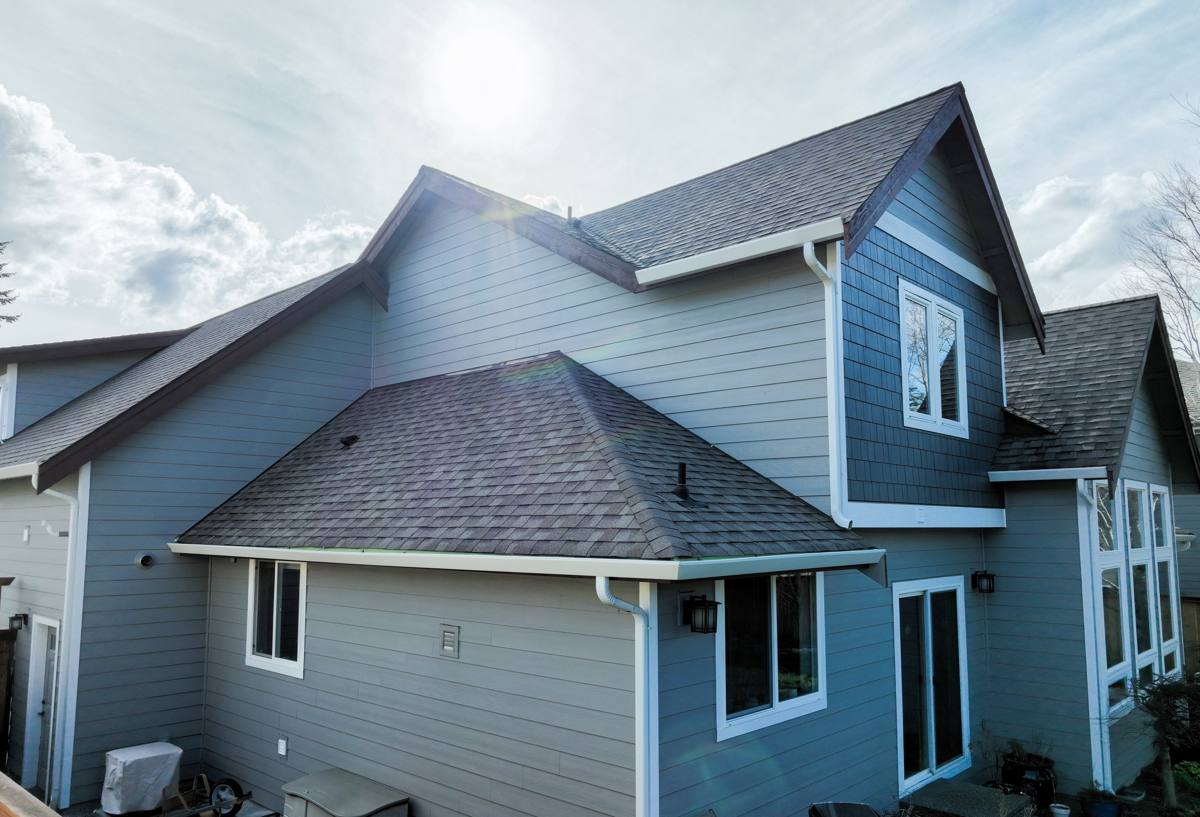
Why We Install Only James Hardie Fiber Cement
We don't install vinyl, LP SmartSide, Cemplank, Allura, or bare wood siding, and we're upfront about why. Each of those products can be a reasonable choice somewhere — but in a marine, high-moisture climate like Blaine's, we've found the trade-offs stack up against the homeowner over time. Vinyl expands, contracts, and can warp or crack in temperature swings and wind-driven rain. Engineered wood products like LP SmartSide use wood strand cores that are vulnerable if moisture gets past the coating, especially at cut edges and fastener points. Untreated or primed wood siding needs a repaint and recaulk cycle that most homeowners underestimate, and it's a magnet for the moss and mildew this area produces.
James Hardie fiber cement is cement, sand, and cellulose fiber — it doesn't rot, it isn't a food source for moss or mildew the way wood is, and it holds paint and factory finish far longer than wood-based alternatives. It's also non-combustible, which matters increasingly to insurers and homeowners alike. We put it on every home we side because it's the product we're willing to warranty our labor against in this specific climate — not because it's the only siding that exists.
HZ5 — Built for the Pacific Northwest
James Hardie engineers its HardieZone products for regional climate exposure, and the Pacific Northwest falls under the HZ5 designation. HZ5 products are formulated for high-moisture, freeze-thaw conditions rather than a generic national spec. For a Blaine home exposed to salt air and near-daily damp conditions, that regional engineering — not just the fiber cement material itself — is part of why the product holds up.
What Correct Hardie Installation Looks Like Here
Fiber cement siding is only as good as the installation behind it. Hardie's own installation instructions are detailed for a reason — moisture management is where most siding failures actually start, regardless of brand. On a Blaine home, we pay particular attention to:
- A drainable rainscreen gap behind the siding so any water that does get past the surface can drain and the wall can dry, instead of sitting against the sheathing
- Correct flashing at every window, door, and roofline penetration — the majority of siding leaks trace back to flashing details, not the siding material itself
- Manufacturer-specified fastener type, spacing, and embedment depth, using corrosion-resistant fasteners appropriate for a salt-air environment
- Proper board overlap and clearance at the ground, walkways, and roof lines to keep splash-back and standing moisture away from cut edges
- Factory-primed or ColorPlus cut edges sealed in the field per Hardie's guidelines, since an exposed raw edge is where moisture intrusion typically begins
- Caulking only where Hardie's instructions call for it — over-caulking traps moisture just as often as under-caulking lets it in
None of this is exotic. It's the difference between following the installation manual and not, and it's the single biggest factor in whether Hardie siding delivers the 30-plus years of service it's capable of, or develops problems inside a decade.
ColorPlus Finish vs. Field Painting
James Hardie's ColorPlus finish is baked on at the factory under controlled conditions, with a finish warranty that typically outperforms field-applied paint. In a climate with Blaine's UV-plus-salt-air exposure, that factory bond resists fading and chipping noticeably better than a job-site paint job, and it removes an entire maintenance task from your plate for years at a stretch.
Salt Air, Moss, and What They Actually Do to a House
It's worth being specific about the two climate factors called out for this area, because they cause different problems.
Salt air is corrosive to unprotected metal — nails, screws, flashing, and trim fasteners. Over years, corroding fasteners can loosen boards, stain the face of the siding with rust streaks, and compromise the very connections holding your siding to the wall. This is why fastener selection isn't a minor spec detail on a waterfront job — it's central to how long the installation lasts.
Moss and algae thrive in shaded, damp, poorly ventilated wall conditions — common on north-facing walls, tree-shaded lots, and anywhere airflow behind the siding is restricted. They don't just look bad; sustained moisture retention on an organic material like wood accelerates rot. Fiber cement doesn't feed moss the way wood does, but moss and algae can still grow on its surface if a wall stays damp long enough, which is another reason the rainscreen gap and proper drainage details matter as much as the siding material choice.
Comparing Siding Options for a Blaine Home
| Factor | James Hardie Fiber Cement | Vinyl | LP SmartSide / Wood |
|---|---|---|---|
| Salt air resistance | Strong — cement-based, doesn't corrode or feed organic growth | Moderate — can chalk, fade, and become brittle over time | Weaker — organic materials susceptible to moisture damage |
| Moisture / rot risk | Very low when installed per spec | Low material risk, but seams and fasteners are failure points | Higher — engineered or solid wood cores vulnerable at cuts and edges |
| Finish longevity | ColorPlus factory finish, long warranty | Color is through-body but can fade and chalk | Requires repainting on a regular cycle |
| Fire resistance | Non-combustible | Combustible, can melt/deform near heat | Combustible |
| Maintenance in this climate | Occasional wash; minimal upkeep | Low, but damage isn't easily repaired | Regular inspection, repaint/reseal cycle |
Our Process for a Blaine Siding Project
1. Assessment and Estimate
We start with an on-site look at your home's exposure — which walls face prevailing wind and rain, where shade and moisture collect, and the condition of what's currently on the wall. That tells us where extra attention to flashing, drainage, and fastening will matter most on your specific house.
2. Tear-Off and Sheathing Check
Old siding comes off and we inspect the sheathing and existing water-resistive barrier underneath. This is often the first time hidden moisture damage from years of wind-driven rain becomes visible, and it needs to be addressed before new siding goes on top of it.
3. Weather Barrier and Rainscreen
We install or verify a proper water-resistive barrier and build in the drainage gap that lets the wall assembly dry between rain events — the detail that matters most in a climate that doesn't get many fully dry weeks.
4. Hardie Installation to Spec
Boards, flashing, fasteners, and sealed edges installed per James Hardie's published instructions for HZ5 climate zones — not a generalized national approach.
5. Final Walkthrough
We walk the finished job with you, covering what basic maintenance looks like and what to watch for, so you know your home rather than just handing you an invoice.
Homeowner Maintenance Checklist for a Waterfront Climate
- Rinse siding with a garden hose once or twice a year to clear salt residue, pollen, and surface grime — a soft wash, not a pressure washer aimed directly at seams
- Check gutters and downspouts before the fall rains to keep water from overflowing onto siding and trim
- Look at north-facing and shaded walls periodically for early moss or algae growth and address it while it's light, before it thickens
- Keep landscaping trimmed back from the wall so air can circulate and walls can dry between storms
- Inspect caulking at trim and penetrations every year or two — caulk is a maintenance item even on a well-installed job
- Have any impact damage (a stray branch, equipment, etc.) repaired promptly rather than left, since an unsealed crack is an entry point for moisture
What Siding Replacement Typically Involves, Cost-Wise
Every home is different, and we won't quote a number without seeing your house, but the factors that drive cost are consistent across Blaine projects:
| Cost Factor | Why It Matters |
|---|---|
| Home size and wall complexity | More corners, gables, and trim details mean more labor and cut waste |
| Current siding removal | Tear-off of old material and disposal adds time versus new construction |
| Sheathing condition | Hidden rot or water damage found during tear-off may need repair before new siding goes on |
| Product line and profile | Lap width, texture, and trim choices affect material cost |
| Site access and exposure | Waterfront and hillside lots can require more scaffolding or staging |
Why It Matters That We Already Work in Blaine
A crew that only occasionally works this far north treats every Blaine job as a one-off. A crew that regularly works Whatcom County's waterfront communities already knows how a north wall on a shaded, water-adjacent lot behaves differently than a south-facing wall three blocks away, already carries the right fasteners for salt-air exposure, and isn't guessing at how much drainage detail a given wall needs. That local pattern recognition doesn't show up on a spec sheet, but it shows up in how long the siding lasts.
If you're planning a siding project in Blaine, we're happy to walk your property, look at how weather and moisture actually move across your walls, and put together a straightforward, no-pressure estimate for a correctly installed James Hardie system. Use the form below to get started.