 Bellingham Exterior
 Why Blaine's Climate Is Tougher on Siding Than Most of Whatcom County
Blaine sits right on the water at the northern edge of Whatcom County, and that location comes with a specific set of conditions that most siding products simply weren't built to handle long-term. Salt-laden air moves in off the bay and settles on exterior surfaces year-round. Driving rain, pushed sideways by wind off the water, gets forced into joints and laps that would stay dry on a more sheltered inland lot. And the long, wet, low-light stretch of fall through spring gives moss and algae months at a time to establish themselves on anything that holds moisture against its surface.
None of this is unique to any one property in Blaine — it's the baseline for homes anywhere near the coastline here, whether the lot is fully exposed to the bay or tucked back under tree cover. What changes from house to house is how much of that stress the siding is actually built to shed, and how correctly it was installed in the first place.
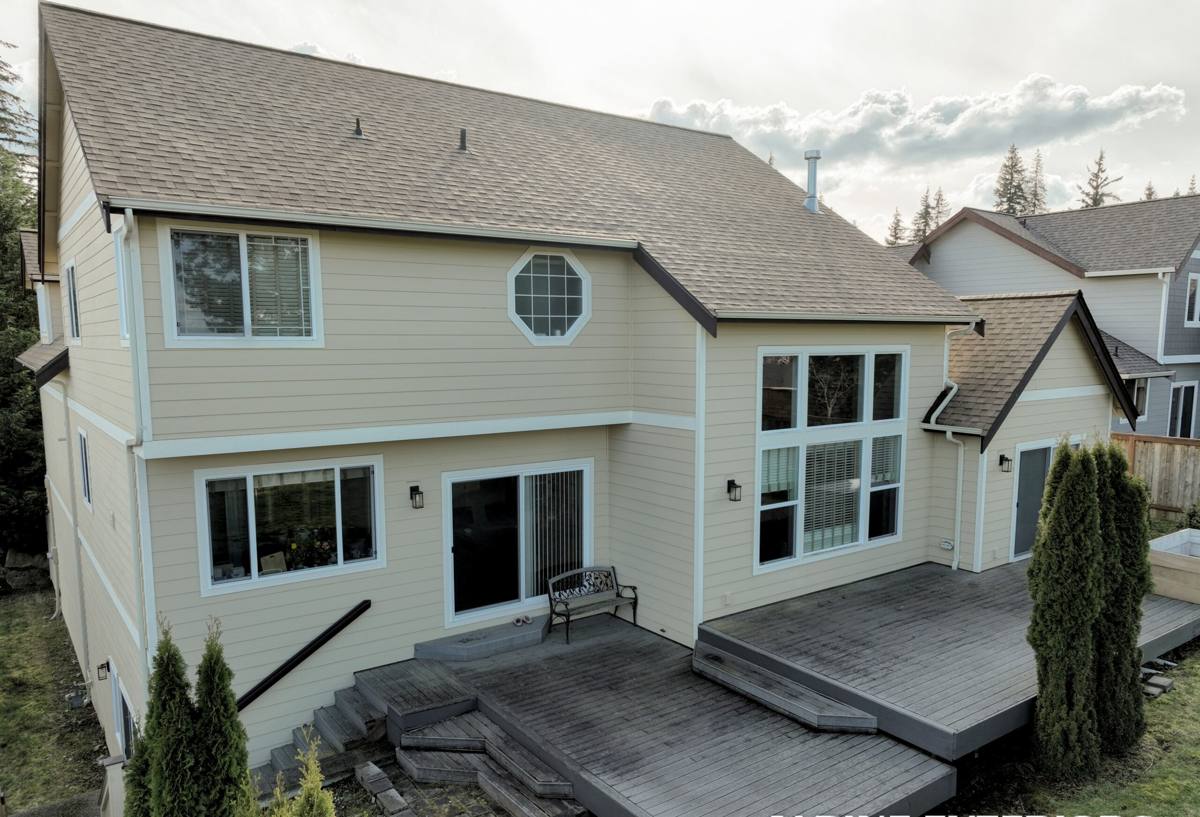
What Salt Air and Coastal Moisture Actually Do to a House
Salt Air and Metal Components
Airborne salt accelerates corrosion on anything metal — fasteners, flashing, trim screws, even paint film over time. Siding systems that rely on the wrong fastener type, or that expose fastener heads without adequate coating, tend to show rust streaks and loosening well before the siding material itself would otherwise need attention. This is a detail that's easy to get wrong and expensive to ignore.
Moss, Algae, and Prolonged Dampness
North-facing walls, shaded siding under tree canopy, and any wall that doesn't get direct sun for long stretches of the day are prime territory for moss and algae growth in this climate. On wood-based or wood-fiber siding products, that sustained moisture contact is exactly the condition that leads to swelling, softening, and eventual rot at seams and butt joints. The siding material matters here — some resist it far better than others.
Driving Rain and Wind-Driven Water Intrusion
Open exposure to the bay means wind-driven rain isn't a rare storm event — it's a recurring condition. Siding systems depend on more than the face material to stay dry behind the wall; the water-resistive barrier, flashing details, and lap geometry all have to work together. A siding product that's marginal on paper becomes a real problem once it's tested by repeated wind-driven rain over several winters.
Why We Install Only James Hardie Fiber Cement Siding
We standardized on James Hardie fiber cement for every siding job we take on, including here in Blaine, because it's engineered to handle exactly the conditions described above. It's a non-combustible cement-based product, not a wood or wood-composite material, so it doesn't swell, delaminate, or feed rot the way organic siding materials can when they stay damp. Hardie's ColorPlus factory finish is baked on under controlled conditions and holds up to UV and moisture exposure far better than a field-applied paint job, which matters on a coastline where repainting every few years isn't something most homeowners want to sign up for.
Hardie also builds region-specific product lines — its HZ5 formulation is engineered for climates like ours, with freeze-thaw cycling and sustained moisture exposure factored into the product itself rather than left to chance. That's a meaningful difference from siding products designed as one-size-fits-all for the whole country.
We understand fiber cement costs more upfront than vinyl and installs differently than LP SmartSide or cedar. That's a real trade-off, and we'll talk through it honestly during an estimate. But for a coastal Whatcom County property, we've found it's the product that actually holds up to the specific combination of salt, rain, and moss pressure this area produces — which is why it's the only siding we put on houses.
What a Correct Fiber Cement Installation Actually Involves
Fiber cement siding performs the way it's supposed to only when it's installed to spec. In a climate like Blaine's, the margin for error is smaller than it would be somewhere drier, because any gap in the moisture management sequence gets tested by real weather almost immediately.
- A continuous, properly lapped water-resistive barrier behind the siding, with no gaps or reverse laps that could direct water inward
- Correct flashing at every window, door, and roofline intersection, integrated with the barrier rather than just caulked over
- Proper clearance between the bottom of the siding and grade, roof lines, decks, and patios — typically several inches — so splashback and standing water can't wick into the material
- Fasteners driven flush, not overdriven, at the manufacturer's specified pattern and blind-nailed where the product allows it
- Field-cut edges sealed or touched up with matching ColorPlus product so raw cut ends aren't left exposed to moisture
- Caulking used only where Hardie's installation instructions call for it — over-caulking joints that are designed to move can trap moisture instead of shedding it
Skipping or rushing any one of these steps is the most common reason a fiber cement job underperforms — not the material itself. This is also where a lot of installation problems on older homes in this area trace back to: siding that looks fine from the curb but was never given proper clearance or flashing when it went up.
How Our Installation Process Works
- On-site assessment. We walk the exterior, check the condition of the existing sheathing and water-resistive barrier, and note problem areas — shaded walls, moss buildup, low-clearance sections near grade or decking.
- Removal and substrate check. Old siding comes off and we inspect the sheathing underneath for rot or moisture damage before anything new goes on. Problems found here get addressed before installation, not covered up.
- Weather barrier and flashing. A new water-resistive barrier goes on with correctly lapped seams, and flashing is integrated at every penetration and transition point.
- Siding installation. HardiePlank, panel, or shingle siding is installed per Hardie's fastening and clearance specifications, adjusted for the specific exposure of each wall on the house.
- Trim and finish work. Corner boards, trim, and cut-edge sealing are completed, and touch-up is applied where field cuts exposed raw material.
- Final walkthrough. We go over the finished work with the homeowner and point out anything worth knowing for long-term upkeep.
Choosing the Right Hardie Product Line for a Blaine Home
James Hardie makes several siding profiles, and the right choice depends on the home's style and how exposed the walls are to wind and rain off the water.
| Product | Look | Best suited for |
|---|---|---|
| HardiePlank Lap Siding | Traditional horizontal lap, smooth or woodgrain texture | Most home styles; the standard choice for full-exposure walls facing the bay or open wind |
| HardiePanel Vertical Siding | Clean vertical panels, often paired with battens | Modern or craftsman-style homes, accent walls, gable ends |
| HardieShingle Siding | Staggered or straight-edge shingle profile | Homes wanting a cedar-shake look without the moisture and moss issues real cedar shingles develop in this climate |
All three are manufactured in Hardie's HZ5 formulation appropriate for our region and come with the same factory ColorPlus finish options, so the choice usually comes down to architectural style rather than performance.
What Affects the Cost of a Blaine Siding Project
| Factor | Why it matters |
|---|---|
| Home size and wall complexity | More square footage and more corners, gables, and dormers mean more material and labor |
| Tear-off vs. new sheathing | Homes with rot or moisture damage under the old siding need substrate repair before new siding goes on |
| Siding profile and finish | Lap, panel, and shingle products vary in material and labor cost, as do premium ColorPlus color options |
| Trim and detail work | Custom corner boards, window trim, and transitions add labor time |
| Site access | Waterfront lots, steep grades, or tight setbacks can affect staging and equipment access |
We give a firm, itemized quote after walking the property — not a rough estimate based on square footage alone, since the condition of what's underneath the existing siding often matters as much as the size of the house.
Maintaining Fiber Cement Siding in a Coastal, Moss-Prone Climate
One of the real advantages of fiber cement in this climate is how little upkeep it needs compared to wood siding — but "little" isn't "none." A short annual routine goes a long way toward protecting the investment.
- Rinse the exterior with a garden hose (not a pressure washer aimed directly at seams) once or twice a year to clear salt residue and organic buildup
- Check shaded and north-facing walls for early moss or algae growth and address it before it spreads
- Keep gutters clear so overflow isn't running down the siding face repeatedly
- Trim back vegetation and tree limbs that keep a wall section shaded and damp longer than the rest of the house
- Inspect caulking at trim and penetrations every year or two and have any cracked sections redone
Why Hiring a Crew That Already Works in Blaine Matters
Siding installation isn't one-size-fits-all across Whatcom County. A crew that mostly works inland jobs may not think twice about fastener corrosion resistance near salt air, or about how much extra clearance a wall facing open water needs compared to a sheltered one. Working in and around Blaine regularly means we've seen how moss patterns show up on local homes, which wall orientations take the worst of the wind-driven rain, and where standard installation details need to be tightened up for this specific stretch of coastline. That local pattern recognition, combined with manufacturer-correct installation, is what keeps a siding job performing well ten and twenty years out instead of just looking good on install day.
If you're weighing a siding replacement on a Blaine home, we're happy to walk the property, look at what your current siding is telling us, and put together a straightforward, no-pressure estimate for a correctly installed James Hardie system built for this climate.