 Bellingham Exterior
 Why Decks in Columbia Wear Out Faster Than the Manuals Say
Every deck manufacturer publishes a lifespan estimate, and almost none of them were written with a neighborhood like Columbia in mind. Sitting close to Bellingham Bay, homes here take on a combination that's harder on outdoor structures than most inland areas of Whatcom County ever see: salt-laden air off the water, long stretches of driving rain that comes in sideways instead of straight down, and a moss season that can stretch from October well into May. None of these factors alone would be a big deal. Together, applied year after year to the same ledger board, joists, and fasteners, they add up fast.
Salt air is corrosive to exposed metal — nails, screws, joist hangers, bolts — even when that metal is rated for outdoor use. Driving rain doesn't just wet the deck surface; it drives moisture sideways into board gaps, under flashing, and into end grain where boards were cut on site and never resealed. And moss doesn't just make a deck slippery. It holds moisture against the wood surface for months at a time, which is exactly the condition that lets rot organisms get established. A deck built to a generic national spec, without those three things in mind, tends to show its age in this part of Washington well before it should.
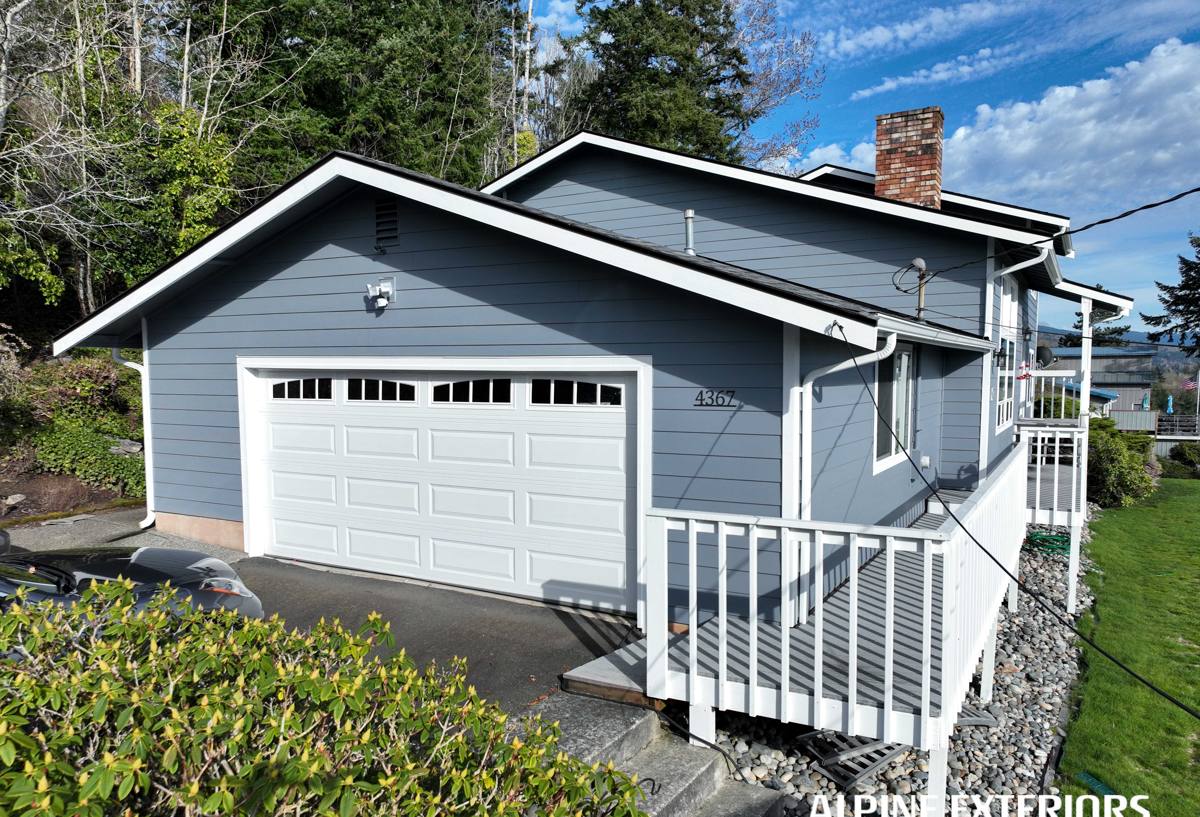
Signs a Columbia Deck Needs Replacement, Not Another Repair
Not every tired-looking deck needs to come out. But there's a point where patching boards and re-staining stops being a fix and starts being a way to delay a decision. Here's how we tell the difference during an inspection.
Repair Is Usually Enough When:
- A handful of boards are cupped, splintering, or soft, but the framing underneath is solid
- The ledger board connection to the house is intact and properly flashed
- Footings and posts show no rot, heaving, or movement
- Fasteners are surface-corroded but not failing structurally
Replacement Is the Honest Answer When:
- A screwdriver sinks easily into joists, beams, or the ledger board
- Moss or algae has colonized the underside of the deck, not just the walking surface
- Footings have shifted, cracked, or lost contact with the posts they support
- The deck was built without proper ledger flashing — common in older construction here — and water has been tracking behind the siding
- Multiple structural members are affected rather than isolated boards
That last point matters most. A deck is a structural assembly, not a collection of independent boards. Once rot or corrosion has reached the framing in more than one area, spot repairs just relocate the failure point rather than solving it.
What a Correct Deck Replacement Actually Involves
A deck replacement done right is a rebuild from the ground up, not a resurfacing job. Skipping any of the steps below is how a brand-new deck ends up with the same problems as the old one within a few wet seasons.
Structure First
Footings get inspected or replaced to current frost-depth and bearing requirements. Posts, beams, and joists are sized for the actual span and load — not just matched to whatever was there before. Joist spacing gets tightened where the old deck was under-built, which is more common than homeowners expect on decks that predate current code.
The Ledger Connection
Where the deck attaches to the house is the single most important — and most often botched — part of the entire structure. It needs proper flashing that sheds water away from the house framing, correctly rated structural screws or bolts (not deck screws), and a gap or drainage plane so water doesn't sit trapped between the ledger and the siding. In a climate that delivers rain sideways for months at a time, a poorly flashed ledger is where the next rot problem starts.
Fasteners and Hardware
Every joist hanger, post base, and structural screw should be rated for the specific wood treatment used and for coastal exposure. Mixing incompatible metals accelerates corrosion — an issue that shows up faster here than it would forty miles inland.
Decking Surface and Drainage
Board spacing, ventilation underneath the deck, and slope away from the house all affect how quickly the structure dries out after a storm. A deck that can't shed water and air it out between rain events stays wet longer, and wet is what invites moss and rot.
Choosing a Decking Material for This Climate
There's no single right answer here — it depends on budget, maintenance appetite, and how the deck will be used. What we won't do is install something that looks good on day one but creates a maintenance trap in a climate this wet. Here's how the common options actually compare for a Columbia-area home.
| Material | Moisture Behavior Here | Maintenance | Typical Lifespan |
|---|---|---|---|
| Pressure-treated lumber | Good if sealed regularly; end grain and cut edges are vulnerable | Annual cleaning, re-sealing every 1-2 years | 10-15 years with upkeep |
| Cedar | Naturally rot-resistant but still needs sealing against driving rain | Cleaning and finish renewal every 1-2 years | 15-20 years with upkeep |
| Composite decking | Excellent moisture resistance; won't absorb and swell like wood | Periodic washing to keep moss/algae from gripping the surface texture | 25-30+ years, manufacturer-dependent |
| PVC decking | Fully moisture-proof; nothing to swell, cup, or rot | Occasional washing | 25-30+ years, manufacturer-dependent |
Composite and PVC decking have become popular in this area for a simple reason: moss and algae still land on the surface, but they don't get a foothold in swollen grain or checking the way they do on wood. That doesn't mean wood is a bad choice — a well-sealed cedar deck, maintained on schedule, holds up fine here. It just means the maintenance commitment is real, and we'll tell you that honestly rather than sell you a material that doesn't match how much upkeep you actually want to do.
Our Deck Replacement Process
- On-site assessment — we inspect the existing structure, ledger connection, footings, and framing to confirm replacement is the right call and identify anything hidden (rot behind siding, undersized framing, etc.)
- Design and material selection — sizing, layout, railing, and decking material chosen based on your budget and how the space gets used
- Permitting — we handle the paperwork with the City of Bellingham or Whatcom County, depending on the property's jurisdiction
- Demolition and disposal — full removal of the old deck, including any hidden rot in the ledger area
- Structural rebuild — footings, posts, beams, joists, and ledger flashing installed to current code, not just replicated from the old build
- Decking, railing, and finish work — installed with proper spacing and fastening for drainage and long-term stability
- Final walkthrough — we go over the finished deck with you, including realistic maintenance expectations for the material you chose
Permits and Local Code
Most deck replacements in and around Bellingham require a building permit, particularly when the structure attaches to the house or exceeds a certain height above grade. Requirements depend on whether the property falls under City of Bellingham or Whatcom County jurisdiction, and on specifics like deck height, footprint, and proximity to property lines. Skipping the permit step is a common shortcut that causes real problems later — at resale, with insurance, or if the work doesn't hold up to inspection when you eventually sell. We pull the necessary permits as part of the job rather than leaving that on you.
What Affects the Cost of a Deck Replacement
Every deck is different, so we won't put a number on your project until we've seen it. But these are the factors that move the price up or down, in rough order of impact.
| Factor | Why It Matters |
|---|---|
| Size and footprint | More square footage means more material and labor across the board |
| Decking material | Composite and PVC cost more upfront than wood but less over time in maintenance |
| Height and stairs | Taller decks and multi-level layouts require more structural framing and railing |
| Ledger/structural condition | Hidden rot behind siding or undersized old framing adds scope once uncovered |
| Railing style | Cable, glass, and custom railing systems cost more than standard baluster railing |
| Access and site conditions | Tight lots, slopes, or limited equipment access can add labor time |
Why It Matters to Hire a Crew That Already Works in Columbia
A deck built to a generic spec sheet, without accounting for the specific way weather behaves this close to the water, tends to develop the same problems the old deck had — just on a delay. A crew that already works in Columbia and the surrounding Bellingham neighborhoods has seen how ledger flashing fails here, which fastener grades actually hold up against salt air over years rather than months, and how much drainage and airflow a deck really needs underneath to keep moss from taking over the underside. That's not something you can get from a materials catalog. It comes from having replaced enough decks in this specific environment to know where the shortcuts show up later.
Before you hire anyone for a deck replacement in this area, it's worth asking a few direct questions:
- Will you pull the required permit, or is that left to me?
- What fastener and hardware ratings will you use, and why?
- How will the ledger board be flashed against the house?
- What's your plan for drainage and airflow underneath the deck?
- Can you walk me through why you're recommending this decking material for my situation specifically?
If a contractor can't answer those clearly, that's worth noting before you sign anything.
If your deck in Columbia is showing its age — soft spots, moss that won't stay off, or a structure that just doesn't feel as solid as it used to — we're happy to take a look and give you an honest assessment of repair versus replacement. Use the form below to request a free, no-pressure estimate.