 Bellingham Exterior
 Sehome's Siding Has a Harder Job Than It Looks Like
Sehome sits close enough to Bellingham Bay to catch salt-laden air on a regular basis, and close enough to Sehome Hill's tree canopy that a lot of homes in the neighborhood live in partial shade for a good chunk of the day. That combination — salt air plus shade plus Whatcom County's long, wet stretch of driving rain from fall through spring — is exactly the kind of environment that separates siding that holds up for decades from siding that starts failing in year eight or ten. It's not dramatic. It's slow: a little more moss on the north wall each winter, paint that dulls faster than it should, caulk lines that crack a season before you'd expect. By the time it's obvious from the street, the substrate underneath has usually already taken damage.
We work on homes throughout Sehome regularly, and the pattern is consistent. Whatever siding is on the house, the wall assembly behind it — the water-resistive barrier, the flashing, the fastening, the clearances at grade — matters as much as the material itself. A siding replacement done right in this neighborhood has to account for both.
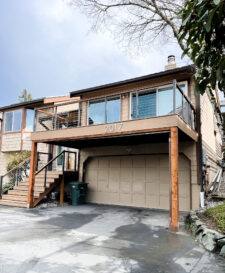
What Bellingham's Climate Actually Does to Siding
It helps to be specific about the mechanisms, not just say "wet climate":
- Salt air off Bellingham Bay accelerates corrosion on fasteners, flashing, and any exposed metal trim — and it degrades some paint and coating systems faster than a dry inland climate would.
- Driving rain in wind-driven storms pushes moisture sideways into seams, laps, and butt joints, not just straight down. Siding and flashing details that only shed vertical water fail here.
- Shade and tree cover, common on lots near Sehome Hill, keep walls damp longer after a storm and create the conditions moss and algae need to establish.
- A long moss season — realistically most of the year in a shaded, humid climate like this — means any siding with texture, seams, or absorbent surface is going to host growth if it isn't shedding water and drying out efficiently.
None of this is unique to Sehome specifically — it's the Pacific Northwest coastal reality — but Sehome's mix of older housing stock, mature trees, and proximity to the bay puts it on the harder end of that spectrum within Bellingham.
Sehome's Housing Stock and What It Means for a Replacement
Sehome is one of Bellingham's older, more established neighborhoods, with a mix of home ages and a lot of houses that have been re-sided at least once already, sometimes with materials that were reasonable choices decades ago but haven't aged well under this climate. When we replace siding on a Sehome home, we're almost always dealing with an existing wall assembly that needs a real look, not just a materials swap:
- Older water-resistive barriers (or none, on some older construction) that need to be brought up to a modern standard.
- Window and door flashing that may have been installed to a lower standard than current best practice, especially on homes that predate today's flashing tape and integrated systems.
- Trim, fascia, and soil-to-siding clearances that have shifted over the years — landscaping grown up, grade raised, gutters altered — all of which change how water behaves against the wall.
A siding replacement is the one point in a home's life where all of that is exposed and fixable at once. Doing it well means treating it as a wall-assembly project, not a facade change.
What a Correct Siding Replacement Actually Involves
Tear-off and inspection
Old siding comes off down to the sheathing, and we inspect for rot, soft spots, and prior water damage before anything new goes up. Anything compromised gets repaired or replaced — covering damaged sheathing with new siding just hides a problem that keeps getting worse.
Water-resistive barrier and flashing
A new WRB goes on correctly lapped, and flashing at every window, door, and penetration is integrated with that barrier so water is directed out and down, never trapped behind the cladding. In a driving-rain climate like Bellingham's, this layer does more long-term work than the siding itself.
Fastening and clearances
Fastener type, spacing, and penetration depth all follow manufacturer specification — this is where a lot of installations quietly go wrong, since undriven or overdriven fasteners and wrong-length nails cause problems that don't show up for years. Clearances at grade, decks, patios, and roof lines are set to keep siding out of standing water and splash-back.
Finish and trim
Trim, corners, and joints are detailed to shed water at every seam, not just look finished from the curb.
Why We Install Only James Hardie Fiber Cement
We standardized on James Hardie fiber cement siding and don't install vinyl, LP SmartSide, or other fiber cement brands, and it's worth being straightforward about why. Vinyl performs fine in mild conditions but softens, fades, and cracks under long-term sun and cold-cycling stress, and its seams give wind-driven rain plenty of opportunities. Engineered wood products like LP SmartSide are treated to resist moisture but remain wood-based, meaning any breach in that treatment — a cut edge, a fastener hole, a chip — opens a path for water and rot in a climate that rarely lets a wall fully dry out. Cedar and primed spruce look great initially but demand a repainting and caulking schedule that most homeowners underestimate, and they're combustible.
James Hardie fiber cement is non-combustible, dimensionally stable, and doesn't feed moss and algae the way wood-based products can — it also holds a factory-applied ColorPlus finish that's baked on and warrantied, rather than a field-applied coat that's the first thing to fail. It's engineered in climate-specific product lines, and the Pacific Northwest HZ5 formulation is built for exactly the freeze-thaw and moisture cycling that Whatcom County sees. It costs more than vinyl up front. Over the life of the siding — fewer repaints, less caulk maintenance, no rot risk from moisture intrusion — it's the material we're willing to put our name behind in this climate.
Comparing Siding Options for a Sehome Home
| Material | Moisture behavior in this climate | Maintenance | Longevity |
|---|---|---|---|
| Vinyl | Sheds water but seams and laps are weak points under driving rain; can warp in temperature swings | Low, but limited repair options once damaged | Variable; UV and cold-cycling shorten lifespan |
| LP SmartSide / engineered wood | Treated wood substrate — vulnerable at cuts, fastener holes, and joints if the treatment is breached | Repainting and joint caulking on a recurring schedule | Depends heavily on installation quality and upkeep |
| Cedar / primed spruce | Natural wood; absorbs moisture, prone to moss and rot without diligent upkeep | High — regular repainting, caulking, moss treatment | Shortest without consistent maintenance investment |
| James Hardie fiber cement | Non-combustible, dimensionally stable, engineered HZ5 line for PNW moisture and freeze-thaw cycling | Low — factory ColorPlus finish resists fading and chalking | Long-term, backed by a strong transferable warranty |
Our Process on a Sehome Job
- On-site assessment. We look at the existing siding, wall assembly condition, shade and drainage patterns specific to your lot, and any trouble spots — north-facing walls, areas under tree cover, low-clearance sections.
- Tear-off and sheathing inspection. Old material comes off, damaged sheathing is identified and addressed before anything new is installed.
- WRB and flashing installation. A continuous, correctly lapped water-resistive barrier with integrated flashing at every opening.
- James Hardie installation to spec. Correct fastening, spacing, and clearances, following manufacturer requirements for the HZ5 product line.
- Trim, caulking, and final detail work. Every seam and joint finished to shed water, not just look clean.
- Walkthrough and cleanup. We review the finished work with you and leave the site clean.
Signs a Sehome Home Needs Siding Replacement
- Moss or algae returning within months of cleaning, especially on shaded or north-facing walls
- Paint that's chalking, peeling, or fading noticeably faster than the rest of the house
- Soft spots, warping, or visible gaps at seams and corners
- Caulk lines cracking or separating from the siding
- Musty smells or discoloration on interior walls that share an exterior wall
- Siding that's original to a home built more than 20-25 years ago and has never been replaced
Why It Matters to Hire a Crew That Already Works Sehome
A crew that regularly works this neighborhood already understands the practical realities that don't show up in a spec sheet — how shade patterns from mature trees affect drying time on different walls, where salt exposure tends to concentrate, and how older Sehome homes were typically built and previously re-sided. That familiarity shows up in better decisions during tear-off, when the existing wall assembly is exposed and choices have to be made about what to repair versus what's fine to build over. It also means a contractor who can speak plainly about what your specific lot and home need, instead of applying a generic approach.
What Affects Your Estimate
Every home is different, but the main cost factors on a Sehome siding replacement are consistent: the size and complexity of the home's exterior (corners, gables, dormers all add labor), the condition of the sheathing and framing once old siding is removed, the amount of trim and detail work involved, and the James Hardie product line and color selected. We won't know your real number until we've seen the house, and we won't inflate a lowball estimate just to win the job and change it later.
If your Sehome home's siding is showing its age — moss that keeps coming back, paint that's failing early, or siding that's simply reached the end of its service life — we'd be glad to take a look and put together a straightforward, no-pressure estimate. There's a form below to get started.