 Bellingham Exterior
 Storm Damage Roofing on South Hill
South Hill sits up above downtown Bellingham with mature trees, older homes, and enough elevation to catch wind that the flats below don't get. That combination — big trees, exposed rooflines, and decades-old roofing on a lot of the housing stock — means storm damage here tends to look different than storm damage in a newer, more sheltered subdivision. We work on South Hill roofs regularly and know what to look for after a wind event, a heavy rain system, or a branch strike, and what an honest repair actually requires.
This page is specifically about storm damage repair for South Hill homes. If you just went through a windstorm or an atmospheric river event and you're not sure whether your roof needs attention, this is what we'd walk you through in person.
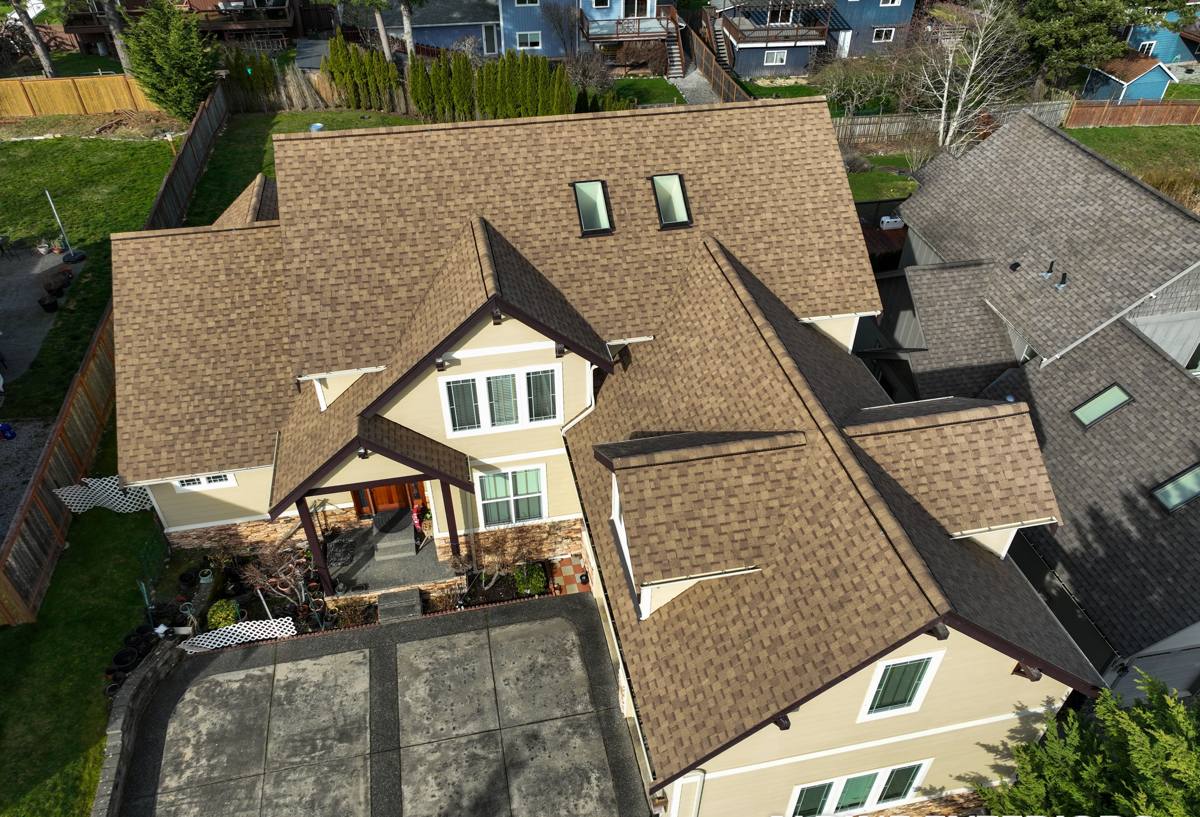
Why South Hill Roofs Take a Different Kind of Beating
Wind and Tree Exposure
Elevation and mature tree canopy are the two biggest factors on South Hill. Wind that funnels off Bellingham Bay and up the hill can hit roof edges and ridgelines harder than it does in low-lying, more sheltered parts of town. Add in large conifers and deciduous trees close to a lot of these older properties, and you get two failure modes: direct impact damage from falling limbs, and long-term wear from constant branch rub, needle drop, and shade that never lets a roof fully dry out.
Salt Air, Driving Rain, and Moss
Whatcom County's marine climate doesn't spare South Hill. Salt-laden air off the bay slowly works on exposed metal — flashing, fasteners, gutter hardware — and driving rain during winter storms tests every seam, valley, and penetration a roof has. Between storms, our long moss season does its own quiet damage: moss holds moisture against the roofing material, lifts shingle edges, and works its way under flashing over a few seasons if it isn't kept in check. A roof that survives a windstorm intact can still be losing integrity to moss nobody's looked at in years.
Age of the Housing Stock
A meaningful share of South Hill homes are older builds, some with roofs that have been re-covered more than once. Older roofs have less reserve capacity — a wind event or a falling limb that a newer roof would shrug off can be the thing that finally exposes decking, degraded underlayment, or flashing that was already marginal. That's part of why storm damage repair on South Hill so often turns into "let's talk about what else is going on up here" rather than a single isolated fix.
What Counts as Storm Damage (and What Doesn't)
Homeowners often assume storm damage means missing shingles or a hole you can see from the ground. In practice, most storm damage on South Hill roofs is quieter than that.
- Lifted or creased shingle tabs from wind uplift, especially along ridges, hips, and roof edges
- Cracked, dented, or displaced flashing around chimneys, skylights, and roof-to-wall transitions
- Granule loss from wind-driven rain and debris, visible as bare-looking patches or granules in gutters
- Branch or limb strikes that puncture, crack, or displace roofing material without leaving an obvious hole
- Gutter and downspout damage that lets water back up under the roof edge during heavy rain
- Nail pops and fastener backout from repeated wind flexing over multiple storms
- Underlayment or decking issues that only show up once you pull back the surface layer
Some of these are obvious from the ground. Most aren't. That's the main reason we recommend a roof gets looked at after any notable wind event, even if nothing looks wrong from the driveway.
What a Correct Storm Damage Repair Involves
Diagnosis Before Repair
The first step is figuring out the actual extent of the damage — not just the visible symptom. A cracked shingle near a valley might mean the valley flashing underneath took the real hit. A soft spot on the ceiling below might trace back to a flashing failure ten feet away, not directly above the stain. We inspect the full roof plane involved, not just the spot the homeowner points to, because storm damage rarely stays exactly where it started.
Matching Materials, Not Improvising
Repairs need to match the existing roofing system in material, weight, and installation method — mismatched shingles or the wrong underlayment can create a new leak path even when the visible repair looks fine. On older South Hill roofs, that sometimes means sourcing a close match rather than an exact one, and being upfront with the homeowner about that tradeoff before starting.
Flashing and Water Path First
Most roof leaks trace back to flashing and water management details, not the field of the roof itself. Any real storm repair re-establishes a correct water path — proper laps, sealed penetrations, flashing that directs water away from the structure rather than just covering the damaged area. Covering a hole without correcting the water path underneath it is a patch, not a repair, and it tends to fail again in the next storm.
Structural Check When Warranted
If a limb strike or long-term water intrusion has reached the decking, we check for soft spots, rot, or sagging before closing anything up. Replacing damaged decking costs more up front than skipping it, but roofing over compromised decking just guarantees a repeat call.
Our Process for South Hill Storm Repairs
- Inspection. We walk the roof (or use a ladder and binoculars when conditions or pitch make that safer) and document the damage with the homeowner present or informed.
- Straight explanation. We tell you what's damaged, what's just wear, and what we'd genuinely recommend fixing now versus watching.
- Written scope and estimate. You get a clear description of the repair, the materials involved, and the cost before anything starts.
- Repair. We do the work, including flashing and water-path corrections, not just surface patching.
- Follow-up. We'll tell you if there's anything worth revisiting after the next heavy rain, particularly on older roofs where a repair sometimes reveals a second issue nearby.
Repair vs. Replacement: How We Help You Decide
| Factor | Leans Toward Repair | Leans Toward Replacement |
|---|---|---|
| Age of roof | Under roughly half its expected service life | Near or past expected service life |
| Extent of damage | Isolated to one area or plane | Spread across multiple sections |
| Decking condition | Solid, no rot found | Soft spots or rot discovered during inspection |
| Moss/wear history | Minimal prior moss buildup or granule loss | Heavy moss history or widespread granule loss |
| Storm frequency | First notable event in years | Repeated damage across recent storm seasons |
None of these factors decide things alone — they're weighed together. A 20-year-old roof with an isolated flashing failure and solid decking is usually a repair. A 20-year-old roof with the same flashing failure plus heavy moss and soft decking is a different conversation, and we'll tell you that plainly rather than repairing around a bigger problem.
What to Do Right After a Storm
- Check attic spaces or ceilings for new water stains, especially after the first heavy rain following a windstorm
- Look at gutters and the ground below the roofline for shingle granules, torn material, or fallen flashing pieces
- Note any large limbs down near the house, even ones that didn't visibly strike the roof
- Avoid climbing onto a wet or storm-damaged roof yourself — pitch, moss, and hidden soft spots make this genuinely dangerous
- Get an inspection scheduled before the next rain system, since exposed damage gets worse fast in back-to-back storms
- Photograph visible damage from the ground for your records and any insurance conversation
Why a Crew That Already Works South Hill Matters
Storm repair on a hillside neighborhood with mature trees and older roofing isn't the same job as storm repair on a flat, newer subdivision. Knowing which South Hill roof types tend to hide decking issues, how the wind behaves coming up off the bay, and how aggressively moss builds under this area's tree cover means less guessing and a repair that's scoped correctly the first time. We're not learning South Hill's roofing quirks on your project — we've already seen them on the house down the street.
Get a Free, No-Pressure Estimate
If a recent storm has you wondering about your roof, we're glad to come take a look. There's no cost and no pressure — just a straight assessment of what we find and what, if anything, needs doing. Use the form below to request your free South Hill storm damage estimate.