 Bellingham Exterior
 Decks in Sudden Valley Face a Different Set of Problems
Sudden Valley sits in the trees along Lake Whatcom, and that setting is exactly what makes it a beautiful place to build a deck — and exactly why decks here need to be built differently than a deck in an open, sunny subdivision. Heavy tree canopy means shade that lingers most of the day on a lot of homes. Proximity to the lake means humidity that doesn't burn off quickly, even in summer. And Whatcom County's long wet season means a deck surface can stay damp for days at a stretch between storms. None of that is a reason to avoid building a deck — it's just information that should shape how the deck gets built.
A deck that would hold up fine on a dry, open lot elsewhere in Bellingham can develop real problems in a shaded Sudden Valley yard within a few seasons: soft spots in the decking, moss creeping across boards, hardware that stains or weeps rust, and framing that never fully dries out between rain events. The fix isn't exotic materials or a radically different design — it's getting the basics right for the site conditions, which is where a lot of decks quietly go wrong.
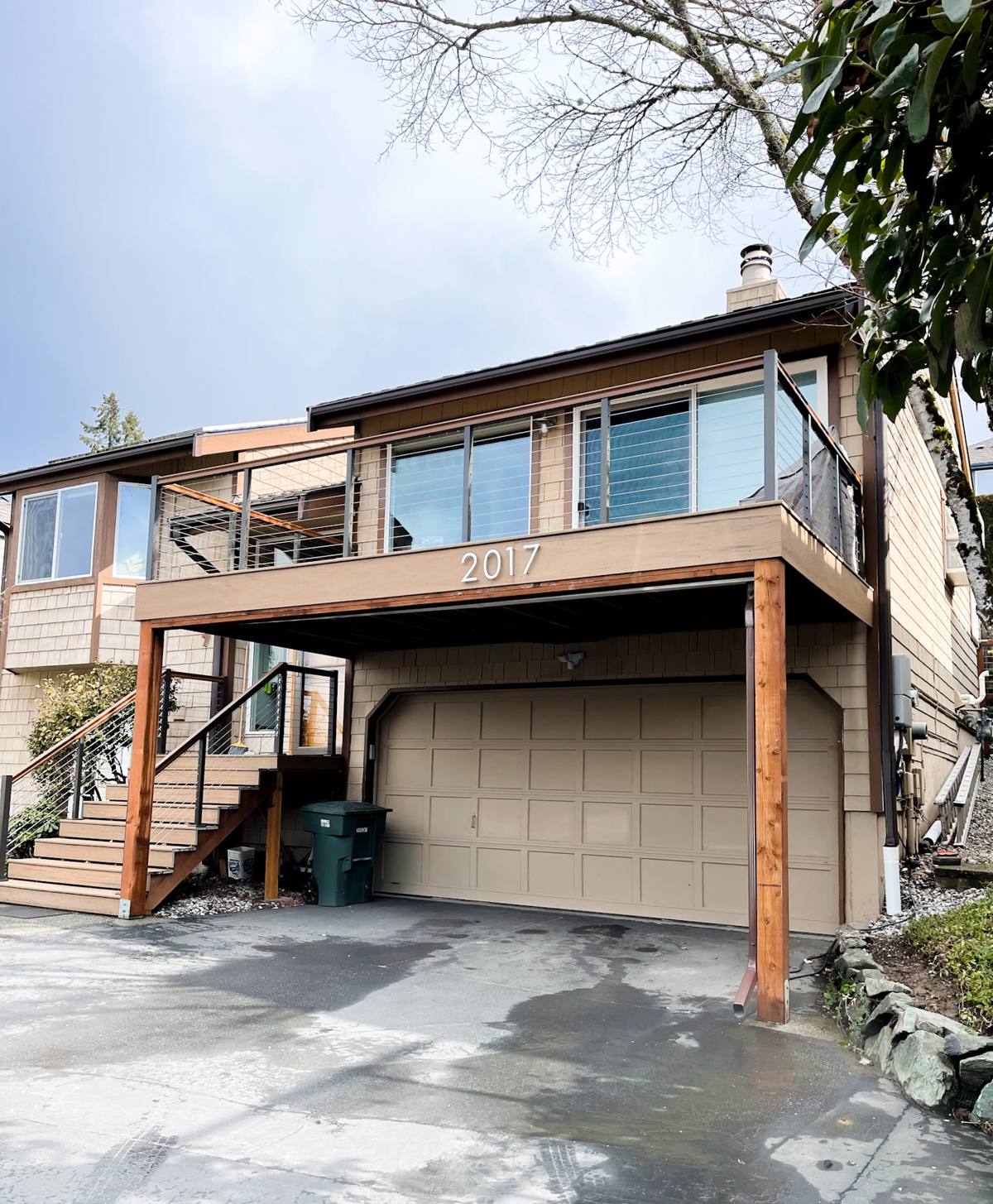
What Local Conditions Actually Demand From a Deck
Moisture That Doesn't Leave
Driving rain off the lake combines with tree cover that blocks sun and wind, so wood surfaces and framing members can stay wet far longer than they would in the open. That extended wet time is the single biggest driver of rot, mold, and moss growth on a deck in this kind of setting.
Moss and Organic Buildup
Shaded, damp wood surfaces are exactly what moss and algae need to establish. Beyond looking bad, a mossy deck surface holds moisture against the boards and turns slick and dangerous underfoot — a real slip hazard on stairs and landings, especially with morning dew.
Salt Air and Metal Hardware
Being close to the water means a low but steady exposure to salt-laden air, which accelerates corrosion on fasteners, brackets, and any exposed metal connectors. Hardware that isn't rated for this kind of exposure can start staining the decking or losing strength well before the wood itself is due for replacement.
Uneven, Wooded Lots
Many Sudden Valley properties are sloped, tree-lined, or both. That affects footing depth, ledger attachment, drainage under the deck, and sometimes the whole structural approach — a deck stepping down a hillside needs different engineering than a flat deck off a walkout basement.
Getting the Framing and Fasteners Right
Most deck failures we see in this area trace back to the parts nobody looks at once the boards are down — the framing, flashing, and fasteners. In a wet, shaded environment, these details matter more than they would in a drier climate:
- Ledger board flashing that actually sheds water away from the house rim joist, not just a bead of caulk behind the ledger
- Stainless steel or heavy-duty coated fasteners rated for ground contact and coastal exposure, not general-purpose hardware
- Joist tape or a comparable moisture barrier on top of framing lumber to slow water intrusion at every screw hole
- Proper board spacing and consistent gaps so water and debris can actually drain instead of pooling between boards
- Footings set below frost depth and sized for the soil conditions on the specific lot, especially on sloped ground
- Airflow underneath the deck — enough clearance and ventilation that the framing has a chance to dry between rain events
Skipping any one of these doesn't show up on day one. It shows up two, three, or five years in, as soft framing, streaking on the fascia, or a deck that starts to feel spongy near the house.
Choosing Decking Material for a Shaded, Wet Lot
There's no single "best" decking material — there's a best material for a given lot, budget, and how much upkeep an owner actually wants to do. In a canopy-covered, humid setting like much of Sudden Valley, the trade-offs shift a bit compared to an open, sunny yard.
| Material | How It Handles Shade & Moisture | Maintenance | Typical Lifespan |
|---|---|---|---|
| Pressure-treated wood | Prone to moss and staining in deep shade; needs regular cleaning and sealing to shed water | Annual cleaning, periodic staining/sealing | 10–15 years with upkeep |
| Cedar | Naturally more rot-resistant but still needs finish maintenance to stay ahead of moss in low-light areas | Regular cleaning, refinishing every few years | 15–20 years with upkeep |
| Capped composite | Resists moisture absorption well; still needs occasional washing to keep moss/algae from gripping the surface texture | Periodic washing, no staining or sealing | 25–30+ years |
| PVC decking | Fully synthetic, minimal moisture absorption, best resistance to mold and moss staining | Occasional washing | 25–30+ years |
We don't push one material on every job. Wood has a real place, especially where budget matters and an owner is willing to keep up with cleaning and refinishing. Composite and PVC cost more up front but make sense on heavily shaded lots where an owner wants to spend weekends doing something other than scrubbing moss off a deck every spring.
A Word on Product Selection
We install both wood and composite/PVC systems, including well-established composite brands, and we're upfront about the trade-offs of each rather than steering every job toward the highest-margin product. Composite and PVC systems are more sensitive to installation details — hidden fastener spacing, expansion gaps, and picture-frame trim all need to be done to the manufacturer's spec or the warranty can be at risk. That's a reason to hire carefully, not a reason to avoid the material.
Structural Considerations on Sloped and Wooded Lots
A meaningful share of Sudden Valley properties aren't flat. Elevated decks, decks stepping down toward the lake, and decks built around mature trees all call for footing and framing decisions that a cookie-cutter deck plan doesn't account for. Depending on the height and slope, that can mean deeper or additional footings, engineered beam sizing, and sometimes guardrail and stair configurations that need more planning than a simple ground-level deck. We assess the actual site — soil, slope, tree root zones, and drainage path — before finalizing a design, rather than fitting the lot to a standard plan.
Permits and Whatcom County Requirements
Deck projects above a certain height or attached to the house typically require a building permit, and elevated or complex structures may need an engineer's stamp on the framing plan. Requirements can vary depending on whether the property falls under Bellingham city jurisdiction or unincorporated Whatcom County, and Sudden Valley's location means it's worth confirming which applies before design work goes too far. We handle the permit application and inspection scheduling as part of the job, so an owner isn't left figuring out which jurisdiction's rules apply on their own.
How We Approach a Sudden Valley Deck Project
1. On-Site Assessment
We walk the actual lot — slope, tree cover, drainage, sun exposure through the season — before recommending a design or material. What works on an open lot down the road may not be the right call under heavy canopy.
2. Design and Material Selection
We talk through material trade-offs honestly, including what each option will actually require in year three and year ten, not just what it costs on day one.
3. Permitting
We prepare and submit what the project needs for the applicable jurisdiction and schedule inspections at the right points in the build.
4. Construction
Framing, flashing, and fastener choices are matched to the site conditions described above — not a generic spec sheet. Footings are set to the depth and bearing the soil and slope actually require.
5. Walkthrough
Before we call it finished, we walk the deck with the owner, cover basic care for the material installed, and make sure drainage and railings are exactly where they should be.
Why Local Experience Matters Here
A deck contractor who mostly works flat, open lots elsewhere in Whatcom County can still build a structurally sound deck in Sudden Valley — but they're more likely to miss the details that matter specifically in a shaded, lakeside, tree-covered setting: where moss actually forms first, which side of the house catches the worst of the driving rain, how a slope affects footing placement. A crew that has done this work in this community repeatedly has already made those judgment calls on similar lots and builds them into the plan from the start, instead of learning them on your project.
Questions Worth Asking Any Contractor Before You Hire
- Do you pull permits and handle inspections directly, or is that left to the homeowner?
- What fastener and flashing spec do you use, and is it rated for coastal/humid exposure?
- How do you handle footing design on sloped or wooded lots?
- Can you walk me through the real maintenance difference between the materials you're quoting?
- Have you built decks in this specific neighborhood or similar wooded, lakeside settings before?
If you're planning a new deck or replacing one that's showing its age in Sudden Valley, we're happy to take a look and walk the site with you. Fill out the form below for a free, no-pressure estimate — there's no obligation, and you'll get a straight answer about what your specific lot and budget actually call for.