 Bellingham Exterior
 Why Decks in Sudden Valley Wear Out Faster Than Homeowners Expect
Sudden Valley sits in a heavily wooded, lake-adjacent pocket of Whatcom County, and that setting is exactly what shortens the life of an outdoor deck. Tree cover keeps decking surfaces shaded and damp long after a storm has passed, tall firs and cedars drop needles and debris into board gaps, and the humidity off Lake Whatcom keeps wood assemblies from ever fully drying out between rain events. Add in the broader marine climate that defines Bellingham and Whatcom County — a long wet season, driving rain that gets pushed sideways under railings and skirting, and salt-tinged air moving in off the Sound on windier days — and you have conditions that are hard on fasteners, hard on finishes, and unforgiving of any weak point in the original build.
Moss is the most visible symptom, but it's rarely the real problem. Moss grows where moisture sits, and moisture sits wherever a deck wasn't detailed correctly the first time — inadequate ledger flashing, joists without proper spacing for airflow, decking laid tight against a house wall with no drainage path. By the time moss has taken hold on the boards, there's a good chance the framing underneath has been absorbing water for years.
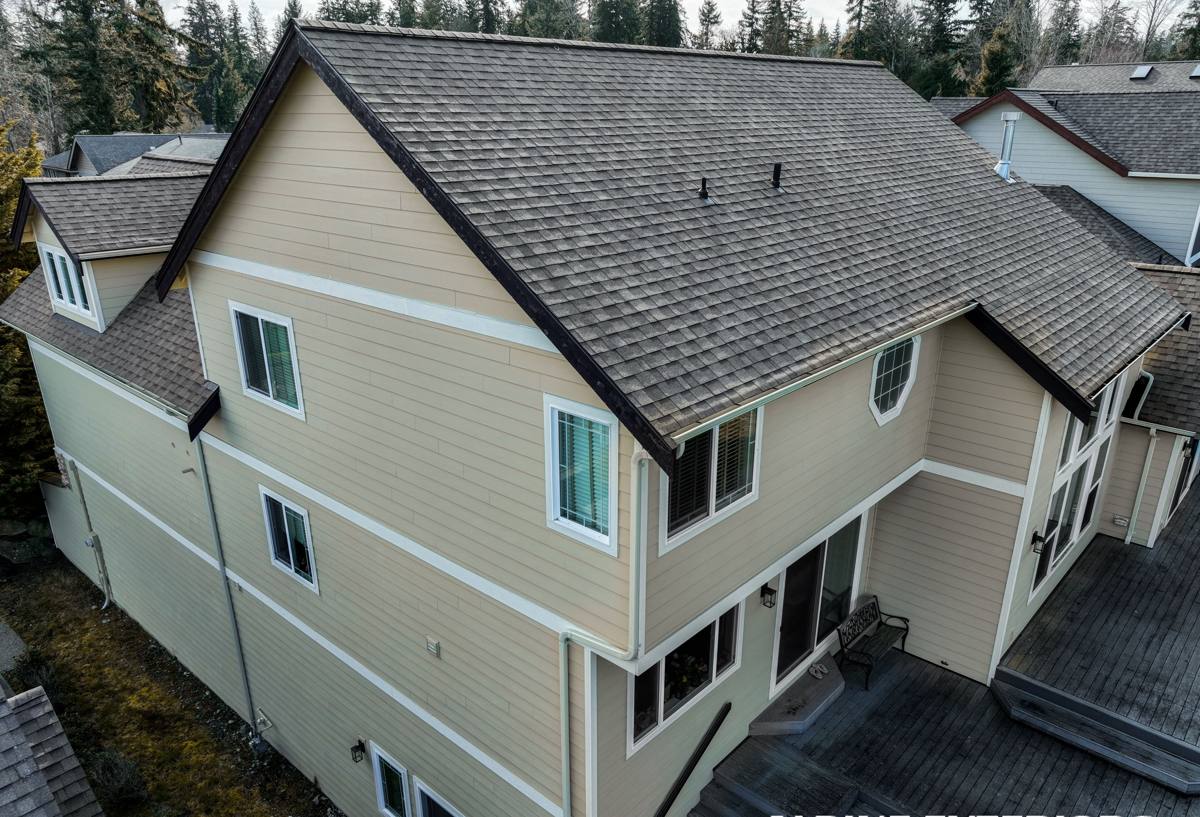
Repair or Replace? How to Tell
Not every tired-looking deck needs a full teardown. But in a climate like ours, surface problems often point to structural ones, and it pays to know the difference before you spend money on the wrong fix.
- Soft, spongy, or spring-y decking boards, especially near the house or stair landings
- Rust streaks around fasteners or visible corrosion on brackets and hangers
- Gaps or separation where the ledger board meets the house
- Persistent moss or black-green staining that returns within weeks of cleaning
- Wobble in the railing posts or stairs, not just the boards
- Visible rot, delamination, or crumbling wood at joist ends and post bases
- A deck more than 15-20 years old that has never had framing inspected
If what you're seeing is limited to a few worn boards and the substructure is sound, repair or partial re-decking can make sense. If the framing, ledger connection, or footings are compromised, replacement is the honest recommendation — patching over a weak structure just delays a bigger repair bill and, more importantly, a safety issue.
What a Correct Deck Replacement Actually Involves
A deck replacement done right is a structural project first and a finish-carpentry project second. Skipping steps in the framing is the single biggest reason decks in this region fail early.
Framing and Footings
Every replacement starts below the decking. Footings need to be sized and set for our soil conditions, joists spaced correctly for the decking material chosen, and all structural connectors rated for exterior use. In a lake-humid, high-rain environment, we favor stainless or heavy hot-dip galvanized hardware throughout — standard coated fasteners corrode faster here than in drier parts of the state, and a rusted hanger is a hidden liability long before it's a visible one.
Ledger Board and Flashing
The ledger board — where the deck attaches to the house — is the single most common point of failure on Pacific Northwest decks. Water that gets behind an improperly flashed ledger doesn't just rot the deck; it can work its way into the house's rim joist and wall framing. Correct flashing, proper fastening into the home's structure (not just siding), and a drainage gap between the ledger and the house are non-negotiable on every job we do.
Decking Material
Once the structure is right, the decking surface is where homeowners get to make choices around look, feel, and long-term maintenance.
Comparing Decking Materials for a Sudden Valley Property
| Material | Moisture & Moss Resistance | Maintenance | Typical Lifespan |
|---|---|---|---|
| Pressure-treated wood | Fair — needs sealing to perform in a wet, shaded lot | Annual cleaning and re-sealing | 10-15 years with upkeep |
| Cedar | Good natural resistance, but still absorbs moisture over time | Periodic cleaning, staining/sealing every 2-3 years | 15-20 years with upkeep |
| Composite decking | Very good — non-organic surface resists moss and rot | Occasional washing, no sealing or staining | 25-30+ year manufacturer warranties, varies by brand |
| PVC/capped polymer | Excellent — fully sealed surface, best for shaded/damp lots | Minimal — soap and water | Often longest warranty coverage of the group |
For a shaded, tree-heavy lot near the lake, composite or capped polymer decking is usually the lower-maintenance long-term choice — it doesn't feed moss growth the way organic wood fibers do. That said, plenty of homeowners still prefer real wood for the look and are willing to keep up with sealing. We'll walk through the honest trade-offs for your specific lot and sun exposure rather than push one product line.
Our Deck Replacement Process
- On-site assessment — we inspect the existing structure, footings, ledger connection, and note any moisture damage before quoting anything
- Design and material selection — sizing, railing style, decking material, and any code-driven changes (guard height, stair geometry) are decided together
- Permitting — we handle the paperwork with Whatcom County or the City of Bellingham depending on your address, so nothing gets flagged during resale
- Demolition — full removal of the old deck, with a check of the house's rim joist and sheathing behind the ledger for hidden rot
- Framing and flashing — footings, joists, ledger, and structural hardware installed to code, with attention to drainage and airflow underneath
- Decking, railing, and stairs — final surface installed with fastening patterns and spacing appropriate to the material and our wet climate
- Final walkthrough — we go over care and maintenance for whatever material you chose before we consider the job done
Permits and Code Considerations
Deck replacements in Whatcom County and within Bellingham city limits generally require a permit once you're rebuilding the structure, not just swapping boards — this covers footing depth, guardrail height, stair rise and run, and ledger attachment. Sudden Valley properties may also fall under community-specific design guidelines depending on your HOA, which is worth checking before material selection, not after. We pull the required permits and build to current code as a matter of course; it protects you at resale and, more importantly, it means the structure was actually inspected rather than just approved on paper.
Why It Matters to Hire a Crew That Already Works This Area
Sudden Valley's lots aren't uniform — slope, tree cover, and proximity to the lake vary block to block, and each of those affects how a deck should be framed and detailed. A crew that regularly works in Bellingham and Whatcom County knows which fastener grades hold up here, how to detail flashing for our rain patterns, and what the local permitting process actually expects, rather than treating every job like it's in a dry climate. That familiarity shows up in fewer callbacks and a deck that's still solid a decade from now, not just at the final walkthrough.
Keeping a New Deck Healthy After Installation
- Sweep debris — needles, leaves, moss spores — off the surface regularly, especially in fall
- Keep gutters and downspouts near the deck clear so water isn't dumping onto it
- Rinse composite or PVC decking a few times a year to prevent surface buildup
- Re-seal wood decking on the manufacturer's recommended schedule, not "when it looks bad"
- Check under the deck once a year for standing water, blocked airflow, or early rust on hardware
- Trim back overhanging branches that keep the surface shaded and slow to dry
What Deck Replacement Typically Costs
| Cost Factor | How It Affects the Project |
|---|---|
| Deck size and shape | Larger footprints and multi-level designs increase framing and material costs |
| Decking material | Pressure-treated is the lowest upfront cost; composite and PVC cost more up front but less over time |
| Structural condition | Rot in the ledger, rim joist, or footings adds repair scope beyond the deck itself |
| Railing and stairs | Custom railing styles, glass panels, or multiple stair runs add labor and material |
| Site access | Slope, tree removal needs, or tight lake-lot access can affect labor time |
Every Sudden Valley lot is different, so we don't quote off a phone call — an accurate number comes from seeing the existing structure and the site conditions in person.
If your deck is showing its age or you're just ready to stop fighting moss every spring, we're happy to take a look and give you an honest read on repair versus replacement — no pressure, no sales script. Use the form below to request a free estimate for your Sudden Valley property.