 Bellingham Exterior
 Birchwood's Climate Puts Real Stress on a Deck
Birchwood sits close enough to Bellingham Bay and the Puget Sound air that salt-laden moisture is a constant, low-grade presence on anything left outdoors. Add in Whatcom County's long stretch of driving rain from fall through spring, mature tree canopy that keeps a lot of yards shaded most of the day, and a moss season that can run six months or longer, and you have a set of conditions that will find every weakness in a deck within a year or two. Wood decking in this neighborhood is famous for graying, splintering, and growing a green film almost no matter how often it's cleaned. Composite decking was built to solve exactly this combination of problems, but only when it's installed correctly for this specific climate — not just installed to spec sheet minimums.
We work on decks throughout Bellingham and Whatcom County, and the jobs in Birchwood consistently show the same pattern: houses with partial shade, damp crawlspaces or low-clearance framing, and decks that were either never designed for adequate airflow or were installed with fasteners and flashing details that weren't rated for constant moisture cycling. Composite decking fixes the surface problem. Good installation practice fixes the rest.
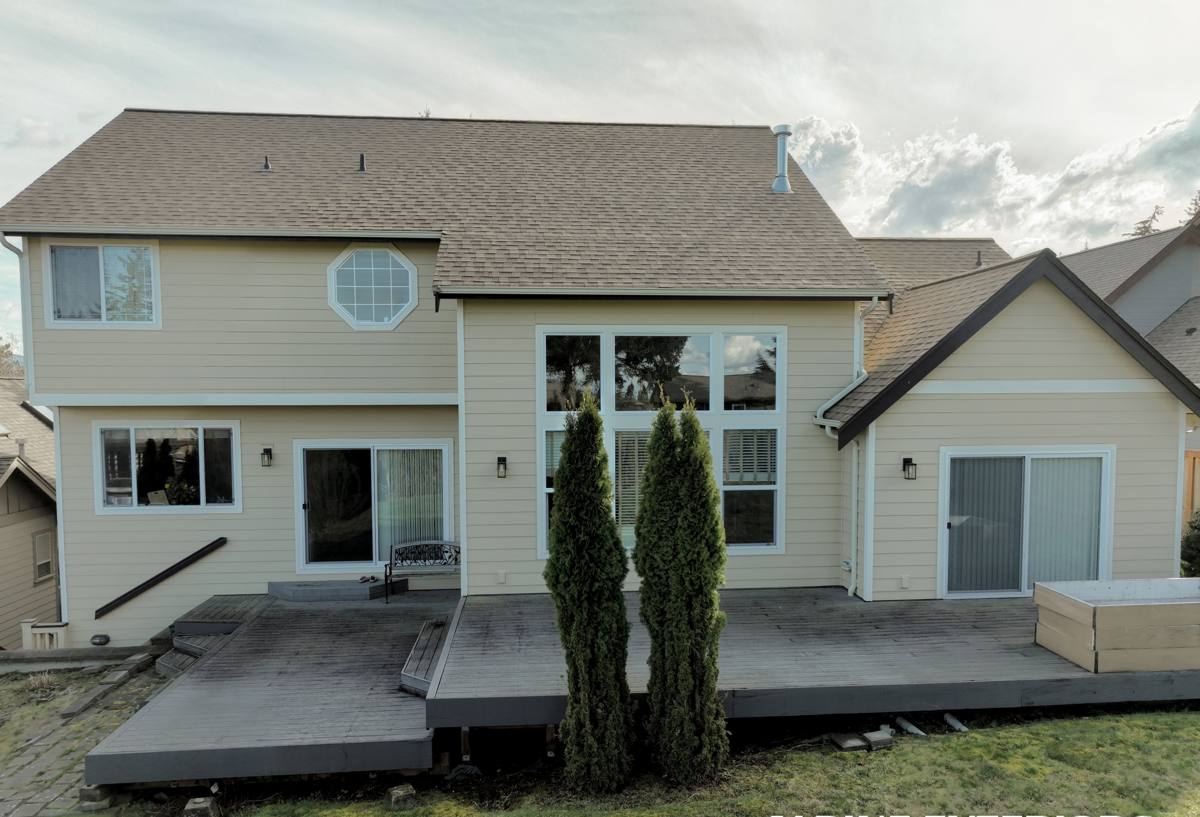
What a Correct Composite Deck Installation Actually Involves
Composite boards are only as good as what's underneath them. A huge share of the "composite deck failures" homeowners hear about aren't a material problem — they're a substructure or fastening problem that would have caused issues with any decking material.
Substructure and ventilation
In a damp, shaded lot like much of Birchwood, joist spacing and airflow underneath the deck matter as much as the boards themselves. Composite manufacturers publish minimum joist spacing (often tighter than the old 16-inch wood standard, especially at angles or on lower-clearance decks), and we build to those specs rather than to habit. Low-clearance decks also need real attention to drainage and ventilation underneath — standing moisture under a deck with poor airflow accelerates rot in the framing even when the walking surface is composite and immune to it.
Ledger boards and flashing
Where a deck attaches to the house, the ledger board and flashing detail is the single most common point of water intrusion we find on older decks in this area. Correct flashing (metal, properly lapped, with a drainage gap or membrane behind it) keeps driving rain from working its way behind the siding and into the house framing over time — a slow leak that can go unnoticed for years in a wet climate like ours.
Fasteners and hidden clip systems
Hidden fastener clip systems are now standard on most composite decking, and they matter beyond appearance. Face-screwing composite boards creates a puncture point where water can sit against the core of the board. Correct clip spacing, stainless or coated fasteners rated for treated lumber contact, and correct gapping between boards for expansion all affect how the deck performs after five or ten Bellingham winters, not just how it looks on day one.
Composite vs. Other Decking Materials in a Wet, Shaded Climate
Homeowners in Birchwood usually compare composite against pressure-treated wood, cedar, or PVC. Each has real trade-offs — we'll give you the honest version rather than a sales pitch for one material.
| Material | Performance in salt air / heavy rain | Moss and mildew resistance | Maintenance |
|---|---|---|---|
| Pressure-treated wood | Absorbs moisture, prone to cupping and checking over time | Low — porous surface holds moss spores and organic film | Annual cleaning, periodic sealing or staining |
| Cedar | Naturally rot-resistant but still absorbs moisture at the surface | Low to moderate | Regular oiling/sealing to hold color and resist graying |
| Capped composite | Strong — capped shell resists moisture absorption into the core | Moderate to high depending on brand and surface texture | Periodic washing, no sealing or staining needed |
| PVC (cellular) | Excellent — no organic wood content to absorb moisture | High | Low; can run hotter in direct sun and shows scratches more visibly |
For most Birchwood properties — especially shaded lots with real moss pressure — we recommend a quality capped composite board as the right balance of moisture performance, cost, and appearance. PVC is worth discussing for decks in full sun with less moss concern, or for owners who want the lowest possible long-term maintenance and are less bothered by its distinct look and feel underfoot.
Our Process, Start to Finish
- On-site assessment: we look at drainage, slope, existing framing condition, sun/shade exposure, and how the deck ties into the house before quoting anything.
- Design and material selection: board profile, color, and fastening system chosen based on your home's exposure and how the deck will be used.
- Permitting: we handle the permit application with the City of Bellingham or Whatcom County as applicable, including any required inspections.
- Demolition and framing: removal of the old deck (if present) and construction or reinforcement of the substructure to current code and manufacturer spec.
- Flashing and waterproofing: ledger board flashing and any house-side waterproofing details are addressed before a single composite board goes down.
- Decking installation: boards installed with correct spacing, hidden fasteners, and manufacturer-specified expansion gaps.
- Final walkthrough: we review the finished deck with you, including basic care guidance specific to our climate.
Living with Moss, Rain, and Shade: What Ongoing Care Actually Looks Like
Composite decking dramatically reduces maintenance compared to wood, but "low-maintenance" doesn't mean "no maintenance," especially in a moss-heavy environment like Birchwood's tree-covered lots. A short seasonal routine keeps a composite deck looking and performing the way it should for decades.
- Sweep debris (leaves, needles, seed pods) off the deck regularly — trapped organic matter is what feeds moss and mildew growth on any surface.
- Wash the deck at least once or twice a year with a soft-bristle broom, mild soap, and water; a pressure washer can be used on a wide, low-pressure fan setting but should never be aimed directly at board seams.
- Keep gutters and downspouts near the deck clear so runoff isn't dumping extra water onto or under the decking.
- Trim back overhanging branches where practical to increase sun exposure and airflow, which are the two biggest natural deterrents to moss.
- Check hidden fastener clips and any visible hardware annually for movement, especially after a hard winter.
- Inspect the ledger board area at the house each year for any sign of moisture staining or gaps in flashing.
Cost Factors for a Birchwood Deck Project
Every deck is different, but the factors that move the price on a composite deck in this area are fairly consistent. We'll always give you a firm, itemized quote rather than a vague estimate — the table below is meant to help you understand what drives cost, not to substitute for that quote.
| Factor | Why it affects cost |
|---|---|
| Deck size and shape | More linear footage of framing and board cuts, and complex shapes (curves, angles) increase labor and waste |
| Height and access | Elevated decks need railing, stairs, and often engineered footings; tight side-yard access slows material staging |
| Existing structure condition | Reusing sound framing costs less than a full tear-out and rebuild |
| Board tier and brand | Entry-level capped composite vs. premium capped composite or PVC changes material cost per square foot substantially |
| Railing and fascia choices | Composite or aluminum railing systems cost more than basic wood but match the deck's low-maintenance profile |
| Site drainage work | Lots with poor drainage or standing water underneath may need grading or gravel work before decking goes down |
Permits and Local Requirements
Most new or replacement decks in Bellingham and unincorporated Whatcom County require a building permit, particularly when the deck is attached to the house, elevated, or includes structural changes like new footings. Requirements can vary depending on deck height, size, and whether it's within city limits or the county's jurisdiction. We handle the permit application and inspection scheduling as part of the job so you're not tracking down requirements yourself — but it's worth knowing up front that a properly built composite deck in this area will go through an inspection process, and that's a good thing: it's an extra check that the framing and flashing were done right before the finish work is complete.
Why Hiring a Crew That Already Works in Birchwood Matters
A composite deck built to a generic spec sheet can still fail early in a climate like ours if the crew hasn't accounted for local conditions — shade patterns, moss pressure, driving rain direction, and soil drainage all vary block to block even within Bellingham. A contractor who already works Birchwood and the surrounding Bellingham neighborhoods has a working sense of which lots need extra attention to under-deck ventilation, which exposures need a higher-tier board to resist moss, and how local permitting actually moves through the city or county process. That familiarity shows up in fewer surprises during the job and a deck that holds up the way it's supposed to once the marine layer, the rain, and the moss season come back around, as they reliably do here.
If you're weighing a new composite deck or replacing an aging wood deck in Birchwood, we're happy to walk the site with you and put together a straightforward, no-pressure estimate — just fill out the form below to get started.