 Bellingham Exterior
 Composite Decking in Sehome: Built for the Weather We Actually Get
Sehome sits close enough to the water and to Bellingham's tree canopy that decks here take a specific kind of beating. It isn't one hard freeze or one big storm — it's the accumulation. Salt-laden air off Bellingham Bay works into fasteners and hardware year-round. Driving rain off Whatcom County's marine weather pattern finds every gap in a deck that wasn't built to shed it. And the long stretch of gray, damp months every fall through spring gives moss and algae months to establish themselves on any surface that holds moisture. A deck built without those three things in mind will look fine for a season or two and then start showing problems all at once — soft spots, staining, slick spots, corroded fasteners.
Composite decking, done right, handles this weather better than wood does. But "composite" is not one product with one behavior. The board you choose, the substructure underneath it, and the way the whole system is detailed for drainage matter more in a climate like ours than they would somewhere dry. This page is about what a composite deck actually needs to hold up in Sehome specifically, and what our process looks like when we build one.
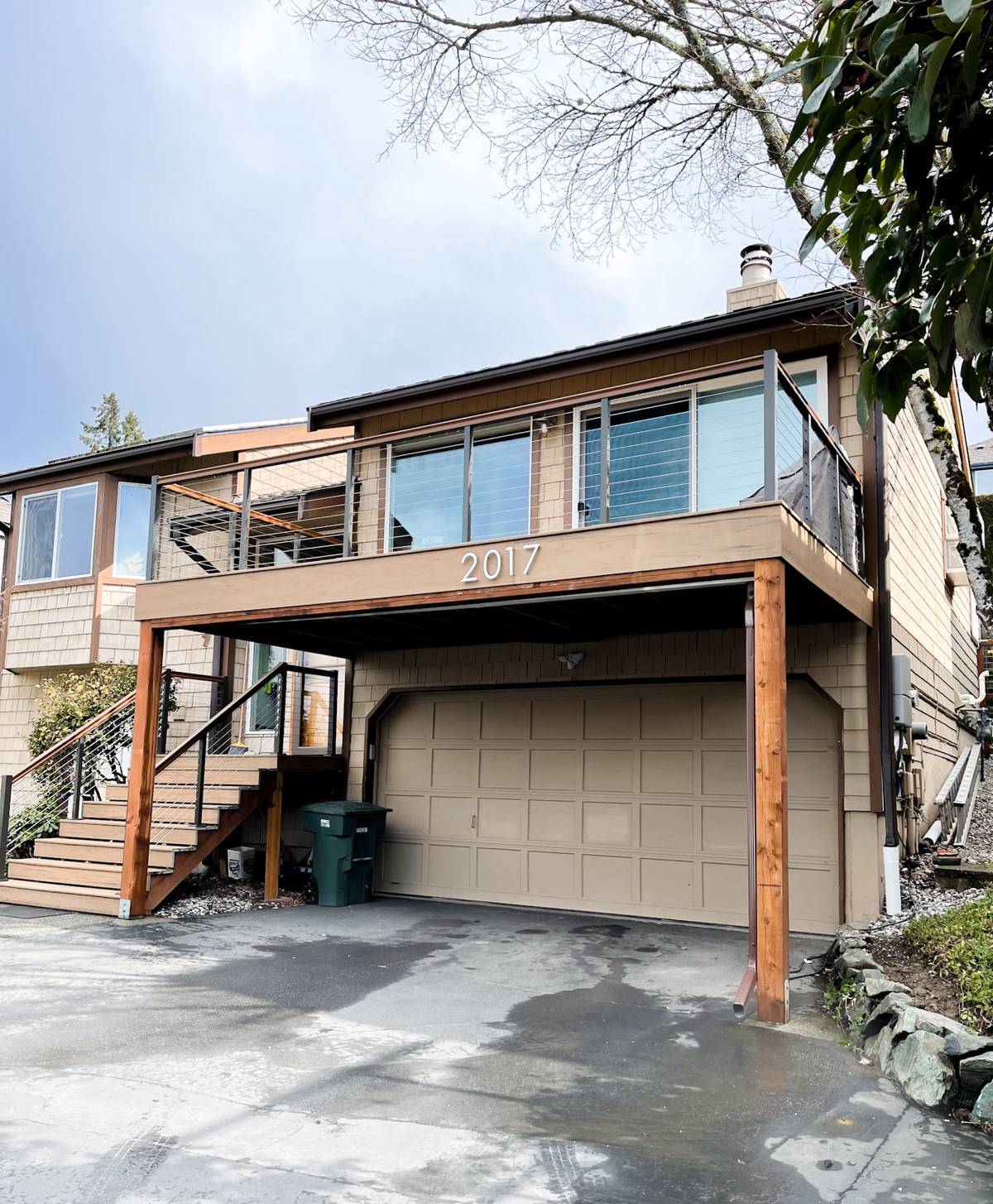
What Sehome's Climate Actually Does to a Deck
Salt Air and Metal Fatigue
Even a few miles inland from the bay, homes in Bellingham get enough marine air that untreated or poorly coated fasteners and connectors will corrode faster than manufacturer literature assumes. This shows up first as rust streaking on the board surface around screw heads, then eventually as failed hardware in structural connections you can't see. It's a slow problem, which is exactly why it gets ignored until it isn't.
Driving Rain and Trapped Moisture
Whatcom County doesn't get dramatic downpours as often as it gets sustained, wind-driven rain that pushes water sideways into ledger connections, stair stringers, and any place two materials meet. A deck that isn't flashed and sloped correctly at these transition points will trap water against the house band board or the frame, and that's where rot and mold start — even when the decking itself is composite and technically won't rot.
Moss Season
Bellingham's damp season runs long. Any deck surface that stays shaded and doesn't dry out between rains will grow moss and algae, and composite boards are not automatically immune — some capped boards resist it better than others, and board orientation, airflow underneath the deck, and gap spacing all affect how fast growth takes hold. A deck built tight to the ground with poor ventilation underneath will grow moss noticeably faster than one with proper clearance.
Why Composite Makes Sense for This Neighborhood
We install composite decking in Sehome because it removes the two biggest wood failure points in this climate: rot from sustained moisture and surface degradation from UV and damp cycling. A quality capped composite board doesn't absorb water into the core the way wood does, so it doesn't swell, cup, or splinter the way a pressure-treated deck eventually will in this weather. That said, composite is not maintenance-free — it's low-maintenance, and the difference matters when you're deciding what to expect from it.
| Factor | Wood (Cedar/Treated) | Capped Composite |
|---|---|---|
| Moisture absorption | Absorbs and swells; drives cupping and splitting over time | Minimal absorption into the core with a proper cap |
| Moss/algae resistance | Depends heavily on maintenance and staining schedule | Better with capped boards, but not immune without airflow |
| Refinishing needs | Sanding and staining every 1-3 years in this climate | Periodic cleaning; no staining or sealing required |
| Upfront cost | Lower material cost | Higher material cost |
| Long-term cost | Higher over 15-20 years due to upkeep and replacement | Lower over the same span if installed correctly |
| Fastener/hardware exposure | Standard exterior-grade hardware often sufficient | Requires corrosion-resistant hardware matched to board manufacturer specs |
We don't push composite as a universal upgrade — for a covered porch surface or a very low-budget project, wood can still be the honest answer. But for an exposed deck in Sehome that will see full weather exposure, composite's resistance to moisture-driven failure is the main reason homeowners choose it here.
What a Correct Composite Deck Build Actually Involves
The board itself is maybe a third of what determines how long a deck lasts in this climate. The rest is in the parts you don't see once it's finished.
The Substructure
Composite decking is heavier than wood per board foot in most product lines, and it also behaves differently under load and temperature swings — it expands and contracts more with temperature than wood does. Framing needs to be sized and spaced to the manufacturer's actual span tables for the specific board, not generic joist spacing left over from a wood deck plan. We also use joist tape or an equivalent moisture barrier on top of the framing — this is one of the most commonly skipped steps on lower-bid jobs, and it's the difference between joists that last 25 years and joists that start rotting from the top down in 8-10.
Ledger Attachment and Flashing
Where the deck meets the house is the single highest-risk point for water intrusion in our climate. Proper flashing — metal flashing integrated with the house's water-resistive barrier, not just caulk over a ledger board — is non-negotiable on any deck we attach to a structure. This is also the point where a lot of older decks in this area were built to a lower standard, and it's usually the first thing we check on a re-deck or repair call.
Fasteners and Hardware
Given the salt air exposure this close to the water, we spec stainless steel or coated fasteners rated for coastal exposure on structural connections, and hidden fastener systems matched to the specific board manufacturer for the decking surface itself. Mixing hardware brands or using standard exterior-grade screws where a coastal-rated fastener is called for is a common shortcut that shows up as rust stains within a couple of seasons.
Drainage and Slope
The deck surface, the substructure, and any covered area below all need a deliberate slope away from the house — typically a small but specific pitch built into the framing, not left to chance. Board gapping also needs to be correct for composite specifically, since these boards move with temperature more than wood and need consistent spacing to drain properly and avoid buckling.
Ventilation Underneath
Low-clearance decks are common on older Sehome lots, and low clearance means poor airflow, which means the underside stays damp longer after every rain. Where clearance allows, we build in ventilation gaps and keep skirting from fully sealing off airflow. Where clearance doesn't allow much, we adjust the plan rather than ignoring the issue.
Our Process
- On-site assessment. We look at the existing structure or planned footprint, house connection point, drainage path, sun/shade exposure, and clearance underneath — all of which affect the moss and moisture risk specific to that lot.
- Board and system selection. We walk through board options with actual trade-offs for this climate — cap type, color (darker boards run hotter and show pollen/debris differently than lighter ones), and manufacturer warranty terms.
- Structural plan. Framing sized to the chosen board's span tables, ledger flashing detail, drainage slope, and fastener spec are all decided before demo or excavation starts, not improvised mid-build.
- Demo and prep (if replacing an existing deck), including an honest look at ledger and framing condition before we cover anything back up.
- Build. Framing, moisture barrier, ledger flashing, decking installation with correct gapping, and hardware installed to spec.
- Final walkthrough. We go over care basics for the specific board installed — cleaning schedule for moss prevention, what not to use on the surface, and what the warranty actually covers.
Maintenance That Actually Matters Here
Composite is low-maintenance, not no-maintenance, and in a climate with a long moss season the maintenance that matters is different from what a homeowner in a drier region needs to do.
- Sweep debris off the surface regularly in fall — trapped leaves and needles hold moisture against the board and accelerate any surface growth
- Rinse or lightly scrub with a soft brush and manufacturer-approved cleaner a couple of times a year, more often on shaded sections
- Check underneath the deck periodically for standing water or blocked drainage paths, especially after major storms
- Inspect visible fasteners and hardware annually for early rust staining — catching it early is a cleaning issue, catching it late can be a hardware replacement issue
- Avoid pressure washing at high PSI directly into board gaps or fastener heads, which can force water into places it shouldn't go
Why Hiring a Crew That Already Works in Sehome Matters
A lot of deck problems we get called to fix started as a builder applying a generic plan to a house in a climate that doesn't forgive generic plans. Crews who don't regularly work in coastal Whatcom County sometimes under-spec fasteners for salt exposure, skip ledger flashing details that matter here more than in drier regions, or don't account for how shaded, low-clearance lots in older neighborhoods like Sehome need different ventilation planning than an open, sunny lot. None of that shows up on day one. It shows up in year three or four, as a warranty claim the manufacturer won't honor because the installation didn't meet their spec, or as a repair bill that costs more than doing it right the first time would have.
We build decks in this specific weather pattern regularly, which means the flashing detail, the fastener spec, and the drainage plan aren't things we're figuring out on your project — they're standard practice because we've seen what happens when they're skipped.
Get a Straight Answer for Your Deck
If you're planning a new composite deck in Sehome, or replacing one that's showing early wear from rain, salt air, or moss, we're happy to take a look and give you a straightforward assessment — no pressure, no inflated scope. Use the form below to request a free estimate and we'll walk the site with your specific conditions in mind.