 Bellingham Exterior
 Building Decks for Sudden Valley's Conditions
Sudden Valley sits in a pocket of Whatcom County shaped by Lake Whatcom on one side and dense second-growth forest on the other. That combination creates a microclimate that's noticeably different from a deck built on an open, sunny lot elsewhere in Bellingham. Tree cover means more shade, more standing moisture on horizontal surfaces, and a longer window each year where moss and algae can take hold before the sun burns it off. Add in the driving rain that comes through this part of Washington for much of the fall, winter, and spring, and you've got a set of conditions that will find every weak point in a deck's design within a few seasons.
None of this means a deck can't hold up well here — it means the build has to account for how water moves, where shade sits through the day, and how much airflow the structure actually gets. A deck plan copied from a drier, more open part of the county won't perform the same way once it's under a canopy near the lake.
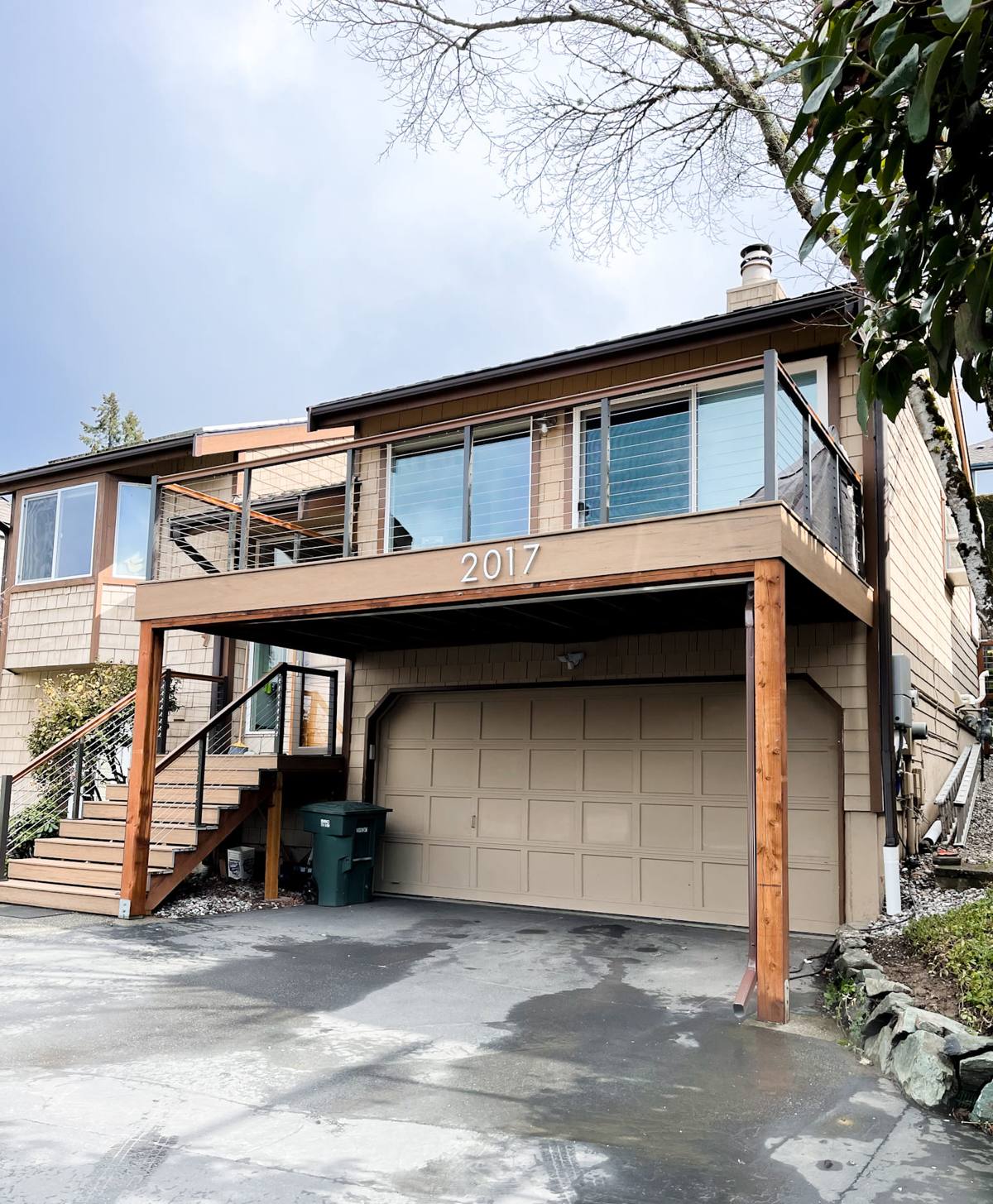
What a Deck Built for This Neighborhood Actually Needs
Drainage first, everything else second
The single biggest factor in how long a deck lasts in a shaded, wet environment is how fast water leaves the surface and the substructure underneath it. Board spacing, joist orientation relative to the slope of the lot, and the grading under the deck all affect whether water sheets off cleanly or sits and soaks in. On lots with a slope toward the lake — common throughout Sudden Valley — we pay close attention to where runoff wants to go naturally and build the deck to work with that instead of fighting it.
Ledger attachment and flashing
Where a deck ties into the house is the most common failure point we see on rebuilds, and it's almost always a flashing or fastening issue rather than a design flaw. Proper ledger flashing keeps water from working its way behind the siding and into the rim joist over years of driving rain. This detail matters more in a wet, shaded lot than almost anything else in the build.
Hardware that matches the exposure
Standard fasteners corrode faster in persistently damp, shaded conditions than they do on a dry, sun-exposed deck across town. We spec hot-dip galvanized or stainless hardware and connectors rated for ground contact and sustained moisture exposure, not just whatever meets minimum code for a drier application.
Choosing Decking Material for a Shaded, Wet Lot
Material choice matters more here than in most parts of Bellingham, because a shaded surface near the lake stays damp longer after every rain and gets less direct sun to dry out and inhibit moss growth. Here's how the common options compare under those specific conditions.
| Material | Moisture behavior | Moss/algae resistance | Maintenance |
|---|---|---|---|
| Pressure-treated wood | Absorbs and releases moisture readily; can cup or check if it dries unevenly | Needs regular cleaning and treatment in shade; moss takes hold quickly if neglected | Annual cleaning, periodic staining/sealing |
| Cedar | Naturally moisture-tolerant, but still needs to breathe and dry between rains | Better natural resistance than treated wood, still needs upkeep in deep shade | Periodic cleaning and oiling to hold color and resist graying |
| Capped composite | Doesn't absorb water into the core; surface sheds water | Can still grow surface film in constant shade — cap doesn't stop organic growth sitting on top | Periodic washing; no staining or sealing |
| PVC decking | Fully non-absorbent; unaffected by moisture cycling | Same surface-film consideration as composite in heavy shade | Lowest ongoing maintenance; occasional washing |
We don't push one material as universally "best" — we walk through how much sun the specific deck footprint gets, how the homeowner wants to spend their maintenance time, and the budget, then make a recommendation based on that actual site. A deck tucked under fir and cedar canopy is a different decision than one on a lot with more open exposure.
Why we're selective about certain composite products
Not every composite or capped board on the market is built the same way, and in a shaded, high-moisture environment the difference shows up faster than it would on a dry lot. We favor products with a full cap on all sides rather than partially capped boards, because exposed composite cores can wick moisture at cut ends and fastener penetrations over time. This isn't about brand loyalty — it's about matching the product's moisture tolerance to the actual conditions the deck will sit in.
Framing and Substructure on Sloped Lots
Sudden Valley has more grade change than a lot of Bellingham neighborhoods, especially closer to the lake. Sloped lots change footing depth requirements, post height, and often call for a stepped or multi-level deck design rather than a single flat platform. Taller post sections need proper bracing to handle wind and seismic load, and footings need to be sized and set below frost depth and on undisturbed or properly compacted soil — not just poured wherever's convenient.
We also look at how the substructure will get airflow. A deck built low to the ground on a shaded, sloped lot with poor crawlspace ventilation underneath will trap moisture against the joists no matter how good the decking material is. Sometimes the right fix is raising the deck height slightly or adding skirting with ventilation gaps rather than building tight to grade.
Permits and Site Considerations Specific to This Area
Sudden Valley is an unincorporated community, so deck permitting typically runs through Whatcom County rather than the City of Bellingham — the requirements, setbacks, and inspection process differ from projects inside city limits. Many Sudden Valley properties also fall under community association design guidelines in addition to county permitting, which can affect height, materials, or visibility from neighboring lots or common areas. We handle the permit application and figure out what applies to your specific lot before work starts, so there are no surprises partway through the build.
Guardrail height, baluster spacing, and stair requirements follow the same structural safety standards regardless of neighborhood, but a permit reviewer will confirm the details are built to code for your specific deck height and configuration.
Our Process, Start to Finish
- Site visit and design conversation — we walk the lot, check sun exposure and slope, and talk through how you actually plan to use the space.
- Material and layout recommendation — based on shade, drainage, and your maintenance preferences, not a one-size-fits-all default.
- Written estimate — clear scope, materials, and price before anything is scheduled.
- Permitting — we submit and manage the Whatcom County permit and any applicable community review.
- Build — footings, framing, decking, railing, and finish work, with attention to flashing and hardware detail throughout.
- Final walkthrough — we go over the finished deck and basic care with you before we consider the job done.
Living With a Deck in a Moss-Prone, Shaded Yard
Even a well-built deck in this environment needs some seasonal attention to stay ahead of moss and stay safe underfoot. A little regular upkeep goes a lot further than an occasional deep clean after moss has already gotten established.
- Sweep leaves and debris off the surface regularly through fall — trapped organic matter is what feeds moss growth
- Rinse or wash the deck surface periodically during the wet months, especially in shaded sections
- Keep gutters and downspouts near the deck clear so runoff isn't dumping extra water onto or under it
- Check railings, stairs, and connection points once a year for looseness or corrosion on hardware
- Trim back overhanging branches where practical to let more light and air reach the deck surface
- Address any soft or discolored boards early — they're cheaper to replace individually than as part of a larger repair later
Why It Matters to Hire a Crew That Already Works This Neighborhood
A contractor who's built decks on flat, sunny lots elsewhere in Whatcom County can still do competent framing — but they may not have a feel for how a specific Sudden Valley lot drains, how much shade a given tree line actually casts through the seasons, or what the county and community review process expects on a site like yours. Working in this specific area repeatedly means fewer surprises during permitting, a design that's already accounting for the slope and shade instead of correcting for it after the fact, and material choices grounded in how decks in this exact environment actually hold up over years, not just how they look on day one.
If you're planning a new deck or replacing one that's struggled with moss, soft spots, or drainage issues, we're happy to come take a look and talk through what makes sense for your lot. Reach out for a free, no-pressure estimate using the form below.