 Bellingham Exterior
 South Hill's Weather and Older Housing Stock
South Hill sits up above downtown Bellingham on a slope that catches weather differently than the flatter neighborhoods below it. Walls that face open water take a steady dose of wind-driven rain and salt-tinged marine air off Bellingham Bay and the Salish Sea, while walls tucked under the neighborhood's mature tree canopy stay shaded and damp for most of the year, which is exactly the setup moss and algae need to take hold. Add in a housing stock that skews older, with plenty of homes built well before today's siding materials and installation methods existed, and South Hill ends up being a neighborhood where the exterior envelope works harder than it does in a lot of newer Whatcom County subdivisions.
We install James Hardie fiber cement siding exclusively — no vinyl, no LP SmartSide, no Cemplank, Allura, primed spruce, or cedar. This page is about what that decision actually means for a South Hill home: what the climate demands, what a correct install looks like, and why the crew doing the work matters as much as the material itself.
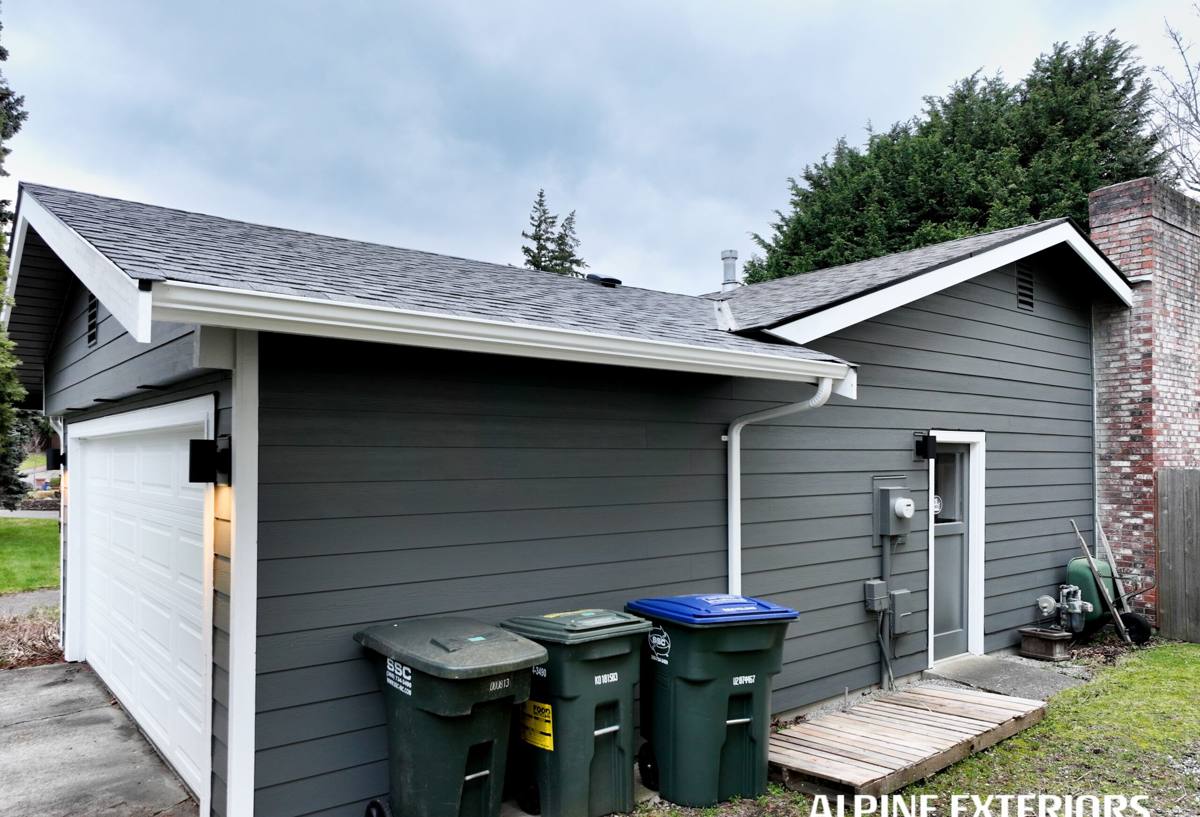
Why Fiber Cement Fits This Neighborhood
A lot of South Hill homes were originally sided in wood, and many have already gone through at least one round of vinyl or engineered wood siding since. Both materials have their place, but neither holds up as cleanly as fiber cement against this particular combination of sustained rain, salt exposure, and long stretches of shade. Wood-based products absorb moisture at cut edges and fastener holes and need consistent upkeep to keep that in check. Vinyl doesn't rot, but it relies on loose, overlapping panels rather than a sealed surface, which gives wind-driven rain more opportunity to get behind it on exposed walls.
Fiber cement is dimensionally stable — it doesn't swell, cup, or warp the way wood-based siding can when it takes on moisture, and it doesn't get brittle in cold snaps the way vinyl does. James Hardie also builds its HZ5 product line specifically for climate zones like ours: cold, wet, and prone to repeated moisture cycling rather than the drier, warmer conditions other regions deal with. That's not a marketing distinction — it changes how the board itself is engineered to perform on a wall that rarely gets a long dry stretch.
What a Correct Fiber Cement Install Involves
The board is only part of the system. Most of the siding failures we get called out to look at on South Hill trace back to installation shortcuts, not the material itself.
Clearance and Drainage
Hardie's installation specs call for specific clearance between the bottom of the siding and grade, decking, and roof lines. Skip that clearance and the board sits in a spot that stays wet far longer than it should, especially on shaded, downhill-facing walls that already dry out slowly.
Fastening Pattern
Fastener type, size, and spacing all come from the manufacturer's installation manual, not a generic rule of thumb. On a home this close to salt air, corrosion-resistant fasteners placed at the correct spacing are what keep the fastening system from becoming the weak point years down the line.
Joints, Caulking, and Touch-Up
Butt joints need to be treated correctly — backed, sealed, or flashed depending on the detail — rather than just caulked over and left. Caulk is a maintenance item, not a substitute for proper flashing, and leaning on it too heavily is one of the more common shortcuts we see.
Flashing and the Weather-Resistive Barrier
Every window, door, and penetration needs flashing that actually directs water out and away from the wall assembly, over a correctly lapped weather-resistive barrier. This step happens before a single piece of siding goes up, and it's the part of the job that's completely invisible once the project is finished — which is exactly why it's worth asking a contractor about directly.
Mistakes We Find on South Hill Re-Sides
When we tear old siding off a South Hill home, a handful of issues show up often enough to be worth naming directly:
- Siding installed tight against grade, a deck, or a lower roofline with no clearance for drainage or airflow
- Butt joints sealed with caulk alone instead of properly lapped or flashed
- Fasteners overdriven or placed too close to board edges, leading to cracking that isn't visible from the ground
- Missing or poorly lapped weather-resistive barrier behind the siding, found only once the old boards come off
- No drainage gap on shaded walls, which traps moisture right where moss and mildew already have the advantage
None of these are visible from the curb on install day. They show up two, five, or ten wet seasons later, which is exactly why the installation details matter more than how the finished wall looks the week the crew leaves.
Fiber Cement Compared to Other Siding Options
| Factor | James Hardie Fiber Cement | Vinyl | Cedar | LP SmartSide |
|---|---|---|---|---|
| Behavior in driving rain | Stable; performs when flashed and fastened to spec | Relies on loose seams; can let water behind panels | Absorbs moisture without regular sealing | Sensitive at cut edges and fastener holes |
| Moss/algae on shaded walls | Holds finish; still needs periodic washing | Discolors, textured surface holds grime | Prone to staining and softening | Moderate; finish needs upkeep |
| Salt air exposure | Factory finish resists fading and chalking | Chalks and fades faster near the water | Weathers unevenly, greys without upkeep | Edge sealing needs regular attention |
| Fire behavior | Non-combustible | Softens and deforms under heat | Combustible | Combustible |
| Typical lifespan, correct install | 30-50+ years | 20-30 years | 15-25 years with upkeep | 15-25 years, climate-dependent |
Our Process, Start to Finish
Walkthrough and Assessment
We start at the house, not a spreadsheet — looking at which walls take direct weather, which stay shaded and slow to dry, and whether there's already moisture damage under the existing siding that needs to be addressed before anything new goes up.
Tear-Off and Sheathing Check
Once the old siding is off, we check the sheathing and weather-resistive barrier underneath. New siding over damaged sheathing just buries a problem instead of fixing it, and this is the point in the project where that gets caught.
Installation to Manufacturer Spec
Clearances, fastening, flashing, and joint treatment all follow James Hardie's published requirements for this climate zone. That's what keeps the manufacturer's warranty intact and what actually determines how the wall performs over the decades that follow.
Final Walkthrough
We walk the finished job with you, explain what little ongoing maintenance fiber cement actually needs, and make sure you know what a healthy wall looks like if you ever want to check it yourself.
Maintenance in a Moss-Prone, Marine Climate
Fiber cement is low-maintenance compared to wood or vinyl, but "low" isn't "none," especially on a hillside neighborhood with this much shade and salt exposure. A short annual routine keeps a correctly installed system performing the way it's supposed to:
- Rinse siding annually, focusing on shaded, north-facing walls where moss and algae take hold first
- Keep gutters and downspouts clear so overflow isn't running down the wall face
- Trim back vegetation and tree limbs that hold walls in shade and block airflow
- Check caulking at joints and trim once a year, and reseal anywhere it's cracked or pulled away
- Watch ground-contact areas near grade, decks, and walkways for moss buildup, which usually signals a clearance or drainage issue rather than just dirt
Cost Factors for a South Hill Project
Fiber cement typically costs more up front than vinyl and can run close to or above painted wood siding once labor is factored in, but the installed price on any given South Hill home depends on more than square footage alone. A few things tend to move the number most:
| Factor | Why It Matters Here |
|---|---|
| Wall height and complexity | More corners, dormers, and hillside multi-story walls mean more cuts, scaffolding, and flashing detail |
| Existing wall condition | Rot or moisture damage behind older siding needs repair before new material goes up |
| Siding profile | Lap siding installs faster than board and batten or shingle-style profiles |
| Trim and window count | More openings mean more flashing and finish labor |
| Site access | Steep or narrow lots can add time for staging material and equipment |
We'll walk your specific home and give you real numbers rather than a rough estimate based on square footage alone — two South Hill homes of similar size can price out very differently depending on how many of these factors are actually in play.
Why Hire a Crew That Already Works This Neighborhood
South Hill's mix of older homes, hillside exposure, and heavy tree cover rewards a crew that's already spent time on its walls. That means knowing which orientations need extra attention because of shade, what condition to expect from sheathing on a home of a certain age before the tear-off even starts, and where a drainage gap earns its keep versus where it's optional. It also means being able to pull the right City of Bellingham permits, work efficiently around the tighter lots and steeper driveways common on the hill, and match trim and color details so a repair or partial re-side doesn't stand out against the rest of the house. That kind of judgment doesn't show up on a price sheet, but it's the difference between a wall that still looks and performs the same in twenty years and one that's showing seam staining and soft spots in five.
If you're planning a siding project on South Hill, we're glad to walk the property, point out what your specific walls are dealing with, and put together a straightforward, no-pressure estimate — there's a form below to get started.