 Bellingham Exterior
 Happy Valley sits in the hills south of downtown Bellingham, close to Fairhaven and Western Washington University, and it's a neighborhood where mature tree canopy, sloped lots, and a real mix of housing ages all shape how exterior siding actually performs. Some homes here are older, built well before fiber cement was even an option; others are newer infill on the same terrain. Whatever the age, siding on a Happy Valley home is dealing with the same three pressures year-round: salt-tinged marine air drifting in off the water, driving rain that doesn't fall straight down so much as get pushed sideways, and a moss season that can run most of the calendar. This page is about one thing specifically: what a full siding replacement needs to get right in this neighborhood, not exterior work in general.
Why Siding Wears Out Faster Here Than in a Lot of Places
Salt Air and Steady Marine Moisture
Bellingham's proximity to the water means the air itself carries a low, constant level of moisture and salt, even away from the immediate shoreline. That exposure works slowly on fasteners, flashing, and lower-grade finishes — it rarely announces itself, and it's rarely dramatic. Years in, it shows up as rust bleed at nail heads, caulk that's degraded and pulled away from a joint, or a painted finish that's chalked and faded well ahead of its expected life.
Wind-Driven Rain
Rain in this part of Whatcom County tends to arrive with wind behind it, which changes where water actually ends up on a wall. Lap joints, trim seams, and anything around a window or door opening take on water from angles a siding system built for a calmer, drier climate was never really tested against. A wall assembly that would hold up fine forty miles inland can still leak here, for no reason other than how the wind moves the rain.
A Long Moss and Mildew Season Under the Tree Canopy
Happy Valley's mature trees are part of what makes the neighborhood what it is, but they also mean a lot of shaded wall area that stays damp longer between rain events. Moss and mildew need exactly that kind of sustained dampness to establish themselves, and once they do, they hold moisture against the wall behind them. Porous or absorbent siding materials become a growth surface over time — and it typically starts in the spots homeowners check least, like the north-facing wall behind a hedge or the section under a low eave.
Hillside Lots and Water Movement
A fair number of Happy Valley properties sit on sloped ground, which changes how water moves around the foundation and up the base of the wall during a hard rain. On these lots, getting the clearance between siding and grade right, and making sure water sheds away from the wall instead of pooling against it, matters just as much as the siding material itself.
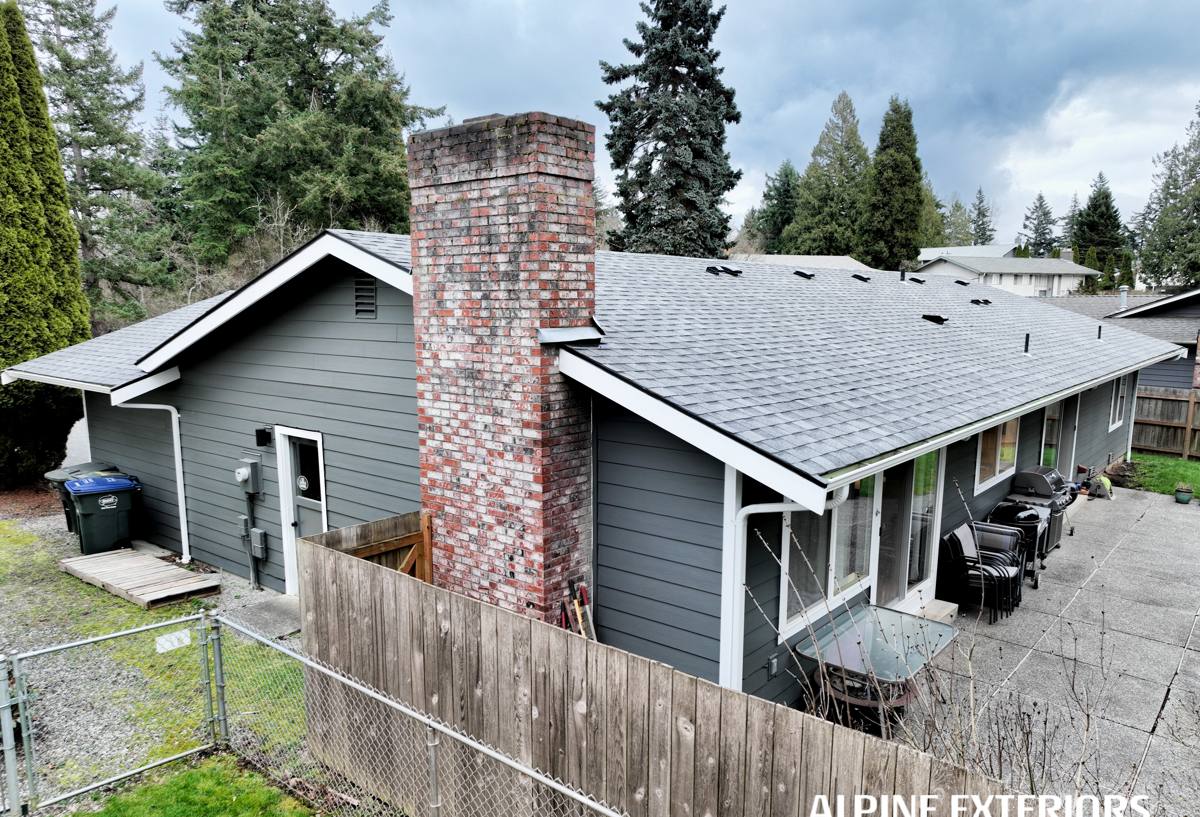
Signs a Happy Valley Home Needs Full Replacement, Not Another Repair
Repair makes sense for isolated damage. Full replacement becomes the right call once the underlying material or the wall assembly behind it has been compromised broadly enough that patching just delays a bigger job. Watch for:
- Moss or dark staining that comes back quickly after cleaning, especially on shaded or north-facing walls
- Soft, spongy, or crumbling siding, particularly near the base of the wall or around window and door trim
- Paint that's peeling, bubbling, or chalking across multiple sections rather than one isolated spot
- Visible gaps or separation at seams, corners, and trim joints where wind-driven rain can track in
- Rust staining around fasteners or flashing, an early sign of sustained marine air exposure
- Cracked, warped, or missing sections after wind events
- A noticeable jump in heating costs, which can point to a wall assembly that's no longer sealing the way it should
- Siding that's simply reached or passed its rated service life for the material it's made from
If what you're seeing is confined to one section, a repair and match-in against existing material may be all that's needed. If it's showing up in multiple places, or there's evidence water has been tracking behind the wall for a while, replacement is usually the more honest recommendation — and we'll tell you which situation you're actually in before we suggest a scope.
What a Correct Siding Replacement Involves
The material is only part of the job. A siding replacement that actually performs the way it's supposed to depends on a handful of details that are easy to skip and hard to catch once the wall is closed back up.
Tear-Off and Substrate Inspection
Removing the old siding is also the only real chance to see what's happening underneath — sheathing condition, any hidden rot, and how the previous water-resistive barrier held up. Skipping a real inspection here just means covering up a problem instead of fixing it.
Water-Resistive Barrier and Flashing
House wrap and flashing need to work as one continuous system, layered so water is always directed outward and downward, never trapped behind the new siding. This is the single detail most responsible for whether a siding job lasts twenty years or leaks within five.
Fastening, Laps, and Clearance to Grade
Correct fastener placement, proper lap dimensions at horizontal joints, and adequate clearance between the bottom of the siding and grade or hardscaping all affect how well the wall sheds water and resists moss establishing at the base. On sloped Happy Valley lots, that clearance detail deserves extra attention.
Trim and Detail Work
Window and door trim, corner boards, and any transitions between siding and other materials are where most leaks actually originate. These details take longer to do right, and they're usually the first thing a rushed installer shortcuts.
Why We Replace Siding with James Hardie Fiber Cement, and Only James Hardie
We don't offer a menu of siding brands and let price make the decision. Every replacement we do uses James Hardie fiber cement, because of what we've consistently seen on tear-offs in exactly this kind of marine, wet-winter climate.
- Non-combustible core: Fiber cement doesn't feed a fire the way wood-based siding can, which matters for household safety and can matter for insurance.
- Factory-applied ColorPlus finish: The color coat cures under controlled factory conditions rather than being brushed on at the jobsite, which gives it far more resistance to fading, chalking, and moisture intrusion over time.
- Climate-engineered HZ product lines: Hardie's HZ5 formulation is built for regions with heavy sustained moisture and freeze-thaw cycling, a closer match to coastal Whatcom County than a generic national spec.
- Dimensional stability: Fiber cement doesn't swell, cup, or warp the way engineered wood products can after repeated wet-season moisture cycles.
- Strong transferable warranty: Backed by one of the more substantial warranty structures in the industry, provided the installation follows spec.
We don't install LP SmartSide, vinyl, Cemplank, Allura, primed spruce, or cedar. Those are legitimate products, and plenty of contractors install them well. We made a professional call that in a climate this consistently wet and salt-exposed, standing fully behind one system we understand completely serves Happy Valley homeowners better than offering a cheaper option that quietly shifts maintenance risk onto them later.
Our Siding Replacement Process, Start to Finish
- On-site assessment: We walk the property, look at the existing siding and any visible damage, and talk through what you're seeing and what's actually going on.
- Written scope and estimate: You get a clear plan that specifies material, flashing and house wrap details, and timeline — not just a square-footage number.
- Tear-off: Old siding comes off and the substrate gets inspected for hidden moisture damage before anything new goes up.
- Substrate repair: Any compromised sheathing or framing gets addressed before the new water-resistive barrier goes on, not covered over.
- House wrap, flashing, and Hardie installation: Installed to manufacturer spec, with fastening, laps, and clearances set correctly for this climate.
- Trim, caulking, and final detail work: The parts most likely to leak if rushed get the most attention, not the least.
- Final walkthrough: We go over the finished job with you before calling it done.
What to Expect During the Project
A full siding replacement on an average Happy Valley home typically runs from a few days to a couple of weeks, depending on square footage, how much trim detail the house has, and what tear-off reveals underneath. Expect noise and dust during tear-off, landscaping and walkways protected around the work area, and scheduling that accounts for this area's rain pattern — we don't leave a wall open to weather overnight if it can be avoided. On sloped lots, staging and access can add setup time up front, which we account for in the estimate rather than discovering it mid-project.
Siding Replacement Cost Factors in Happy Valley
| Factor | What It Affects | Why It Matters Here |
|---|---|---|
| Home age and trim complexity | Material and labor total | Older Happy Valley homes often carry more trim detail and roofline intersections where wind-driven rain works its way in |
| Substrate condition | Repair costs before new siding goes on | Years of trapped moisture behind aging siding can rot sheathing before it's ever visible from the street |
| Slope and site access | Labor time and equipment needs | Sloped lots common in the neighborhood can add staging, scaffolding, and setup time |
| Wall exposure and orientation | Flashing and detailing time | Shaded, north-facing walls under tree cover need extra attention to moss- and moisture-resistant detailing |
| Trim and color selection | Material cost and finish longevity | Factory-cured ColorPlus finishes outlast field-applied paint against salt air and UV exposure |
Real numbers depend on the specific house, which is why we walk the property in person before quoting instead of pricing off square footage alone.
Why a Crew That Already Works Happy Valley Matters
A crew that replaces siding in this neighborhood regularly sees how salt air, wind-driven rain, and moss actually behave on real houses over a full year, not just how a product performs on a spec sheet. That translates into practical calls on install day: where to add extra flashing attention, which wall orientations stay damp longest, which lots need extra clearance at grade because of slope, and which details are worth the extra time so you're not dealing with a callback two winters from now. Happy Valley's tree cover, hillside terrain, and mixed housing stock aren't identical to conditions elsewhere in Bellingham, and a crew with real, repeated experience in the neighborhood accounts for that instead of applying a one-size-fits-all install.
If your Happy Valley home needs new siding, or you'd just like an honest opinion on whether what you're seeing is a repair or a replacement, we're glad to take a look. Reach out using the form below to schedule a free, no-pressure estimate.