 Bellingham Exterior
 Happy Valley's Climate Is Tougher on Siding Than Most Homeowners Realize
Happy Valley sits close enough to Bellingham Bay that salt-laden air is a constant, low-grade stress on every exterior surface of a home. Add in the driving rain that comes off the water during fall and winter storms, and you've got moisture finding its way into every seam, lap joint, and fastener hole that isn't sealed correctly. Then there's the moss. Whatcom County's damp, mild climate keeps humidity high for much of the year, and shaded, tree-lined lots like the ones common around Happy Valley stay wet longer after a storm than open, sun-exposed sites. That combination — salt, rain, and a moss season that can run six months or longer — is exactly the kind of environment that exposes weak siding materials and sloppy installation work.
None of this is exotic. It's just Pacific Northwest weather, applied consistently, year after year. But siding that isn't engineered and installed for it will show the wear faster here than it would in a drier climate — swelling, delaminating, growing moss and mildew, or letting moisture behind the cladding where it can rot sheathing and framing nobody sees until it's a real problem.
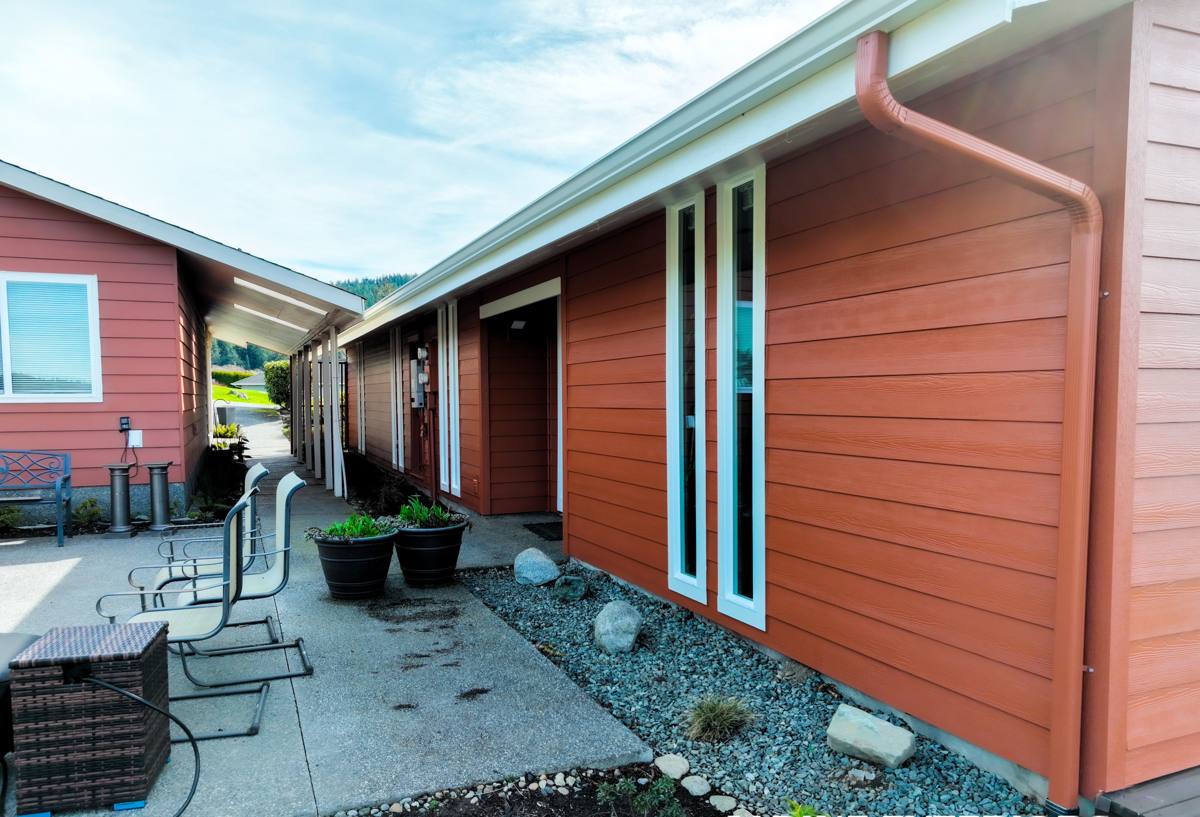
What James Hardie Fiber Cement Solves in This Environment
James Hardie fiber cement siding is made from cement, sand, and cellulose fiber — an inorganic composition that doesn't feed mold and moss the way wood-based products can, and doesn't absorb and release water the way wood swells and shrinks with the seasons. For a Happy Valley home dealing with near-constant humidity and salt exposure, that stability matters more than most cosmetic features.
James Hardie also engineers its products by climate zone. The HZ5 formulation, built for regions with more freeze-thaw cycling and moisture exposure, is what we specify for Whatcom County homes. It's not a marketing distinction — it changes the composition of the board to better handle the moisture load this area sees. On top of that, Hardie's ColorPlus finish is a factory-applied, baked-on finish that holds up to UV and salt air significantly better than field-applied paint, and it comes with its own finish warranty separate from the substrate warranty.
None of that is a guarantee against problems on its own. Fiber cement still has to be installed correctly — with the right clearances, flashing, and fastening — to actually deliver on that resistance. That's the part that gets skipped on a lot of jobs, and it's where most siding failures in this climate actually start.
Why We Only Install James Hardie
We don't install vinyl, LP SmartSide, Cemplank, Allura, primed spruce, or cedar. That's a deliberate standard, not a limitation we apologize for. Each of those products has a real place in the market and honest strengths, but each also carries a trade-off — impact sensitivity, moisture behavior, repainting cycles, or warranty structure — that we don't think holds up well against a salt-air, high-rainfall, moss-prone climate like this one over the long run. Standardizing on one product line lets our crews get genuinely expert at one installation system instead of being average at five. In a climate this demanding, that expertise is what actually protects the home.
What a Correct Installation Involves
James Hardie siding performs the way it's rated to perform only when it's installed to the manufacturer's specifications. In a wet climate, the installation details matter more, not less. Here's what we treat as non-negotiable on every Happy Valley project.
Weather Barrier and Flashing
A correctly lapped weather-resistant barrier goes on before any siding, with all penetrations — windows, doors, vents, hose bibs — flashed to shed water down and out, never into the wall assembly. Kickout flashing gets installed anywhere a roofline meets a sidewall, which is one of the most common leak points on homes in rainy climates and one of the most commonly skipped details on lower-quality jobs.
Clearance and Drainage
Hardie siding needs proper clearance from grade, roof lines, decks, and horizontal surfaces so water has somewhere to go instead of wicking up into the bottom edge of a board. On homes where drainage and drying time are already working against you, that clearance is one of the cheapest and most effective protections you can build in.
Fastening and Joints
Fasteners need to hit framing at the manufacturer's specified pattern and depth — overdriven or underdriven nails are a common source of premature failure. Butt joints get sealed or flashed per spec, not just caulked and hoped for. Caulk is a maintenance item, not a substitute for correct flashing.
Our Process for Happy Valley Siding Projects
- On-site assessment. We look at the existing siding, sheathing condition, moisture points, and roofline details specific to the home before we ever talk product.
- Tear-off and sheathing check. Old siding comes off and we inspect the sheathing underneath for rot or existing water damage — a step that's especially important on older Happy Valley homes that have weathered decades of Bellingham winters.
- Weather barrier and flashing install. This is the layer that does the real waterproofing work; the siding on top is largely a durable, attractive shell over it.
- James Hardie installation. Boards, panels, or shingles go on to manufacturer spec, with attention to the fastening, clearance, and joint details above.
- Trim, caulking, and finish work. Corners, trim boards, and any field-applied touch-ups are finished cleanly, matching the ColorPlus finish where applicable.
- Cleanup and walkthrough. We walk the job with you before calling it done, not after.
Choosing the Right Product Line for a Happy Valley Home
James Hardie makes several distinct products, and the right choice depends on the home's style, age, and how much of the existing trim and detailing you want to keep or update.
| Product | Best fit | Notes for this climate |
|---|---|---|
| HardiePlank lap siding | Traditional and craftsman-style homes | Most common choice locally; wide range of widths and textures |
| HardiePanel vertical siding | Modern builds, accent walls, gable ends | Clean lines; works well combined with lap siding for visual contrast |
| HardieShingle | Homes with a cottage or shingle-style look | Staggered or straight-edge profiles; more labor-intensive install |
| HardieTrim boards | Corners, window and door casing, fascia | Matched to the siding line for a consistent, sealed system |
For color, factory-applied ColorPlus finishes are our default recommendation in this climate — they're engineered to resist the fading and chalking that salt air and UV exposure cause over time, and touch-up product is available that's matched to the exact factory color.
What Actually Drives Cost on a Job Like This
We don't publish flat per-square-foot pricing because it's genuinely dependent on the home, and quoting a number without seeing the house does homeowners a disservice. What we can tell you is which factors move the price and in which direction.
| Factor | Effect on cost |
|---|---|
| Tear-off vs. install over existing sheathing | Tear-off costs more but is often necessary to check for hidden moisture damage |
| Sheathing or framing repair needed | Adds cost, but skipping it means new siding over an existing problem |
| Home size and wall complexity | More corners, gables, and dormers mean more labor and trim work |
| Product line and profile | Shingle-style and mixed-material designs take longer to install than straight lap siding |
| Trim scope | Full trim replacement adds cost but keeps the whole system consistent and warrantied |
The only way to get an honest number is a walk-through of your specific home, which is what a free estimate is for.
Maintenance in a Moss-Prone Climate
Fiber cement is low-maintenance compared to wood siding, but "low-maintenance" doesn't mean "no maintenance," especially with a moss season as long as this region's. A little attention keeps siding performing for decades instead of just years.
- Rinse siding with a garden hose (not a pressure washer aimed directly at seams) once or twice a year to clear pollen, salt residue, and organic buildup before moss gets a foothold
- Keep gutters clear so water isn't sheeting down the wall instead of through the downspout
- Trim back vegetation and tree limbs that keep siding shaded and damp longer than the rest of the house
- Check caulking at trim joints, windows, and doors annually and re-caulk any cracked or separated beads
- Touch up any chips or scrapes with matched ColorPlus touch-up product promptly, before moisture has a chance to get behind the finish
- Watch north-facing and shaded walls most closely — they're the first place moss and mildew tend to show up
Why Local Experience in Happy Valley Matters
A crew that works this neighborhood regularly already understands how the microclimate here behaves — which walls stay damp longest, how local permitting and inspection works in Bellingham and Whatcom County, and what condition to expect under the siding on homes of different ages. That's not something a crew based hours away, or one that treats siding as a side offering, picks up quickly. When you're vetting anyone to work on your home, ask how much of their current work is in this specific climate, ask to see their James Hardie installer training or certification, and ask them to walk you through their flashing and clearance details before you sign anything. A contractor who can't answer those questions specifically isn't the one who should be on your roofline.
If you're weighing a siding replacement or repair for a Happy Valley home, we'd rather walk the house with you and give you a straight answer than guess over the phone. Reach out for a free, no-pressure estimate using the form below.