 Bellingham Exterior
 Storm Damage Roofing in Happy Valley
Happy Valley sits close enough to Bellingham Bay and the hills around Western Washington University that its roofs take a particular kind of beating. Wind off the water, driving rain that comes in sideways during a real Whatcom County blow, and a long wet season that keeps moss and moisture working on the roof deck for most of the year — it's a different set of conditions than you'd design for in a drier climate. A roof that would hold up fine in eastern Washington can still develop chronic problems here if it wasn't built or repaired with our weather in mind.
This page covers what storm damage actually looks like on a Happy Valley roof, what a correct repair involves, and why it matters to hire a crew that already knows this neighborhood's housing stock and its weather patterns.
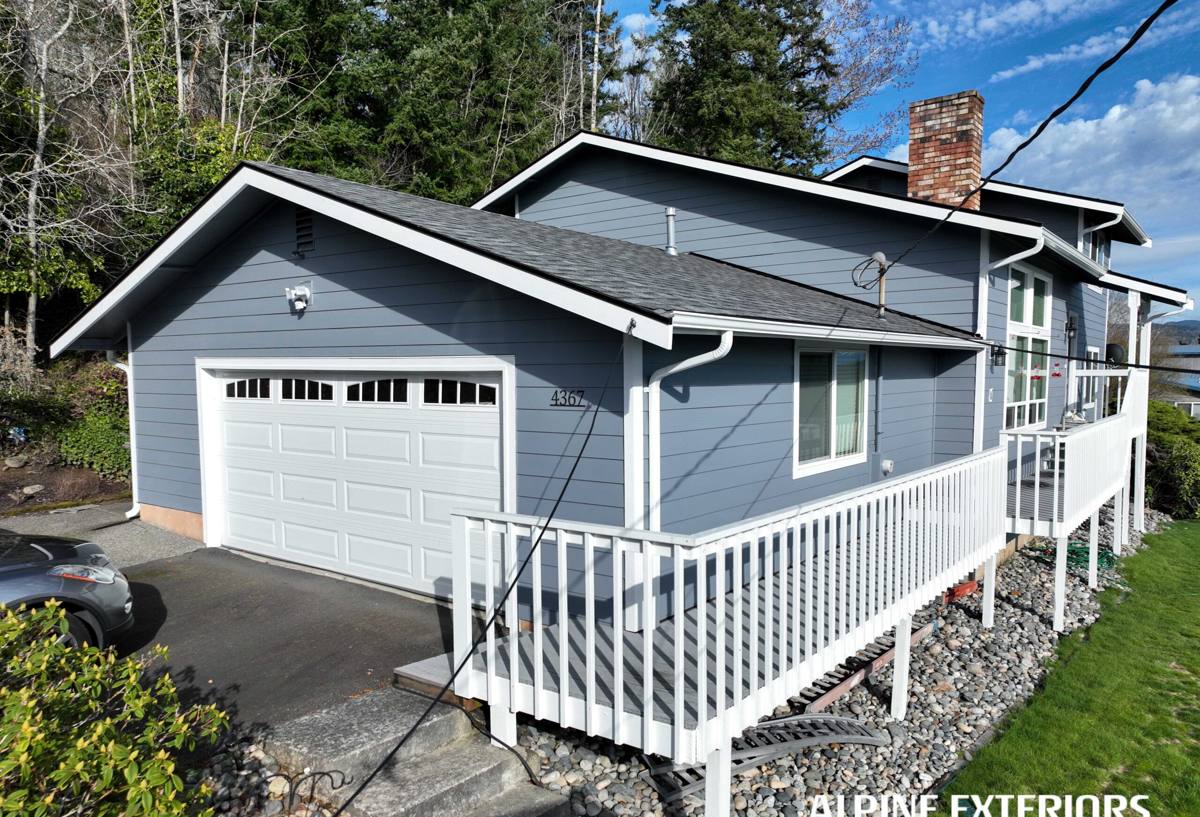
How Local Storms Actually Damage a Roof
Wind and Driving Rain
Bellingham's storms rarely bring the straight-line destruction you see in the Midwest, but they don't need to. Sustained wind combined with heavy rain pushes water sideways and uphill under shingle edges, ridge caps, and flashing that would otherwise shed water fine in a light drizzle. Once wind lifts a shingle tab even slightly, that seal doesn't reliably reseat itself — it becomes a permanent weak point that the next storm exploits further.
Falling Debris
Mature fir and cedar trees are common on Happy Valley lots, and windstorms bring down limbs and sometimes whole trees. Impact damage can range from a few cracked or punctured shingles to compromised sheathing, and it isn't always obvious from the ground — a limb strike can crack a shingle without tearing it loose, so the roof looks intact until the next rain finds the crack.
Moss and Sustained Moisture
Whatcom County's moss season runs long — realistically most of the fall through spring — and moss holds moisture directly against roofing material. On a roof that's already been stressed by wind or impact, that constant dampness accelerates rot at the damaged spot instead of letting it dry out and hold. Storm damage and moss damage often show up together on the same roof because one makes the other worse.
Signs of Storm Damage Worth a Look
Some storm damage is obvious from the driveway; a lot of it isn't. After any significant wind or rain event, it's worth checking for:
- Shingles that are lifted, curled, cracked, or missing entirely
- Granules collecting in gutters or at downspout outlets
- Bent, lifted, or missing flashing around chimneys, vents, and roof-to-wall transitions
- Water stains on ceilings or in the attic, even faint ones
- Sagging or soft-feeling spots when walked on (a sign the deck itself is wet)
- Debris — branches, needles, moss clumps — pooling against a valley or roof edge instead of shedding off
- Daylight visible through the roof deck from inside the attic
Any one of these on its own might be minor. Several together, especially after a named storm or a stretch of high wind, usually means it's time for an actual inspection rather than a guess from the ground.
What a Correct Repair Involves
Inspection Before Anything Else
A proper storm damage repair starts with getting on the roof, not just looking at it with binoculars. That means checking the field of the roof, all flashing points, valleys, and the attic side of the deck for moisture. Wind and impact damage is often worse — or better — than it looks from the ground, and pricing a repair off a drive-by inspection leads to surprises later.
Matching the Repair to the Damage
Not every storm-damaged roof needs full replacement. A localized limb strike or a section of lifted shingles from wind can often be repaired in place if the surrounding material is still sound and a reasonable material match is available. The judgment call is whether the deck underneath is dry and structurally fine, and whether patch repairs will actually seal and last through the next wet season — not just look fixed for a few months.
Flashing and Underlayment, Not Just Shingles
A lot of storm-related leaks trace back to flashing, not the shingles themselves. Replacing damaged shingles without addressing bent or displaced flashing underneath just resets the clock until the next storm reopens the same leak path. Underlayment condition matters too — if wind or a leak has already gotten water under the shingles, the underlayment may need attention even if the shingles above it look repairable.
Repair or Replace: What Actually Drives the Decision
| Factor | Favors Repair | Favors Replacement |
|---|---|---|
| Extent of damage | Isolated area, single slope or valley | Damage spread across multiple slopes |
| Roof age | Roof is relatively young, damage is the exception | Roof is already near end of expected life |
| Deck condition | Sheathing underneath is dry and sound | Sheathing is soft, rotted, or delaminating |
| Material availability | Reasonable match to existing shingle exists | Product discontinued or badly mismatched |
| Moss/moisture history | First real issue on an otherwise healthy roof | Chronic moss or moisture problems predate the storm |
The honest answer for most storm calls in Happy Valley is repair — full replacement is only the right call when the damage is extensive, the deck is compromised, or the roof was already near the end of its service life before the storm hit.
Our Process From First Call to Finished Roof
1. Inspection and Honest Assessment
We walk the roof, document what we find, and tell you plainly whether you're looking at a repair or something bigger. If the damage is minor, we'll say so.
2. Clear Scope and Pricing
You get a written scope of what's being fixed and why, not a vague line item. If insurance is involved, our documentation is built to support that process, not just to justify a number.
3. The Repair Itself
We match materials as closely as possible, address flashing and underlayment where the damage warrants it, and don't consider the job done until the repaired section is actually watertight — not just visually patched.
4. Follow-Up
Storm repairs sometimes reveal secondary issues once the immediate damage is addressed — a soft spot found during the work, a flashing detail nearby that's also aging out. We'll flag those honestly rather than let them turn into next season's emergency call.
Insurance and Documentation
Many storm damage repairs go through a homeowner's insurance claim. What helps that process go smoothly is thorough documentation at the inspection stage — clear photos of the damage, a written description tied to a specific weather event where possible, and a scope of repair that an adjuster can follow. We provide that documentation as a standard part of the inspection, whether or not you end up filing a claim.
Why Hiring a Crew That Works Happy Valley Matters
Storm damage repair isn't a generic skill applied the same way everywhere. A crew that already works in Bellingham and Whatcom County knows what our storms actually do to roofs here — where wind-driven rain tends to find its way in, how aggressively moss takes hold on a north-facing slope under tree cover, and which flashing details tend to be the weak point on the housing stock common in neighborhoods like Happy Valley. That local pattern recognition is the difference between a repair that lasts through several wet seasons and one that reopens with the next storm.
It also matters for response time. Storm damage isn't something you want sitting exposed for a week while a crew from out of the area works its way up a waitlist. Local availability means a tarp or temporary fix can go on fast, and the permanent repair can follow without a long exposure window in between.
Reducing Storm Damage Risk Going Forward
A few habits make a real difference in how much damage future storms do to a Happy Valley roof:
- Keep gutters and downspouts clear so storm rain actually drains instead of backing up under the roof edge
- Have moss treated and removed on a regular schedule rather than letting it build up over multiple seasons
- Trim back tree limbs that overhang the roof, especially any that look dead or weakly attached
- Have flashing and shingle seals checked periodically, not just after a storm already causes a leak
- Address minor damage promptly — small wind lifts and cracked shingles get worse, not better, over a wet winter
If a recent storm has you wondering about the condition of your roof, we're happy to take a look. The estimate is free, there's no pressure to act on it immediately, and you'll get a straight answer about what — if anything — actually needs fixing.